Monday, August 07, 2006

From Tokyo to Tahiti, Islanders' Talks about Delicacy


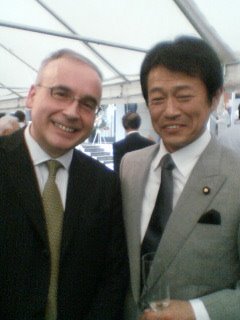
Japanese minister of Agriculture Nakagawa Shoichi
engaged in a chat with the author of Asian Gazette at
the French embassy National Bastille Day July 14, 2006
in Tokyo. A recent delegation of Japanese experts'
visited Tahiti to target and to evaluate potential
methods of bi-lateral cooperation and was initiated
from French Polynesia President Oscar Temaru's visits
to Japan last August and last May. During the May
visit, President Temaru told Japanese Agriculture and
Fishing Minister Shoichi Nakagawa he would be
interested in having Japanese experts visiting Tahiti.


Tahiti Island, Society Islands, French Polynesia,
central South Pacific Ocean. The largest of the
Society Islands, it occupies an area of 402 sq mi
(1,042 sq km) in their eastern group. Papeete, the
capital of French Polynesia, is on Tahiti.


The island's interior is mountainous, rising to 7,339
ft (2,237 m) at Mount Orohena; its towns are located
on the coastal plain. Long inhabited by Polynesians,
it was visited by British Capt. Samuel Wallis in 1767
and in 1768 by Louis-Antoine de Bougainville, who
claimed it for France.


It became a French colony in 1880 and is now part of
the self-governing overseas territory of French
Polynesia. Continued French nuclear testing in the
area has angered the inhabitants and brought calls for
independence. Tourism is economically important.



Attracted by the Polynesian culture and spectacular
climate and scenery, both Paul Gauguin and Robert
Louis Stevenson lived in Tahiti and expressed its
romantic allure through their works.



Maritime activity has a broad spectrum. Fishing and
farming, defense and security, tourism industry,
cultural diversity, sustainable development, a theme
dear to French president Chirac. For instance, about
defense, the Japanese white paper on defense proposed
to advance the status of defense agency to a defense
ministry. It empowers the defense minister to put up
proposals to cabinet independently, conduct marine
preparation activity, make relevant laws and propose
independent budget in order to get more military funds
in the national budget. Research and developement
included.


French Polynesia President Oscar Temaru met late July
with three Japanese experts prior to an exploratory
visit to Tahiti linked to several projects and more to
come in connection with an aquaculture farm on the
Tuamotu Atoll of Rangiroa and a tuna-breeding project
for the Tuamotu Atoll of Hao.

In the last 10 years, a variety of agreements were
signed between France and Japan and among them to
allow Japanese fishermen to come and fish around the
French Polynesia territory in the Pacific ocean.


The Japanese delegation, which included fishing expert
Shingo Ota, was to visit French Polynesia's fishing
and aquaculture centers, accompanied by Tahiti's sea,
fishing, aquaculture and research minister, Keitapu
Maamaatuaihutapu. Those visits including the
government's Fishing Department, the future Sea
Center, Papeete's commercial fishing port, the South
Pacific Shipyard (CPNS) in Papeete Harbor, commercial
fish wholesalers and meetings with French Polynesia
fish transformation industries.


On the splendid paradise on Earth, Rangiroa, the
Japanese experts showed interest in a visit of a
breeding farm for coral reef larvae destined for the
aquaculture market.

More to come, no doubt.

Saturday, August 05, 2006

Japan : Lost paradise for Internet preys


Quote of Matsushita Shuji news:
"My name is Mrs. Fadimatu 'Yar Sakkwato. Once, I was
the second concubine of onetime head of state of
Nigeria, late Alhaji Sani Abacha. As everybody knows
well, he had stashed away more than 3 billion dollars
(US$3,000,000,000)...

Alhaji Sani Abacha, the most corrupt dictator of
Nigeria, who died while whoring. After so many years,
his legacy still works as the central theme of many a
Nigerian letter fraud.

Thus started the infamous Nigerian letter scam, or 419
fraud. Mobile Ojisan receives tons of them in his
inbox everyday. These scammers, I guess, are firm
believers of patterns. Almost all the letters never
deviate from the pattern set around 20 years ago by
creative Igbo gangs in Southern Nigeria.

If only they had translated the emails into readable
Japanese with tolerable honorifics and sent them to
Japan exclusively, those scammers could have retired
very young and rich in Riviera or Bahamas. Because
this land is wall-to-wall carpeted with eager dupes.

Presently, the most fashionable (!) Internet con in
Japan is called One-Click fraud. Of course, there are
millions of variations. But the basic plot is like
this:

First, victim is lured to a dubious Web site by a spam
mail or blog trackback, believing it's a high-powered
libido location. Or, online dating site with full of
supernatural promises.

There on the site, some fineprint is displayed. You
have to click "I AGREE" button to proceed. Then, all
hell breaks out.

.Your IP address: xxxxxxxx,
.Your remote-host: yyyyyyyy,
.Your provicer: zzzzzzzz,
.Your network: aaaaaaa, bbbbbb, ccccc ...
THANK YOU FOR JOINING OUR EXCLUSIVE CLUB.
.Your membership fee is 60,000 yen for 60 days. Please
transfer the amount within three days. If not, we
have no choice but to acquire your name, address, and
phone number from your provider, and physically
contact you. Our agent might call on your
office/school/family, then.
.Our account particulars: ddddddddd, eeeeeeee

Sometimes, a naughty .exe file is quietly pushed into
viewer's PC, and threatening window pops out
constantly to intimidate the victim.

If he calls or sends an email to this con site to
protest, these jokers will be overjoyed. Adding some
concrete information to their easy dupe database!

I guess, most of the Asian Net users, if faced with
this kind of ridiculous but threatening message, would
laugh away scornfully and forget it immediately. But
in Japan, quite a few people take it rather seriously.
Besides, the guilty conscience that one has ventured
into a libido site does not help the situation.

Also, the ingrained Japanese psychological urge to
avoid any kind of fuss, trouble, conflict or dispute
at any cost kicks in.

"Ah, what the heck. Just a matter of small money!"

Oho, you've clicked! Display says: Registration of
your membership application completed. Thank you for
your agreeing with the contract!!

Yes, those con artists never overdo. Their demand
seldom exceeds, say, 50,000 yen (US$435), the
psychological threshold between small money and
not-so-small-money. Online bank transfer completed.
Naughty .exe warning refuses to go away, of course.
The victim finally realizes that he has been done for.

The most beautiful point of this scam is that nobody
rushes to the police station because he's been scraped
off a tiny amount of dough. Thus, One-Click software
keeps on working silently and dilligently without let
and hindrance from the side of law. Con artists' bank
account (constantly shifting from one to another, as
usual) gets fatter and fatter. These scammers shed
absolutely no sweat and toil. Hurray, Internet!

Sure, the One-Crick fraud works only in Japanese
mental environment, as you notice. Wanna stick your
finger in the honeypot? I'm afraid it's a bit too
late because, already, the field is pretty cluttered
up with Chinese and Korean (South, not from North) Net
tricksters." (Copyright From Matsushita Shuji)

Friday, August 04, 2006

Scholars say : Pyongyang's new missiles aim Japan


Kim Sung-han is a professor and director general for
American studies, the Institute of Foreign Affairs and
National Security :

" Now that North Korea has turned its back on the
international community's wish and committed a
provocative act, Washington has no option but to
discuss pressure and sanctions against Pyongyang at
bilateral and multilateral levels. The United States
is seeking ways to "punish" North Korea politically
and economically at the bilateral level and in the
United Nations. Japan, which has always reacted more
sensitively to North Korea's missile threat than to
its nuclear program, has also found it difficult to
just sit and watch as North Korea takes steps to
aggravate the situation. Thanks to the "failure" of
North Korea's latest Taepodong-2 missile test, a
missile did not pass through Japan's airspace, unlike
in 1998. Even if the missile test failure was not the
intended outcome on the part of Pyongyang, however,
Japan has to take preventive measures at all levels."

So, it is said :

North Korea is building new bases on its east coast,
possibly to deploy ballistic missiles targeting Japan
and its U.S. military installations, a state-run
South Korean think tank said. The move could involve
plans to deploy the long-range Taepodong-2 missile
that the North test-fired last month, the Institute of
Foreign Affairs and National Security said in a
report. The reclusive state is also believed to have
obtained Chinese technology via Iran while developing
the Taepodong-2, its newest long-range missile and one
believed capable of reaching the U.S., the state-run
institute said in the report.

"New underground missile bases have been built or are
under construction around the border with China and
along the east coast," the report said. Those "on the
east coast could be seen as bases for medium- or
long-range missiles targeting Japan and U.S. military
bases in Japan," it said. Taepodong-2 and SSN-6
missiles, which have a range of up to 4,000 km, could
be deployed to the new bases, the think tank said. The
report, dated July 26, didn't give a source for the
information. Its main author, Yun Deok Min, could not
be reached for comment. Missile exports have been a
major source of hard currency for North Korea. The
report said the North makes $ 150 million a year from
missile exports. Buyers of North Korean missiles
include Iran, Libya, Syria, Egypt and Yemen, according
to the report. "North Korea is at the center of
global ballistic missile proliferation," it said.


Since North Korea launched a shorter-range Taepodong-1
over Japan in 1998, Pyongyang's missile program has
become a major security issue in Northeast Asia,
adding to concerns about the hardline regime's pursuit
of nuclear arms. Tensions flared anew when the
Pyongyang regime test-fired seven missiles toward
Japan on July 5, including a Taepodong-2. The
missiles landed harmlessly in waters between the
Korean Peninsula and Japan, but the Taepodong-2 failed
right after launch. The report said North Korea
closely cooperated with Iran in developing the
Taepodong-2 and there is a high possibility Chinese
designs and technology are being used in its
development because Iran has cooperative relations
with China in the defense industry. The report also
said the North has a Scud missile base just 50 km
north of the border with South Korea that can hit
targets deep in the South.

Francais : Commentaire

"Toute exacerbation de la confrontation politique
débouchant sur un isolement de la Corée du Nord et
l'application de sanctions contre elle contrediraient
nos intérêts à long terme en Asie du Nord-Est. De
toutes les conséquences négatives éventuelles qui en
découleraient les plus graves seraient la disparition
des perspectives d'un règlement du problème nucléaire,
le torpillage du projet de construction de la voie
ferrée Transcoréenne avec notre participation et de
son raccordement sur le Transsibérien pour assurer
l'acheminement de conteneurs entre l'Asie et l'Europe.
Il faudrait aussi abandonner le projet prévoyant des
livraisons d'hydrocarbures en République de Corée.

Depuis le vote au Conseil de sécurité la Russie ne
détient plus de leviers réels permettant de contrôler
la situation autour de la Corée du Nord. Ils sont
désormais entre les mains des Américains. Avec de
tels atouts, Washington va pouvoir chercher à
attribuer à Moscou le rôle d?auxiliaire. Il est
probable que les Etats-Unis vont concocter un
programme à eux de "mise à mort" de la Corée du Nord,
conforme à leur manière d?agir à l'égard des "Bad
Boys".

Il est patent que maintenant Moscou aura énormément de
mal à renouer la discussion avec les Nord-coréens qui
ont douloureusement réagi aux démarches diplomatiques
russes à l'ONU. Cependant, nous devrions dire
clairement à nos partenaires occidentaux que la Russie
ne considère pas l'histoire des missiles comme un
prétexte pour exacerber la situation autour de la
Corée du Nord et prendre de nouvelles décisions
draconiennes, aussi motivées soient-elles. Maintenant
que la résolution 1695 du Conseil de sécurité a été
adoptée, il faut tirer un trait sur la question des
missiles. La Russie ne saurait appuyer des actions
susceptibles d'approfondir l'isolement et de durcir le
châtiment de la Corée du Nord."

Alexandre Vorontsov, de l'Institut d'études
orientales. Académie des sciences de Russie. Cité par
Vremia novostei, 04/08/2006. (Traduction)


" Hotoke no kao mo, san do made! "