Saturday, September 30, 2006

Japan makes people insane, sometimes.


"More than 80 percent of major companies across the
country have employees who are taking sick leaves
because of mental illnesses, a government survey has
shown. Commenting on the survey results, an expert
urges employers to improve working conditions for
employees to prevent them from suffering from mental
diseases. "Companies should keep in mind that no
employees have any concern about their mental health,
and avoid excessive workload and long working hours
that could cause such problems," said Yasuji Imai, a
senior researcher at the Japan Productivity Center for
Socio-Economic Development.


The Health, Labor and Welfare Ministry has conducted
the survey, the first of its kind, on 12,051 companies
with 10 employees or more throughout the country in a
bid to compile basic statistics aimed at preventing
work-related accidents. Of them, 8,543 firms
responded.

Of the respondents, 3.3 percent said they have
employees who are taking sick leave due to mental
problems. Fully 82 percent of the firms with 1,000
employees or more responded that they have workers who
have been absent from work as a result of mental
diseases.


Most of them, 97.3 percent, have been away from work
for one month or more. Smaller percentages of small
and medium-sized enterprises have employees suspended
from work due to mental problems, with 66.3 percent of
the firms with 500 to 999 employees 40.9 percent of
those employing 300 to 499 replying so. Only 1.5
percent of small businesses with 10 to 29 workers have
workers who have been absent from duty because of
mental sickness.


In the same survey, 13.4 percent of the firms said
some of their employees work 100 hours or more in
overtime per month. More than 40 percent of firms
with 1,000 employees or more and those with 500 to 999
workers said they have such employees. Some 22.9
percent of companies employing 300 to 499 workers and
12.7 percent of firms with 10 to 29 employees replied
that some of their workers work for 100 hours in
excess of their regular monthly work hours." (Click
Title for article URL)

Saturday, September 23, 2006

"Biggest hurdle with be the Upper House election 2007"


Quote :

"Commentary by critic Tetsuya Miyazaki on the election of Shinzo Abe:
Biggest hurdle with be the Upper House election

My initial direct reaction was that now the hard part starts. Becoming
prime minister was easy, but it is difficult to hold on to that seat.
The biggest hurdle will be the election for the House of Councilors next
summer. If the opposition camp gains a majority of seats, calls for the
Liberal Democratic Party (LDP) president to take responsibility will be
unavoidable. I also fear that the trend will be to leave things as is.
The next ten months, everyone will have to prepare for the election, so
I would say that only when there is a victory in the Upper House would
things get moving.

The presidential election was a one-sided game with Abe always winning,
but it should have been a proper election with a real competitive match
going on. And despite Abe never having articulated his political
principles, many lawmakers bet on the winning horse unquestioningly. It
was as if even the grass and trees were bowing to Abe.

Ozawa's Minshuto (Democratic Party of Japan) will now come in with such
buzzwords as income disparity, economic recovery, the pension issue, and
Asia diplomacy. The LDP should have been expending every effort on
policy debate in order to meet the enemy in battle. In that sense, one
can only say that the LDP was left out of the race.

As a result of the bandwagon effect, it will not likely be avoidable for
President Abe to make personnel appointments simply as rewards for
supporting him. If he doesn't do that, the lawmakers who supported him
that were not appointed will be disgruntled and turn against him. This
could create trouble in the party as a whole.

On the foreign policy front, he seems to want to carry out a positive
diplomacy toward East Asia. There's a high probability of the mood
shifting toward favoring a thaw in Japan's relations with China.
Although the political forces backing Abe want him to visit Yasukuni
Shrine, he will have to decide whether such a visit should come after
his China diplomacy is on track.

Perhaps the biggest challenge for his administration will be maintaining
the good economic climate. With the absence of Heizo Takenaka [who
resigned from the Diet], the leading force for economic policy in the
Koizumi administration, there is a possibility that the bureaucracy, led
by the Finance Ministry, will regain its policy clout. "
End of quote MAINICHI Shinbun September 21, 2006


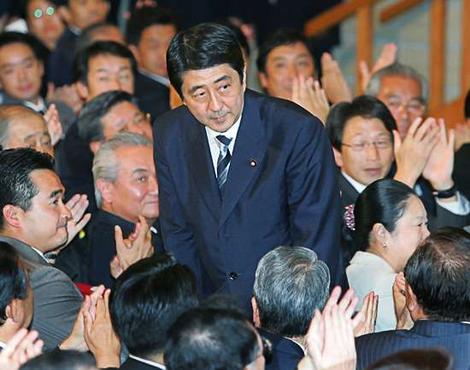
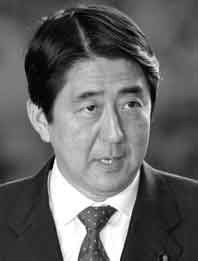
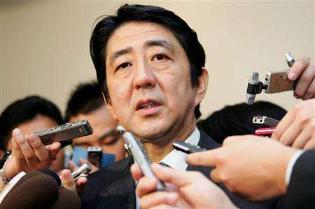
(Image, this is how the foreigners see him...)

Tuesday, September 19, 2006

Abe Shinzo : " persons of excellent caliber " to be in charge.


Japan LDP ruling party presidency election on
September 20th 2006

Shinzo Abe, candidate to LDP presidency and PM job
about the 2007 Upper House election : "The purpose is
not to win the Upper House election," Abe said, "We
should let persons of excellent caliber take part in
our work of building an ideal country." Nikkei
September 5, 2006.

Friday, September 01, 2006

About a Boy


[Update 06 September 2006 08h30 am]

Princess Kiko, wife of Prince Akishino, gave birth to
a boy at 8:27 a.m. Wednesday September 6th 2006 at
Aiiku Hospital in Minato Ward, Tokyo, where she was
hospitalized and underwent a cesarean section, the
Imperial Household Agency said. The newborn prince is
the third in line to the Imperial throne, next to
Crown Prince Naruhito and Prince Akishino. It was the
first birth of a prince since 1965, when Prince
Akishino was born. The baby weighed 2,558 grams and
was 48.8 centimeters in length, according to the
agency. Both Princess Kiko and the baby are in good
health, according to the agency.

The Imperial Household Agency had initially announced
in February the baby was expected to be born in late
September. Princess Kiko had placenta previa
partialis--the partial clogging of the orifice of the
uterus--and doctors were concerned she might suffer a
hemorrhage. To ensure a safe delivery, Masao
Nakabayashi, head of Aiiku Hospital and the physician
in attendance for the princess, conducted the cesarean
section. Prince Akishino was at the hospital at the
time of the birth. The Emperor and Empress were
informed of the baby's birth by the prince himself.
The name of the newborn prince will be announced at
the Meimei no Gi, the Imperial naming ceremony, to be
held next Tuesday. The new prince is the couple's
third child following Princess Mako, 14, who is in the
third year at Gakushuin Girls' Junior High School, and
Princess Kako, 11, who is in the sixth year at
Gakushuin Primary School. The baby boy is the fourth
grandchild for the Emperor and Empress. With the
prince's birth, the Imperial family now has 23
members. In the Imperial family, nine female members
were born in a row since 1969, when Princess Sayako
was born as the only daughter of the Emperor and
Empress. Princess Sayako relinquished her royal
status on Nov. 15 last year by marrying Yoshiki
Kuroda, a Tokyo metropolitan government official.

Article 1 of the Imperial House Law stipulates that
the Imperial throne is succeeded by male heirs of the
male line of the Imperial family. As the new prince
is third in line to the throne, the positions of
Prince Hitachi, Prince Mikasa, Prince Tomohito of
Mikasa and Prince Katsura, who were previously third
to sixth in line, respectively, have been lowered by
one. Since 1779, when the 119th emperor ascended the
throne, the Imperial throne has been succeeded from
father to son--from Emperor Kokaku to Emperor Ninko,
Emperor Komei, Emperor Meiji, Emperor Taisho, Emperor
Showa to his majesty today. If the crown prince
ascends the throne and is survived by Prince Akishino,
the throne will shift to the bloodline of the younger
brother, as long as the Imperial family makeup does
not change. A recent case in which a royal throne was
transferred from an elder brother to a younger brother
occurred in Belgium in July 1993. After King Baudouin
died, his younger brother, Albert II, succeeded to the
throne. (Press DY)


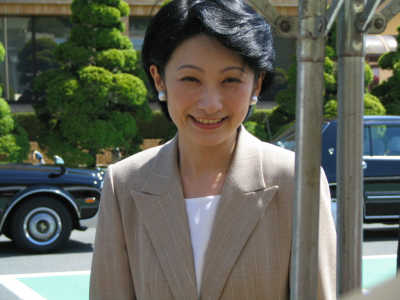
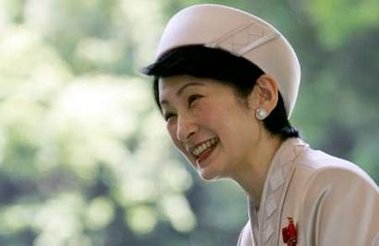
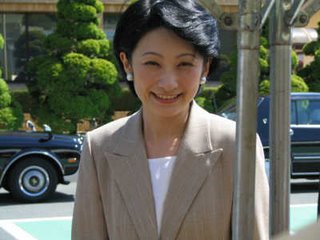
Image : Princess Kiko of the Japan Imperial family.

Date: 8/26/2006 2:10:00 PM

From: Joel J. Legendre

Subject: NBR'S JAPAN FORUM (POL) Japan Imperial family
childbirth

Dear Japan forum members,

The question burns every news-desks. Explanations and
comments from scholars and experts would be most
appropriate regarding the royal pregnancy of Princess
Kiko.

What consequences if Princess Kiko does not give birth
to a baby boy?

What will happen if Princess Kiko gives birth to a
baby boy?

Regards,

Joel J. Legendre
Tokyo
www.rtl.fr

"Agences Tokyo, 31/08 La princesse Kiko, belle-fille de
l`Empereur du Japon, va très bientôt accoucher d`un
garçon, le premier héritier mâle au sein de la famille
impériale depuis plus de 40 ans, susceptible de monter
un jour sur le trône du Chrysanthème, affirme jeudi un
hebdomadaire populaire.

Selon le Shukan Bunshun, souvent bien informé sur les
affaires de la famille impériale, l`époux de Kiko, le
prince Akishino, a confié à l`un de ses amis proches
que sa femme attendait un garçon.

La nouvelle, que le Japon attend avec impatience, est
un secret très bien gardé depuis trois mois. Mais les
cercles politiques, les spécialistes d`obstétrique et
les journalistes qui tiennent les rubriques de la Cour
sont persuadés qu`il s`agit d`un garçon."

Wait and See! Anyhow the next in line is Crown Prince
Naruhito the husband of Princess Masako. Then the
Prince Akishino. Should the royal baby to be born be
a baby boy, he will be a royal dynastic back up, third
in line, securing the royal linage! But a kind of
disillusion for many women who expected the Princess
Aiko, daughter of the Crown Prince Naruhito to become
the first Japanese Empress of the 21st Century, as a
symbol of respect for gender equality.
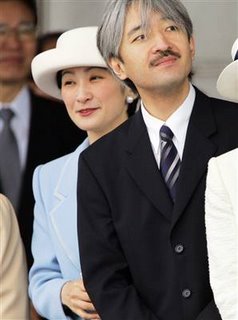


Prince Akishino & Princess Kiko

National debate ? Not much.
Occasionally, equal primogeniture has won in
historical cases of Japanese succession: While it is
true that most succession events in Japan had since
time immemorial went in favor of a male heir, not
necessarily the eldest of the sons themselves, it
nevertheless is established by two precedents [of 1629
CE and of 642 CE] that an imperial princess may ascend
the throne in preference and prior to her younger
brothers. In 1629, the imperial princess Okiko
ascended the Japanese throne as Reigning Empress
Meisho tenno, as successor of her father, prior to her
younger half-brother and other males. Only after her
abdication 14 years later, her brother Tsuguhito
(Emperor Go-Komyo tenno) ascended. However, her
offspring would never have been allowed to ascend the
throne.

- Commentary :
Arguments in favour of primogeniture

Primogeniture prevents the subdivision of estates and
diminishes internal pressures to sell property (for
example, if two children inherit a house and one
cannot afford to buy out the other's share). In
Western Europe most younger sons of the nobility,
having no prospect of inheriting land or property,
were obliged to seek careers in the Church, the Armed
Forces or in Government. Wills often included
bequests to a monastic order who would take the
disinherited. Many of the Spanish Conquistadors were
young sons who had to make their fortune in war. In
the late 17th and early 18th Centuries, many
specifically chose to leave England for Virginia in
the Colonies. Most, if not almost all, of the early
Virginians who were plantation owners were such
younger sons who had left England because of
primogeniture laws. These Founding Fathers of the
United States of America were nearly universally
descended from the landed gentry of England, with many
being descended from English Kings of the late 14th
and early 15th Centuries, especially through the
prodigious offspring of Edward III of England.
William Shakespeare's King Lear can be seen as an
argument in favor of primogeniture as the tragically
flawed action of Lear is dividing his country into
three amongst his daughters. The division of his land
marks the beginning of the unraveling of everything
else in the play.

Arguments against primogeniture

The fact that the eldest son "scooped the pool" often
led to ill-feeling amongst younger sons (and of course
daughters). Through marriage, estates inherited by
primogeniture were combined and some nobles achieved
wealth and power sufficient to pose a threat even to
the crown itself. Alternately, one might think that,
as with most property, the land will go to its most
useful purpose no matter what the initial distribution
(the Coase Theorem). Finally, nobles tended to
complain about and resist rules of primogeniture
(though this opposition might indicate primogeniture
among nobles was good for the king).


A case of agnatic primogeniture is exemplified in the
French royal milieu, the Salic Law (attributed to the
Salian Franks) forbade any inheritance of a crown
through the female line. This accounts for the
dispute over the legitimate successor of Charles IV of
France (Edward III of England or Philip VI of France),
the separation between Hanover (where Ernest I
succeeded) and the United Kingdom upon the accession
of Queen Victoria in 1837, the separation of the
(arch)ducal house of Luxembourg from the royal house
of the Netherlands, and partially explains the role of
Carlism in Spain.

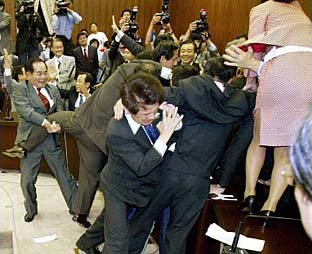
Now... this is the 21st century... right?
Wednesday, August 23, 2006

Penser... a l'Asiatique ou a l'Occidental ?

Les personnes de langue maternelle anglaise, si on les
compare a celles de langue maternelle chinoise,
traitent les calculs mathematiques differemment, selon
une etude conjointe du McKnight Brain Institute de
l'Universite de Floride, du Banner Alzheimer Institute
en Arizonie et de la National Science Foundation de
Chine.

Des recherches ont ete faites sur ces deux groupes en
leur faisant faire des calculs arithmetiques faciles
(3+4, par exemple) et en prenant des images cerebrales
des sujets simultanement. Chaque groupe utilisait,
entre autres, la partie du cerveau appele cortex
inferieur parietal (c'est dans cette partie du cerveau
que se trouvent les capacites de representation
quantitative et les capacites de lecture). En
revanche, les personnes de langue maternelle anglaise
et de langue maternelle chinoise utilisaient en
complement des parties differentes de leur cerveau
durant ces operations. Les personnes de langue
maternelle anglaise montraient de l'activite dans la
partie du cerveau consacree au traitement des langues,
tandis que les personnes de langue maternelle chinoise
avaient plus d'activite dans la partie du cerveau
responsable pour le traitement de l'information
visuelle. Ces resultats impliqueraient alors que les
personnes de langue maternelle anglaise ont une
maniere differente des personnes de langue maternelle
chinoise pour resoudre les problemes mathematiques.

Richard Nesbitt, le directeur du "Culture and
Cognition Program" de l'Universite du Michigan avait
egalement fait une etude l'annee derniere sur les
americains du nord d'origine europeenne et ceux
d'origine asiatique, en etudiant les differences dans
l'activite du cerveau quand ils regardaient une image.
Les americains du nord avaient tendance a se
concentrer sur les details et les objets du premier
plan, tandis que les asiatiques se focalisaient sur
l'arriere-plan et toute l'image. Selon le Dr.
Nesbitt cette nouvelle etude sur les langues et les
maths confirme son hypothese selon laquelle il y a des
differentes facons -au sens de l'activite cerebrale-
de voir le monde et meme de penser.

En fin de compte, ces resultats peuvent aider les
chercheurs a comprendre les avantages de penser a la
maniere "asiatique" ou "occidentale". L'etude a paru
dans les "Proceedings of the National Academy of
Sciences" en juin.

Sources : - Randolph Schmid. " Chinese, English
speakers vary at math ". ADIT.

Wednesday, August 16, 2006

Fulfilling a pledge! Junichiro Koizumi visits Yasukuni August 15th


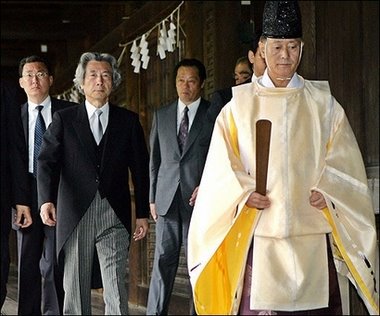
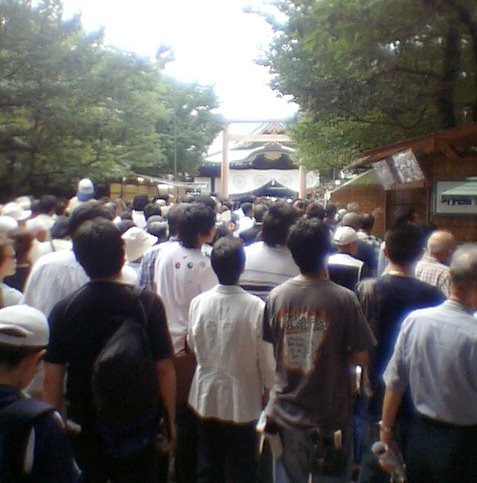
Yasukuni Shrine, Tokyo, August 15th 2006 08h00 : It
was awfully warm and crowded with thousands of prayers
and visitors. Then Prime Minister Junichiro Koizumi
arrived, pictured here in mourning official suit,
praying at the Yasukuni shrine.

On Tuesday Koizumi apologized again for the "huge
damage and suffering" Japan inflicted on Asian nations
in the 20th century, hours after his visit to the
controversial war shrine. "Our country caused huge
damage and suffering to a number of countries,
particularly people in Asia," Koizumi told a secular
official ceremony marking the 61st anniversary of
Japan's surrender.

But on the same day Japanese Junichiro Koizumi's visit
to the Yasukuni Shrine, a symbol of Japan's past
militarism, has stirred anger and protests from people
across China and in other Asian countries.


One BIG difference : he simply bowed once, fast, and
entered into the Shrine. A way to show the simplicity
of his visit according to commentators and not a
religious visit accomplished as Prime Minister...
Families of the tragedy of a war launched by Japanese
militarists and their Zaibatsu allies using Hirohito
as the head felt some comfort but Asia got mad.
Symbolic of the Japanese rulers discrepancy between
words and actions of peaceful coexistence's promises.


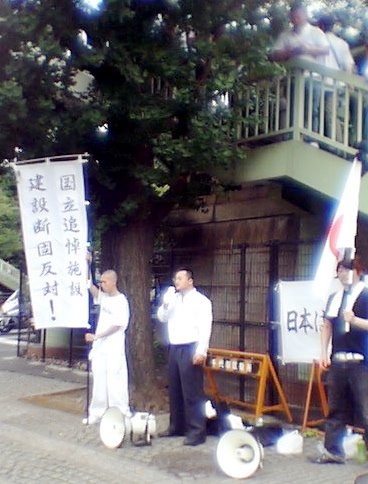
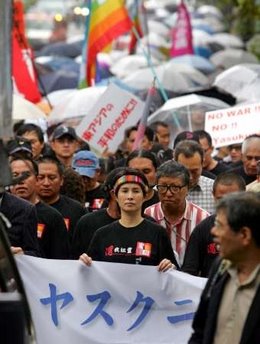
Member of Taiwan's Parliament Kao Chin Su-mei and
other demonstrators from Japan and Taiwan protested
against Japan's Prime Minister Junichiro Koizumi's
visit. Anti-Japan protesters demonstrate outside the
Japanese Embassy in Beijing. The banner reads
'Congratulations on the 61st anniversary of Japan's
fascist surrender'. It was Koizumi's sixth visit to
the shrine since taking office in 2001, but his first
on the highly symbolic Aug. 15 anniversary of Japan's
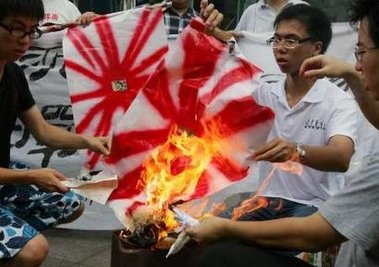
1945 defeat. Last protesters outside the Japanese
consulate in Hong Kong burnt a Japanese military flag
featuring a photograph of Japan's Prime Minister
Junichiro Koizumi defying warnings from South Korea
and China not to go.

The China-Japan Friendship Association issued a
statement yesterday, expressing "outmost indignation."
The shrine is the "ideological prop and a tool of
Japanese militarists during World War II. It still
honours 14 war criminals whose hands were stained with
the blood of the people in China and other countries,"
it said. "Koizumi's act resurrects Japan's wartime
militarism," the statement says. More than 30 Chinese
people gathered outside the Japanese Embassy in
Beijing yesterday morning, protesting Koizumi's shrine
visit for about 20 minutes.


In Nanjing, capital of Jiangsu Province, She Ziqing, a
74-year-old survivor of the Nanjing Massacre, was
outraged by Koizumi's visit. "How can he feel no
regret for the brutal deeds of Japanese militarists?"
he asked. At least 300,000 Chinese, most of them
civilians, were slaughtered by Japanese troops in a
six-week orgy of killing, raping, looting and burning
in 1937 when the city, then the national capital, was
overtaken. Another survivor, Li Xiuying, 76, made a
simple comment on Koizumi: "I hate him." In Hangzhou,
capital of Zhejiang Province, survivors of Japan's
germ warfare were also "indignant." Yang Dafang, whose
father died as a result of Japanese germ warfare in
1940, said Koizumi's repeated visits to the shrine
have hurt the feelings of the Chinese victims. During
the war, the Japanese army's Unit 731 developed many
biological weapons using plague, anthrax and other
bacteria, and conducted experiments on humans.


In Hong Kong, angry activists took to the streets to
condemn Koizumi's shrine visit. At least 30 people
marched to the Japanese consulate, carried banners and
shouted slogans. They set a Japanese flag alight and
demanded the country pay compensation and apologize
for war crimes. David Ko, chairman of the Action
Committee for Defending the Diaoyu Islands, said
Koizumi's move aims to stir Chinese anger against
Japan on the 61th anniversary of Japan's surrender in
World War II. "He just wanted to provoke Asian
countries. He's about to step down but the spirit of
Koizumi will not stop. That puts peace and safety in
Northeast Asia under serious threat," Ko said.


The Democratic People's Republic of Korea, the
Republic of Korea, Singapore and other countries
yesterday also protested against Koizumi's shrine
visit.


Tokyo Gov. Shintaro Ishihara made his seventh
straight Aug. 15 visit to Yasukuni since 2000, which
was his second year in office.National Public Safety
Commission Chairman Tetsuo Kutsukake, one of the 17
ministers in Prime Minister Junichiro Koizumi's
Cabinet, visited Yasukuni. In addition, three senior
vice ministers and three parliamentary secretaries
went to Yasukuni on Tuesday as part of a nonpartisan
group that makes visits en masse to the shrine.
Fifty-six members of the group, including ruling
Liberal Democratic Party and opposition Democratic
Party of Japan lawmakers, paid homage together
Tuesday. Seven members of another group comprising
LDP lawmakers serving their first terms also paid
their respects at the shrine.


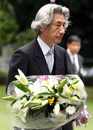
Junichiro Koizumi offered flowers as he paid tribute
at Chidorigafuchi national cemetery, Japan's
nondenominational tomb of the unknown soldier, in
Tokyo after he visited the nearby Yasukuni shrine.


His visit to Chidorigafuchi : A symbolic Japanese
national statement towards the future Asia
reconciliation from soon to be and extremely popular
in the archipelago Diet man Junichiro Koizumi?
Nevertheless it also is a possibility that a mark of
commemoration by one war looser nation will continue
to be seen as an international incident by other Asia
nations.

Time for Asia to work on history and German France
reconciliation.


Verdun, France 22nd of September 1984

Jlk

Monday, August 07, 2006

From Tokyo to Tahiti, Islanders' Talks about Delicacy


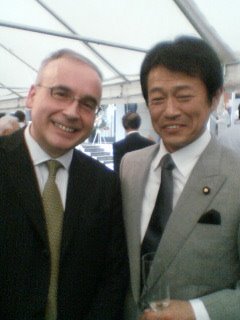
Japanese minister of Agriculture Nakagawa Shoichi
engaged in a chat with the author of Asian Gazette at
the French embassy National Bastille Day July 14, 2006
in Tokyo. A recent delegation of Japanese experts'
visited Tahiti to target and to evaluate potential
methods of bi-lateral cooperation and was initiated
from French Polynesia President Oscar Temaru's visits
to Japan last August and last May. During the May
visit, President Temaru told Japanese Agriculture and
Fishing Minister Shoichi Nakagawa he would be
interested in having Japanese experts visiting Tahiti.


Tahiti Island, Society Islands, French Polynesia,
central South Pacific Ocean. The largest of the
Society Islands, it occupies an area of 402 sq mi
(1,042 sq km) in their eastern group. Papeete, the
capital of French Polynesia, is on Tahiti.


The island's interior is mountainous, rising to 7,339
ft (2,237 m) at Mount Orohena; its towns are located
on the coastal plain. Long inhabited by Polynesians,
it was visited by British Capt. Samuel Wallis in 1767
and in 1768 by Louis-Antoine de Bougainville, who
claimed it for France.


It became a French colony in 1880 and is now part of
the self-governing overseas territory of French
Polynesia. Continued French nuclear testing in the
area has angered the inhabitants and brought calls for
independence. Tourism is economically important.


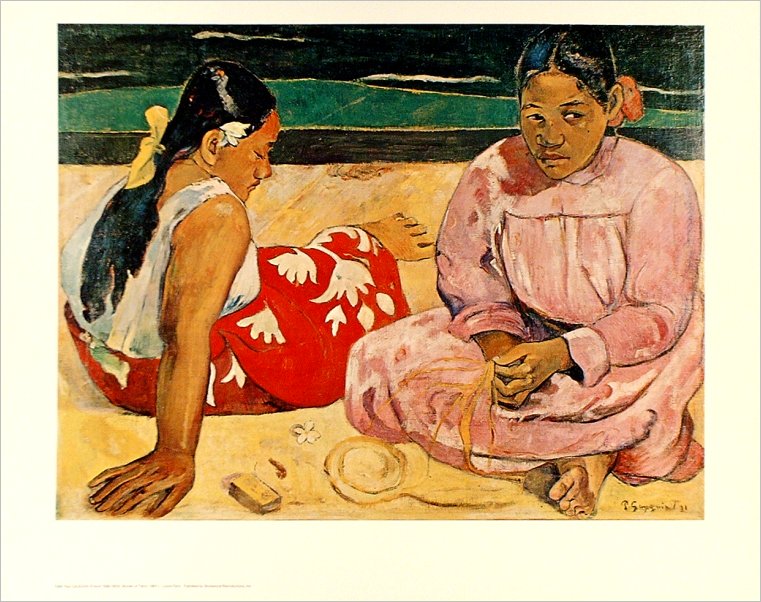
Attracted by the Polynesian culture and spectacular
climate and scenery, both Paul Gauguin and Robert
Louis Stevenson lived in Tahiti and expressed its
romantic allure through their works.


Maritime activity has a broad spectrum. Fishing and
farming, defense and security, tourism industry,
cultural diversity, sustainable development, a theme
dear to French president Chirac. For instance, about
defense, the Japanese white paper on defense proposed
to advance the status of defense agency to a defense
ministry. It empowers the defense minister to put up
proposals to cabinet independently, conduct marine
preparation activity, make relevant laws and propose
independent budget in order to get more military funds
in the national budget. Research and developement
included.


French Polynesia President Oscar Temaru met late July
with three Japanese experts prior to an exploratory
visit to Tahiti linked to several projects and more to
come in connection with an aquaculture farm on the
Tuamotu Atoll of Rangiroa and a tuna-breeding project
for the Tuamotu Atoll of Hao.

In the last 10 years, a variety of agreements were
signed between France and Japan and among them to
allow Japanese fishermen to come and fish around the
French Polynesia territory in the Pacific ocean.


The Japanese delegation, which included fishing expert
Shingo Ota, was to visit French Polynesia's fishing
and aquaculture centers, accompanied by Tahiti's sea,
fishing, aquaculture and research minister, Keitapu
Maamaatuaihutapu. Those visits including the
government's Fishing Department, the future Sea
Center, Papeete's commercial fishing port, the South
Pacific Shipyard (CPNS) in Papeete Harbor, commercial
fish wholesalers and meetings with French Polynesia
fish transformation industries.


On the splendid paradise on Earth, Rangiroa, the
Japanese experts showed interest in a visit of a
breeding farm for coral reef larvae destined for the
aquaculture market.

More to come, no doubt.

Saturday, August 05, 2006

Japan : Lost paradise for Internet preys


Quote of Matsushita Shuji news:
"My name is Mrs. Fadimatu 'Yar Sakkwato. Once, I was
the second concubine of onetime head of state of
Nigeria, late Alhaji Sani Abacha. As everybody knows
well, he had stashed away more than 3 billion dollars
(US$3,000,000,000)...

Alhaji Sani Abacha, the most corrupt dictator of
Nigeria, who died while whoring. After so many years,
his legacy still works as the central theme of many a
Nigerian letter fraud.

Thus started the infamous Nigerian letter scam, or 419
fraud. Mobile Ojisan receives tons of them in his
inbox everyday. These scammers, I guess, are firm
believers of patterns. Almost all the letters never
deviate from the pattern set around 20 years ago by
creative Igbo gangs in Southern Nigeria.

If only they had translated the emails into readable
Japanese with tolerable honorifics and sent them to
Japan exclusively, those scammers could have retired
very young and rich in Riviera or Bahamas. Because
this land is wall-to-wall carpeted with eager dupes.

Presently, the most fashionable (!) Internet con in
Japan is called One-Click fraud. Of course, there are
millions of variations. But the basic plot is like
this:

First, victim is lured to a dubious Web site by a spam
mail or blog trackback, believing it's a high-powered
libido location. Or, online dating site with full of
supernatural promises.

There on the site, some fineprint is displayed. You
have to click "I AGREE" button to proceed. Then, all
hell breaks out.

.Your IP address: xxxxxxxx,
.Your remote-host: yyyyyyyy,
.Your provicer: zzzzzzzz,
.Your network: aaaaaaa, bbbbbb, ccccc ...
THANK YOU FOR JOINING OUR EXCLUSIVE CLUB.
.Your membership fee is 60,000 yen for 60 days. Please
transfer the amount within three days. If not, we
have no choice but to acquire your name, address, and
phone number from your provider, and physically
contact you. Our agent might call on your
office/school/family, then.
.Our account particulars: ddddddddd, eeeeeeee

Sometimes, a naughty .exe file is quietly pushed into
viewer's PC, and threatening window pops out
constantly to intimidate the victim.

If he calls or sends an email to this con site to
protest, these jokers will be overjoyed. Adding some
concrete information to their easy dupe database!

I guess, most of the Asian Net users, if faced with
this kind of ridiculous but threatening message, would
laugh away scornfully and forget it immediately. But
in Japan, quite a few people take it rather seriously.
Besides, the guilty conscience that one has ventured
into a libido site does not help the situation.

Also, the ingrained Japanese psychological urge to
avoid any kind of fuss, trouble, conflict or dispute
at any cost kicks in.

"Ah, what the heck. Just a matter of small money!"

Oho, you've clicked! Display says: Registration of
your membership application completed. Thank you for
your agreeing with the contract!!

Yes, those con artists never overdo. Their demand
seldom exceeds, say, 50,000 yen (US$435), the
psychological threshold between small money and
not-so-small-money. Online bank transfer completed.
Naughty .exe warning refuses to go away, of course.
The victim finally realizes that he has been done for.

The most beautiful point of this scam is that nobody
rushes to the police station because he's been scraped
off a tiny amount of dough. Thus, One-Click software
keeps on working silently and dilligently without let
and hindrance from the side of law. Con artists' bank
account (constantly shifting from one to another, as
usual) gets fatter and fatter. These scammers shed
absolutely no sweat and toil. Hurray, Internet!

Sure, the One-Crick fraud works only in Japanese
mental environment, as you notice. Wanna stick your
finger in the honeypot? I'm afraid it's a bit too
late because, already, the field is pretty cluttered
up with Chinese and Korean (South, not from North) Net
tricksters." (Copyright From Matsushita Shuji)

Friday, August 04, 2006

Scholars say : Pyongyang's new missiles aim Japan


Kim Sung-han is a professor and director general for
American studies, the Institute of Foreign Affairs and
National Security :

" Now that North Korea has turned its back on the
international community's wish and committed a
provocative act, Washington has no option but to
discuss pressure and sanctions against Pyongyang at
bilateral and multilateral levels. The United States
is seeking ways to "punish" North Korea politically
and economically at the bilateral level and in the
United Nations. Japan, which has always reacted more
sensitively to North Korea's missile threat than to
its nuclear program, has also found it difficult to
just sit and watch as North Korea takes steps to
aggravate the situation. Thanks to the "failure" of
North Korea's latest Taepodong-2 missile test, a
missile did not pass through Japan's airspace, unlike
in 1998. Even if the missile test failure was not the
intended outcome on the part of Pyongyang, however,
Japan has to take preventive measures at all levels."

So, it is said :

North Korea is building new bases on its east coast,
possibly to deploy ballistic missiles targeting Japan
and its U.S. military installations, a state-run
South Korean think tank said. The move could involve
plans to deploy the long-range Taepodong-2 missile
that the North test-fired last month, the Institute of
Foreign Affairs and National Security said in a
report. The reclusive state is also believed to have
obtained Chinese technology via Iran while developing
the Taepodong-2, its newest long-range missile and one
believed capable of reaching the U.S., the state-run
institute said in the report.

"New underground missile bases have been built or are
under construction around the border with China and
along the east coast," the report said. Those "on the
east coast could be seen as bases for medium- or
long-range missiles targeting Japan and U.S. military
bases in Japan," it said. Taepodong-2 and SSN-6
missiles, which have a range of up to 4,000 km, could
be deployed to the new bases, the think tank said. The
report, dated July 26, didn't give a source for the
information. Its main author, Yun Deok Min, could not
be reached for comment. Missile exports have been a
major source of hard currency for North Korea. The
report said the North makes $ 150 million a year from
missile exports. Buyers of North Korean missiles
include Iran, Libya, Syria, Egypt and Yemen, according
to the report. "North Korea is at the center of
global ballistic missile proliferation," it said.


Since North Korea launched a shorter-range Taepodong-1
over Japan in 1998, Pyongyang's missile program has
become a major security issue in Northeast Asia,
adding to concerns about the hardline regime's pursuit
of nuclear arms. Tensions flared anew when the
Pyongyang regime test-fired seven missiles toward
Japan on July 5, including a Taepodong-2. The
missiles landed harmlessly in waters between the
Korean Peninsula and Japan, but the Taepodong-2 failed
right after launch. The report said North Korea
closely cooperated with Iran in developing the
Taepodong-2 and there is a high possibility Chinese
designs and technology are being used in its
development because Iran has cooperative relations
with China in the defense industry. The report also
said the North has a Scud missile base just 50 km
north of the border with South Korea that can hit
targets deep in the South.

Francais : Commentaire

"Toute exacerbation de la confrontation politique
débouchant sur un isolement de la Corée du Nord et
l'application de sanctions contre elle contrediraient
nos intérêts à long terme en Asie du Nord-Est. De
toutes les conséquences négatives éventuelles qui en
découleraient les plus graves seraient la disparition
des perspectives d'un règlement du problème nucléaire,
le torpillage du projet de construction de la voie
ferrée Transcoréenne avec notre participation et de
son raccordement sur le Transsibérien pour assurer
l'acheminement de conteneurs entre l'Asie et l'Europe.
Il faudrait aussi abandonner le projet prévoyant des
livraisons d'hydrocarbures en République de Corée.

Depuis le vote au Conseil de sécurité la Russie ne
détient plus de leviers réels permettant de contrôler
la situation autour de la Corée du Nord. Ils sont
désormais entre les mains des Américains. Avec de
tels atouts, Washington va pouvoir chercher à
attribuer à Moscou le rôle d?auxiliaire. Il est
probable que les Etats-Unis vont concocter un
programme à eux de "mise à mort" de la Corée du Nord,
conforme à leur manière d?agir à l'égard des "Bad
Boys".

Il est patent que maintenant Moscou aura énormément de
mal à renouer la discussion avec les Nord-coréens qui
ont douloureusement réagi aux démarches diplomatiques
russes à l'ONU. Cependant, nous devrions dire
clairement à nos partenaires occidentaux que la Russie
ne considère pas l'histoire des missiles comme un
prétexte pour exacerber la situation autour de la
Corée du Nord et prendre de nouvelles décisions
draconiennes, aussi motivées soient-elles. Maintenant
que la résolution 1695 du Conseil de sécurité a été
adoptée, il faut tirer un trait sur la question des
missiles. La Russie ne saurait appuyer des actions
susceptibles d'approfondir l'isolement et de durcir le
châtiment de la Corée du Nord."

Alexandre Vorontsov, de l'Institut d'études
orientales. Académie des sciences de Russie. Cité par
Vremia novostei, 04/08/2006. (Traduction)


" Hotoke no kao mo, san do made! "

Monday, July 24, 2006

Life begins at 70 for Fukuda who goes fishing


Former Chief Cabinet Secretary Yasuo Fukuda said
Friday July 21st that he would not run in the Liberal
Democratic Party's presidential election in autumn.
This was a serious blow to the supporters of Fukuda
who lobbied for him expecting gains from his
candidacy. His decision is explained by Fukuda's
flock as "one made by a responsible politician who
earnestly considers the future of the nation". Fukuda
reportedly decided against throwing his hat in the
ring because he thought running for the presidency
would stir up Yasukuni Shrine visits as a key campaign
issue.


Fukuda has been circumspect about visits to the
shrine, whereas Chief Cabinet Secretary Shinzo Abe,
the prime contender to eventually become the next LDP
president and therefore prime minister, has not been
shy in expressing his support for visits by lawmakers
to the shrine.

In opinion polls on prime ministerial quality, Mr.
Abe Shinzo, current chief cabinet secretary, has
scored about 50 per cent, while Fukuda has only been
able to muster about a mere 18 per cent approval
rating. The move, however, comes as a disappointment
to observers who considered Mr. Fukuda more able to
build friendly relations with China and South Korea by
vowing to shun visits to the Yasukuni shrine, which
honors convicted war criminals, and a steadier pair
of hands when it comes to running the economy. Abe
since admitted he won't go to the Yasukuni shrine
either.


Fukuda had called for updating the last century Fukuda
Doctrine, a policy of conciliation towards the rest of
east Asia. "If I join the race, the issue of Yasukuni
and Japanese diplomacy in Asia will be the biggest
issue. That would divide national opinion into two
blocs. We should avoid such a situation", said an LDP
lawmaker quoting Mr. Fukuda, according to Kyodo wire
news. Mr. Abe's political slap rose greatly after
North Korea test fired missiles, when he warned
Pyongyang that its actions would not be tolerated and
mentioned military surgical strike back against North
Korea. He has also taken a hard line on China at a
time of growing regional friction. His conviction
that Japan should be "normal" again makes him a
natural champion of the sort of active global role
Washington and most European nations' leaders envisage
for Japan.