Tuesday, July 17, 2012


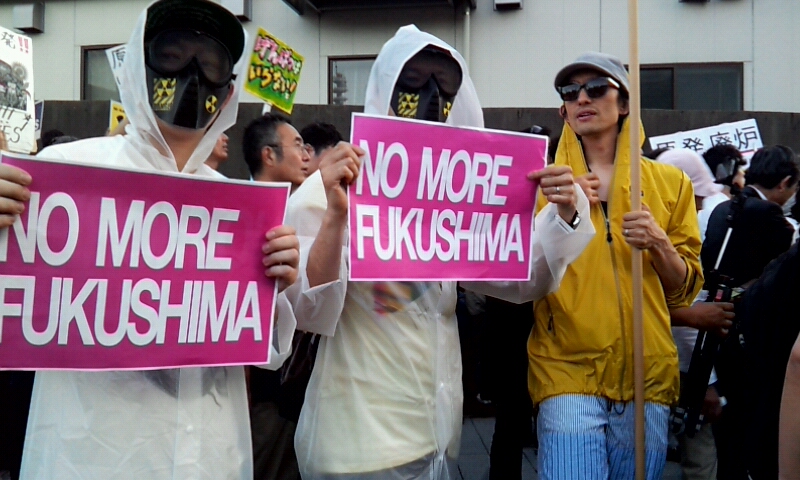
Japanese say "Sayonara to the Nuke" in a massive demonstration.


"I wonder whether we have to maintain nuclear power even putting our life at risk. I don’t think we have to" says Junpei Shigematsu, 37, an office worker from Kumamoto in Japan’s southern island of Kyushu. 

Someone compared it to the anti Vietnam war demonstrations in the USA in the 60's and this Japanese man, quoted in the Wall Street Journal Japan, came to Tokyo to voice his firm stance against the atomic energy. One cannot take the newspaper for an activist anti-atomic association of irresponsible people. 


So what is going on in Japan nowadays? What is behind this Monday July 16 2012 massive gathering of roughly 170.000 demonstrators against the man who was elected to power by the lobbies of the atomic energy, the prime minister Noda? 


Tokyo looked again as the Tokyo of the 60's when students gathered to make their opinion known on world issues with a great difference. This time the people here are from all ages and all professions. Talking to the people gathering at Yoyogi park or Nagatacho is very interesting in my interaction with this society whom I see for the first time as angry and worried as it was with the 1995 Aum Shinrikyo sect sarin nerve gas urban terrorist attack in Tokyo subway.


People were looking for direction in their life listening to Literature Nobel prize Oé Kenzaburo, and others such as music composer Ryuchi Sakamoto (awards winning composer of the music of the Last Emperor), Setouchi Jakucho, Keiko Ochiai, Hirose Takashi and many others such as writer journalist Satoshi Kamata. 


Something the Asahi shimbun who sees the "usual left minded demonstrators" did not see is the diversity and the multitude of people represented here and who acted with the most peaceful and polite manners.  Even the TV evening news program, this time, felt obliged to report, some briefly eventually, about this Yoyogi "Sayonara to the Nuke" massive demonstration. The movement’s leaders have collected 7.8 million signatures for a petition demanding the end of nuclear power but last month, Prime Minister Yoshihiko Noda decided to restart the reactor at Ohi plant in central Japan, while all Japan’s 50 working reactors are offline as unsecured according to international monitoring. The second reactor at Ohi is set to go online later this week, though. 


What is deeply anchored today in people's mind is the lack of trust for the authorities in relation to the atomic or nuclear  industry. Also deeply rooted today is the fear of an other Fukushima atomic energy accident and irradiation for decades, with the obligation as it is the case for 150.000 people ousted from their Fukushima region homes without proper status or compensation, to leave their home, their region, and see an irresponsible cold face bureaucracy destroy their life. "It is time to understand why this is only the beginning of heartbreak for Japan, and time to keep the children of Fukushima in your hearts and minds..." as one critic put it. 


About the Fukushima atomic accident played down by vested interests: The impact is nevertheless very serious, and now there is a time when things become more and more difficult for the Japanese (under tight self censorship restrictions) and the international media, the intellectuals, the politicians, and those who have interest in conformity to facts and accuracy to understand the importance of what is happening to Japan since Fukushima atomic energy accident March 11 2011. 


Why are media reports of those who go into the no go zone of Fukushima or those who follow months of work on the NPP constantly denied by the Noda's government and by the atomic energy sector and by their puddles? Why today are the Japanese average people, having only their kids to take care of, or the electricity bills to pay, getting into anger and challenge the "institutional lies?" We have reporters who visit the Fukushima region and combat the striking propaganda of the Japanese so called "nuclear village."


I did my coverage for RTL about yesterday's demonstration. The people I watched in these weekly gatherings are ordinary people, they see this practice of fooling the society as usual practice. On the other side, being the Devil's advocate, what we can say is that the very low cost of atomic energy is very attractive both for a policy maker and for an investor. But at what time does the low cost get you into troubles? We saw it at Fukushima, people told me, when security has been denied because of what some people or politicians regard as "a cultural" or what I'll call a mindset irresponsibility. 


Here is an example of what is really happening in Japan since Fukushima through the eyes of Professor Yves Lenoir, a well known scientist who work on Chernobyl and Fukushima and the health impact. He gives here an interview in 9 segments. His opinion is that this form of energy as it is built in Japan is dangerous for the people and it will take years to move to a more diversified source of energy. An eye opener, in French language.
Part I
http://www.agoravox.tv/actualites/politique/article/yves-lenoir-on-emploie-le-terme-35742


Last but not least we have here a society -- Japan-- which still lives in the aftermath of the Hiroshima and Nagasaki atomic bombing of August 6 and 9 1945. Here, more than anywhere else in the world, memory is alarmed and traumatic with this word: "Atomic." And nothing will ever erase this excruciating suffering that these people have had to endure and still do as the remaining Hibakusha remind us about the sheer folly of men. 


Making political pressure to shift from war to peaceful use of the atomic power, as Japan did under the pressure of the United States helped by politicians such as Nakasone and by media tycoon of the Yomiuri, was not a bad choice, but the impact was poorly managed as we can see decades after. We see what happens when the authorities decide to forget that security not greed is owned to any individual in a democratic society. 


The July 16th 2012 message of the 170,000 of Tokyo anti-atomic power plant demonstrators is that no-one should attempt to endanger life and to kill "just for electricity" says composer Sakamoto Ryuchi. Otherwise Sakamoto adds: "It is just barbaric." An elder Japanese professor, well versed into international politics, a friend of mine for many years, told me for the first time, on July the 14th Bastille Day celebrations in Tokyo's French embassy that Japan has an "identity crisis and live in the trauma of 1945 still today, but he adds, Japan does not dare to voice its concerns, internationally." It looks like a lot of younger and stable post war generations know exactly what they want and that they proved it on July 16th "Sayonara to the Nuke" huge demonstration!


Naturally, I sent my report about this Sayonara to the Nukes historic demonstration to my network RTL in France as requested by Paris newsroom.
Short URL Link:
http://lnk.nu/rtl.fr/23fs


Original URL Link:
http://www.rtl.fr/actualites/international/article/video-100-000-japonais-manifestent-contre-la-remise-en-marche-des-centrales-nucleaires-7750808767#play

Wednesday, July 11, 2012


Tokyo the sin-city for politicians' tricks...


Ichiro Ozawa recently slammed the door to Noda's ruling party leader and prime minister and left the DPJ with a noisy campaign. Exploding ruling parties is an art the Shadow Shogun excels at... and faithful to his reputation the notorious Ichiro Ozawa inaugurated tonight at the Nagatacho Kensei Kinenkan his new party, the "Kokumin no Seikatsu ga Daiichi", the party of "People's Livelihoods First". They form a 50 upper and lower-house members party, all of whom left the ruling party last week in protest against the tax hike bill. 


 Ichiro Ozawa founder of the "Kokumin no Seikatsu ga Daiichi" party


Ozawa who now leads the third-largest national political party wants to open to new high ranking politicians from everywhere or celebrities such as DPJ Yukio Hatoyama, ex-prime minister and like Ozawa an opponent to the tax increase. Ozawa said that the government increase of the sales tax to 10% in 2015 is a breach of the DPJ's 2009 election promise not to raise the tax for at least four years. Ozawa said the DPJ's shelving of pension and elderly health-care reforms to gain the support of the opposition conservatives parties to pass the tax bill is also a betrayal. This is the fourth party Mr. Ozawa creates since breaking with the Liberal Democratic Party in 1993, causing him to be nicknamed "Destroyer"! He is on his course... Ozawa also will work on reducing Japan's reliance on nuclear power.


I met Yuko Mori san (picture up), a female top strategist from the House of Councillors and Yawara chan --the Judoka Olympic gold medal from Sydney Olympics in 2000 and the Athens Olympics in 2004-- her real name at the Diet is Ryoko Tani (picture under), her wish is to help to create a nation everyone would desire. 


One who desires to come back to politics is ex LDP Taizō Sugimura 杉村 太蔵 , "Sugi kun" is a "Koizumi children", a young politician born in Asahikawa, Hokkaidō bred mid 2000's by former prime minister Junichiro Koizumi. He became the youngest member of the House of Representatives after the September 11, 2005 general election although he was ranked quite far. He is "genki" in good shape and eccentric enough to catch attention in the Japanese area of "talento" politicians. Sugimura kun came then to media attention "for his excitement at the prospect of the range of perks available for elected politicians", including high class restaurants, first class travel on the Shinkansen and being able to afford a BMW. 


Sugimura san (R) Joel (L) tonight at TIF Pronto

Sugimura was at that time harshly reprimanded by LDP executives for his comments, and publicly apologised at a news conference on September 27, 2005 saying they had been "immature and irresponsible. He ran in House of Councillors election in 2010 as a proportional candidate of The Sunrise Party of Japan. 


Nowadays we are happy to say that his mood for expensive French restaurant has come to a pause. He was the guest of honor of the president of the Pronto chain (Suntory group is behind) of nice stylish cafés and restaurants... Sugimura san is now learning the life of ordinary salarymen. Who says politicians don't... change? Two major changes illustrate that very truth of world politics tonight in the real heart of Tokyo the cradle, Tokyo the sin-city for politicians' tricks... Enlightening! 


But let's be serious the big news in the Tokyo evening newspapers and on TVs on Wednesday night is the tragic death of a baby panda at Tokyo Ueno zoo. This is real life.


Sugimura kun knows the price of a simple beer now, like a simple salaryman!


Sunday, July 08, 2012

The Letters of Fukushima...


Fukushima parliament investigation commission president, Dr. Kurokawa was grilled recently about the different version of the 2 reports provided in Japanese and in English at the Parliament and at press events in Tokyo. The major problem is that the English version of the president message is not the translation of the original document in Japanese. It is the translation and interpretation of notes of the commission chair Kurokawa who criticized the Japanese culture and the traditional system applied by the country saying it is responsible for the Fukushima nuclear accident. 

The "Message from the Chairman" in Japanese is the original version, to be read by Japanese people whoever they are, while the English version is rather for policy makers. It is my opinion that the original Japanese version of the President message should be entirely translated into English, as it is to appear end of July or mid August 2012, so that the world readers can accurately understand the report on the Fukushima nuclear accident, as it is presented in its original form to the Japanese society and to foreigners with its causes, its origins, the why and when, and with the recommendation contained after the 6 months investigation of the Kurokawa commission. 

This will answer to the need of: "highest standard of transparency" as Dr. Kurokawa wrote. Since Donald Keene, we know that perfect translation exists. Shouldn't the tragedy of Fukushima deserve a battery of expert world-known translators and specialized companies whose commitment is accuracy and sense of the century rather than a mere contractual obligation...?

So what's next? " They " [Diet members] are going to make it very political." Kurokawa-san told me. " I bet they are going to " I answered and then we both shook hands prior to part.


Japan, China, Taiwan, never ending war on China seas territorial disputes


"Japan's prime minister said the national government is considering purchasing a set of islets, the Senkaku islands in Japanese and the Diaoyu in Chinese, islands at the center of a territorial dispute between Tokyo and Beijing, a move that could further strain ties between Asia's two largest economies. The move by Prime Minister Yoshihiko Noda's government to weigh nationalizing the privately owned property is the latest salvo in a long-standing diplomatic stand-off with China, which also claims sovereignty over the Japanese-administered islands... "An official at the prime minister's office confirmed the central government is in talks with Tokyo and hasn't ruled out an outright purchase of the islands [Senkaku, Diaoyu]. "There is engagement between the prime minister's office and Gov. Ishihara," said the Japanese official, who declined to be named." (End of quotes)

Has Japan the capacity to handle what it is stirring right now? The answer is no. Behind Japanese government move, helped by the conservative Governor Ishihara, is there the perception that this move could endanger peace and security in the China seas? Years after years, we witness the appearance of a more " resilient " and forceful militarized Japan. 

As seen with its interaction overseas with PKO missions since late 20th century and now (Cambodia, Golan Heights, Mozambique, East Timor) and assistance (Djibouti) by the Coast Guards, by the JSDF, Ground, Maritime, and the JP Air Force for transportation. Last year, the JSDF were very instrumental helping the 3/11 victims of the quake and the tsunami. The JSDF of Tohoku military units came to rescue Fukushima after the nuclear accident. 

Does the public perceive it? Yes and if the elder do not like it, those who did not the WW2 are reminded by moves of neo-conservatives and right wing groups. And for the younger generation, scotched to their mobile screens, we can see lots of Manga, movies, novels aiming at remobilizing the nationalist conscience. Again I noticed recently this trend with films which depicts the heroism of the Japanese forces or Coast Guards against evil forces or stane creatures coming from the seas... 

How will China answer? Hard to predict, the Dragon is busy with its own inland policies but I know that Beijing won't ever give up any claim on sovereignty. Shock therapy again. One known device of the psychological governance...


What do the hard-liners say in Japan? After World War II Japan renounced claims to a number of territories and islands including Taiwan in the 1951 Treaty of San Francisco. But under the treaty the Nansei Shoto islands came under US trusteeship and were then returned to Japan in 1971, under the Okinawa reversion deal. Japan says that China raised no objections to the San Francisco deal. And it says that it is only since the 1970s, when the issue of oil resources in the area emerged, that Chinese and Taiwanese authorities began pressing their claims.

Several incidents happened between Japanese and Chinese fishing boats. China says being the owner of the islands (apparently it is inaccurate since a Japanese owner has been identified) and therefore started fishing, at one serious incident the Japanese Coast Guard took a Chinese fishing boat into custody for trespassing and also for violent navigation. After a few days to a week, the Japanese government released the crew.

Now Tokyo wants to buy the islands and integrate those as Japanese public domain.

(Images: agencies, otaku-streamers)

Saturday, July 07, 2012


Fukushima: "C'est la faute à l'homme"


Kiyoshi Kurokawa
Photograph ©JLK 2012


"...donc si on suit la logique de la commission d'enquête du parlement japonais sur l'accident nucléaire du 11 Mars 2011 de Fukushima: "Fukushima, c'est la faute à l'homme!" Oui il fallait y penser et Voltaire n'y est vraiment pour rien!" -quotes from my Facebook wall, url down this post.


Fukushima parliament investigation commission president, Dr. Kurokawa invited at the press club today, he was grilled about the different version of reports provided in Japanese and in English. Problem, the English version is not the translation of the original document in Japanese. It is the translation of notes of the commission chair Kurokawa who criticized the Japanese culture and the traditional system applied by the country saying it is responsible for the Fukushima nuclear accident.


Fukushima Parliament Investigation: Confusing Chair? A report of my fellow colleague Mure Dicky of the Financial Times had this written in today's edition of the FT on the Fukushima investigation commission by the Diet and the estrange sometimes "agent provocateur" and eccentric scientist chair Kiyoshi Kurokawa, chairman of the Diet's Nuclear Accident Independent Investigation Commission (following my post of Friday). 

Quotes of FT article titled "Fukushima crisis 'made in Japan': "... In a message prefacing the English language summary of the commission's final report, Mr Kurokawa blamed the plant's failure on "our reflexive obedience; our reluctance to question authority; our devotion to 'sticking with program'; our groupism; and our insularity". "What must be admitted – very painfully – is that this was a disaster 'Made in Japan'," he wrote. "Had other Japanese been in the shoes of those who bear responsibility for this accident, the result [might] well have been the same." In his preface to the Japanese version of the report, Mr Kurokawa offered a more measured critique of the cultural background to the crisis, blaming the mindset created by postwar effective one-party rule, seniority systems and lifetime employment rather than the nation's culture as a whole."

End of quotes.

Things you can say in English and things you cannot say in Japanese? So again a question: Why on earth a Diet investigative commission on Fukushima report has 2 versions for the same gatherings of facts, analysis and recommendations? 

"Ignoratio Elenchi in Latin". A "red herring in English". Is there an intentional attempt to mislead or confuse the Diet, the readers of the report? 

Now the thing is certainly about Kurokawa Sensei's strong personality, I do not dislike it at all. But as I know of it, it might not exactly fit the Establishment of Japanese politics, cultural, and science world. On this, here is an insightful report - interview of Kiyoshi Kurokawa, earlier August 9th 2011 in the Tokyo Weekender. "Kiyoshi Kurokawa the Maverick" always feels he is surrounded by enemies, quotes: “(When I worked) at Tokyo University, in a way I was surrounded by enemies,” Kurokawa tells me. “I’m very outspoken, and so the Japanese establishment hates me. I’ve had some negative experiences through that, so that’s why I’m always speaking to the younger generation. They are the ones that matter for our future and can change their lives.”

http://www.tokyoweekender.com/2011/08/kiyoshi-kurokawa-the-maverick/


Question: do you change the society by shooting at it as one friend of the press put it yesterday? Mister Kurokawa might very well feels very lonely in the future although he certainly did a very interesting job to shake the walls. Something an other Maverick I know a little, Prime Minister Junichiro Koizumi, perfectly understood before to retire definitely from front politics.


* Joel's Facebook page:
http://www.facebook.com/joel.legendrekoizumi

Saturday, June 30, 2012


Japan expected political explosion after Earthquake, Tsunami and Fukushima


Tens of thousands of citizens occupy 
Japanese government district
Tokyo June 29th 2012.


On Friday June 29th 2012 a White Paper on Science and Technology was presented to the foreign media in Japan. A monument of "Tatemae" with worrying words like "Toward a Robust and resilient Society". But if we look deeper, it is an attempt to hide the lack of preparation of the Japanese big players and rulers in case of natural disasters in a country prone to such unfortunate events. (earthquake, tsunami, industrial accident, atomic explosion, poisoning, radiation, etc.)

On this last point the summary of the Sciences and Technology's photo (PHOTO) I added here elaborates the future agenda of concerns that Japan should not rule out, such as avoiding to see Japan contrive to hang itself for lack of careful preparation. One of the most fundamental right the people here are expecting. 

Apparently, the Japanese government, the administration and the related industrial interests were not yet aware of catastrophic impacts raised by the earthquake, the tsunami and by the Fukushima NPP accident before they opted for atomic energy more than half a century ago. Quotes: 

1) Effect of radiation on human health

2) Promotion of decontamination

3) Securing food safety.
Nuclear safety regulation, SPEEDI etc.

End of quotes.

White Paper

We understand that this is a review of what did not work well before and since 3/11. We can desperately regret that 20.000 people died of the 3/11 earthquake and the tsunami and half a million people lived in precarious conditions and that millions are worried about the impact of atomic radiation in their daily life, because Japan had not deeply thought about the nature of its territory and land ! We are stunned that Japan did not think about these risks before to build cities or atomic energy plant on the shores of its archipelago.

Studying the papers of the SC & Tech White Paper is nothing else than demonstrating the lack of serious consideration to daily life by those who have in their mandate and duties to assure the safety of life in Japan, today. 

And I assume that the a multitude of spin-doctors are going to say that foreign media are again sending false rumors such as what we did in March 2011, when we said, wrote, voiced that there was a meltdown in Fukushima NPP...! 

Maybe rulers' greed is one explanation. There are others.

                                                PART II


Tokyo Nagatacho June 29th 2012 

In the second part (in French) I write today about the strange "Interference between the International Atomic Energy Agency (IAEA) and World Health Organization (WHO) after the report by Michel Ferney, Professor Emeritus at the University of Basel, Michel Ferney was astonished, with the Chernobyl accident as currently in Fukushima: "a strange absence" of the World Health Organization (WHO). His article was published in Rue89 but I add here an extraordinary report published in 1957 about health dangers and mental health when dealing with Atomic Energy, by WHO-OMS... 


Les étranges "Interférences entre l'Agence Internationale de l'Énergie Atomique (AIEA) et l'Organisation Mondiale de la Santé (OMS) par Michel Fernex, Professeur émérite de médecine tropicale. Faculté de médecine, Université de Bâle. 


Les promoteurs des centrales atomiques, et l'AIEA en particulier, ont de tout temps investi dans une propagande bien orchestrée, pour que cessent les craintes "injustifiées" des populations face au nucléaire commercial. Ces craintes risquaient de gêner le développement rapide des centrales atomiques. Pour l'AIEA, il était essentiel de trouver le moyen de mettre fin aux publications de travaux, susceptibles d'inquiéter les populations et les responsables politiques ainsi que le présente ce rapport: 


" En 1957, une publication de l'OMS sur les "EFFETS GÉNÉTIQUES DES RADIATIONS CHEZ L'HOMME" souligne les dommages provoqué par les mutations ponctuelles, et leurs rapports avec les doses de rayonnement.Le travail signé par le professeur américain H.J. Muller, un biologiste célèbre, lauréat du Prix Nobel, de même que les travaux sur les mutations chez l'homme, risquaient de mettre en danger l'industrie atomique du fait de ses atteintes à la santé. Muller avait en particulier relevé que des doses de rayonnement très faibles pouvaient produire des altérations du génôme, sans que l'on puisse déceler de rapport linéaire entre les doses les plus faibles et ces altérations. 


L'année suivante, en 1958, l'AIEA et l'OMS, deux organisations des Nations Unies, concluent un Accord, qui contraint l'OMS à ne plus entreprendre de recherches, ni publier de documents pouvant gêner la promotion des centrales atomiques, et de conserver un caractère confidentiel à certaines informations sensibles. 


L'article 1 de cet Accord stipule en effet que : "Chaque fois qu'une des parties se propose d'entreprendre un programme ou une activité dans un domaine qui présente ou peut présenter un intérêt majeur pour l'autre partie, la première consulte la seconde en vue de régler la question d'un commun accord." 


L'Article III précise en outre que : 


1) L'Agence Internationale pour l'Énergie Atomique et l'Organisation Mondiale de la Santé reconnaissent qu'elles peuvent être appelées à prendre certaines mesures restrictives pour sauvegarder le caractère confidentiel de renseignements qui leur auront été fournis... 


2) Sous réserve des arrangements qui pourraient être nécessaires pour sauvegarder le caractère confidentiel de certains documents, le Secrétariat de l'AIEA et le Secrétariat de l'OMS se tiennent mutuellement au courant de tous les projets et tous les programmes de travail pouvant intéresser les deux parties. 


Cet Accord retire en conséquence à l'OMS la possibilité d'analyser, de manière indépendante, l'impact des installation atomiques sur la santé. La confidentialité instaurée par cet Accord est par ailleurs contraire à la Constitution de l'OMS (voir pp.1 à 18 de la référence 1). En effet, parmi les 22 fonctions qui doivent permettre à l'OMS d'atteindre ses objectifs pour la santé dans le monde, figurent les points suivants: 


- fournir toutes informations, donner tous conseils et toute assistance dans le domaine de la santé 


- aider à former, parmi les peuples, une opinion publique éclairée en ce qui concerne la santé


Malgré les contradictions entre la Constitution de l'OMS et les paragraphes de l'Accord cités ci-dessus, l'Accord entre l'AIEA et l'OMS a été approuvé par la 12e Assemblée Mondiale de la Santé, le 28 mai 1959. 


Pour mieux comprendre la portée de cette restriction de l'information des populations, il faut lire le numéro 151 de la Série de Rapports Techniques de l'OMS. La conclusion du chapitre: "Politique à suivre en cas d'accident et de dangers imprévus", à la page 50 de ce document s'exprime en ces termes sybillins:  "Cependant, du point de vue de la santé mentale, la solution la plus satisfaisante pour l'avenir des utilisations pacifiques de l'énergie atomique serait de voir monter une nouvelle génération qui aurait appris à s'accommoder de l'ignorance et de l'incertitude et qui, pour citer Joseph Addison, le poète anglais du XVIII siècle, saurait chevaucher l'ouragan et diriger la tempête". 


Cette conclusion traduit un mépris des populations, tout à fait contraire à l'esprit et à la lettre de la Constitution de l'OMS. En novembre 1995, lors du congrès organisé par l'OMS sur Tchernobyl à Genève, M. Claude Haegi, représentant le gouvernement de Genève, a lu ce texte en assemblée plénière. Une autre phrase a été citée par M. Haegi est celle exprimée par M. Blix, Directeur Général de l'AIEA, 4 mois après la catastrophe de Tchernobyl, et publiée le 28 août 1986, dans le journal le Monde. M. Blix y affirme que, vu l'importance de l'énergie atomique, le monde pourrait supporter un accident comparable à celui de Tchernobyl par an. M. Haegi de conclure : "Un Tchernobyl suffit. Il faut tendre vers une sécurité quasi totale." Cette contribution, comme tant d'autres n'a pas été mentionnée dans le document fourni après ce congrès." End of quotes.


Notes: http://www.akademia.ch/~sebes/textes/1998/98Fernex1.html#Tast.


NB: I have the original 1957 1958 WHO OMS documents in my files.

Thursday, June 28, 2012

Japan Consumption tax: Not now! 
Katz says "Japan is under psychological depression!"


Richard Katz Editor of the well know "Oriental Economist"

Richard Katz shouted at prime minister Noda about the 100% increase of the consumption tax: "Total Nonsense" says the Editor of the Oriental Economist at the press club today. Katz describes the tax as the "wrong tax at the wrong time." The problem according to the influential newsletter's editor is that Japan "is not growing and that low growth expands deficit." 


Good news? Japan's assets are huge, 60% are overseas, Japan is not Greece, it is the third economic power. But an increase of consumption tax is risky and can cause a recession. Let's hope the benefit of the tax does not only go to the firms and forget the people... He considers the Japanese media are too lenient vis a vis the Japanese ministry of Finances. "Reporters repeat things without really understanding what they are talking about" or he told also are complacent with their self censorship... 


Japan he said is now under a psychological depression. " Car sales are down by half compared to 10 years ago"? Really? He also said that people do not have money to spend and consume and use their savings, 5 to 10% of it. So why charge the consumers with a 100% tax to come? On Fukushima Katz reminded the audience that 84% of Japanese don't trust the government on the "cold shutdown".


Maybe the Osaka Mayor Toru Hashimoto or an other charismatic leader is now expected by voters says Katz who definitely appears to the public as an ice-cube in the coke. Refreshing! We exchanged "名刺" meishi together.

Saturday, June 09, 2012


The Tepco fuzzy world


Notorious Masataka SHIMIZU ex-Tepco president 

Is Japan rewarding those who ruin and bring shame on the nation? 日本は、国を破滅させ国家の恥を晒す人たちに報いるのですか?


National Diet of Japan, my brief comments on Tepco and the 19 meetings of the Fukushima Nuclear Accident Independent Investigation Commission (NAIIC)【国会事故調】

After hearing ex-Tepco president Shimizu at the Diet investigation panel, Shimizu was in charge of the Fukushima Dai I nuclear power plant, I simply would say that he is an example of what Japan produced the worst as servile protector of his business, his bureaucratic career and his Japan nuclear village, Shimizu  stated in front of the panel and the audience, that he did not remember much of what he did during the March 2011 days of international emergency! How awkward.

I have to say a few things about the Japanese press and the Fukushima Diet Naiic investigation panel and first impression is that actually this panel has a method and it is a first for such panel to investigate, and it is hard. The witnesses (Kan, Edano, Shimizu, Sato etc.) are not under oath as this was not decided by Parliament. They do not have this practice they say according to Dr. Kurokawa. The project is here to let Japanese and foreign public to draw their own conclusions on what happened during this Fukushima accident and since March 11. So the panel seems to exist as a tool that is set between, say, a Congress investigation and the South African reconciliation process, but it is still vague.

Maybe it fails of not having a possibility to bring the result of testimonies in front of the Justice. This would eventually happen as people have sued Tepco already. Indeed we are here in Japan in a democracy with strict separation of powers Executive Legislative and Justice in what I observed in the practice of these three powers.

The second thing I observed during these 19 meetings and hearings of the Diet Fukushima investigation is the great work or Mr. Nomura who was in charge of asking questions to witnesses (as a Prosecutor could do), Nomura-san is a quiet, remarkable in the method, the logic and the grilling of a person testifying, impressive.

Last comment is about the Japanese media. Japanese reporters ask very tough questions during press conferences opened to all journalists from all around the world, especially the Japanese free lance journalists (many have a regular basis collaboration with media actually) but the sad thing is that the Japanese big media (5 big TV and in particular the 5 big newspapers group: 朝、毎、読、日経、産経 ) do not publish all they reported and were told. Why?

Last but not least, as my fellow colleague from Reuters newswire (ex Bloomberg) Aaron Sheldrick writes: "... in a sign of the close ties that bind corporate Japan, Shimizu will later this month become an outside board member of Fuji Oil Co., which is owned by AOC Holdings Inc., a firm in which Tepco has an 8.7 percent stake." Is Japan rewarding those who ruin and bring shame on the nation? 日本は、国を破滅させ国家の恥を晒す人たちに報いるのですか?


Wednesday, May 30, 2012


WHO-OMS report on Fukushima, "allegedly questionable"!

Picture by Antonio Pagnotta©2012

Scientific criticisms  are emerging  following the publication of the report of the WHO  on Fukushima after the March 11th 2011 earthquake  and tsunami. (Bilingual French and English)


Part I

Regarding  the  "Preliminary dose  estimation from
the  nuclear  accident after  the 2011  Great East
Japan  Earthquake  and  Tsunami" published  by the
WHO   (OMS)   World   Health   Organization  2012.
Criticisms  about  the  methodology  adopted,  and
about   the  conclusions.   Here  is   a  critical
analysis  of this report  prepared by  a scientist
who works on Chernobyl  and follows  the Fukushima
case from France.

I  could  obtain  a  copy  of  this  document. The
report  focusses  on 5  major themes  of questions
which  are  puzzling  the scientific  community, I
publish  them  here,  they  provide a  pretty fair
assessment of the questions asked today:

"...  Above  all,  we  have  to denounce  the link
between  "dose  assessment"  and   Earthquake  and
Tsunami. If there were no  nuclear power  plant in
operation   along   the   coast   of   Japan,   no
radioactive   contamination   would    have   been
reported.  The  (WHO)   title  should   have  only
referred  to  the  destruction  of  the  Fukushima
Dai-ichi  nuclear  power  plant! The  report title
formulation is chosen to focus  the main  cause of
the   radioactivity   doses   received    by   the
population on the tectonic plates  and not  on the
concentration   of   radioactive    materials   at
facilities subject to the failures of men  and the
upheavals of the nature..."


"... it is  now necessary to  provide answers  to 5
questions that this report raises:

-Why the WHO, which has no human  means to  do the
job, brought its label to  the publication  and by
taking  full  responsibility  in  the eyes  of the
media and public opinion?

-Where  and with what  experience and  history are
involved the main contributors to the  present WHO
report?

-What   position   would   it occupy    in   the
communication     "allowed"      regarding     the
consequences of the accident?

-What  is  the   scientific  context   of  this
assessment? Is it appropriate?

-Can the report bring the Japanese  authorities to
reconsider their handling of the  crisis affecting
the radiological re-contaminated regions?


In  addition:


FR: "... des informations rassemblées  ci-dessus il
découle  à  l'évidence que  ce rapport  “OMS 2012”
sur Fukushima ne s'inscrit pas dans un  conflit au
sein  de  la   technocratie,  l'OMS   essayant  de
recouvrer  une  petite  part  de  l'autonomie dont
l'accord de  1959 et la  Convention de  1986 l'ont
complètement  privée.  Il  est  donc un  élément à
considérer  comme important  dans la  stratégie de
communication visant à verrouiller  les prévisions
sur  les conséquences  sanitaires de  Fukushima et
l'interprétation  de  celles  que les  médecins et
épidémiologistes indépendants observerons  au sein
des  populations  touchées  par  la  radioactivité
répandue. Tout conduit à penser  que la  machine à
broyer le réel est déjà lancée à plein  régime. Il
n'y a pas eu d'irradiations aigües  à Fukushima.
L'accident  n'aura  donc  produit  aucune  mort  à
mettre  au  compte  de  la  radioactivité. Dieu
merci ! pourront s'exclamer  Jean-Pierre Chaussade
et Sunichi Yamashita..., s'ils  ne l'ont  pas déjà
fait.  La  radiophobie a  déjà commencé  à exercer
ses   ravages,    que   les   rapports   officiels
déploreront  et  imputeront  à  l'alarmisme des
intervenants        indépendants,       ignorants,
incompétents et irresponsables..."

CQFD,  we wish to  hear the  concerned authorities
about these questions.

Part II

Details on how the atomic club works, in French:

FR:  "...  La  mécanique  de   la  radioprotection
internationale

1. Le dispositif institutionnel

Une brève description de  la structure  du système
institutionnel    international    (onusien)    de
radioprotection et de la manière dont  ses membres
en disposent est ici indispensable.  Annie Sugier,
une   bureaucrate   éminente   de  l'establishment
atomique  français moult  fois décorée  et primée,
présente    le   diagramme    de   flux    de   la
radioprotection  mondiale dans  le Dossier  167 de
l'ASN10.

Au  sommet,  la  Science  qui produit  des papiers
publiés par les revues à  Comité de  lecture. Rien
à  dire,  sinon  que les  budgets de  recherche ne
vont  pas  toujours  vers  les séquelles  les plus
préoccupantes de  la pollution  radioactive (comme
en  Biélorussie  par exemple,  où tout  ce domaine
est délaissé).

L'UNSCEAR, United Nations Scientific  Committee on
the   Effects    of   Atomic    Radiation,   vient
immédiatement après. Son  rôle est  d'examiner les
publications  scientifiques sur  le sujet  et d'en
retenir ce que bon  lui semble.  L'organisme n'est
soumis à aucun contrôle scientifique.  En d'autres
termes il juge souverainement.

En   dessous   se   trouve  la   CIPR,  Commission
Internationale  de  Protection  radiologique,  une
association  caritative   [sic]  qui   reçoit  les
publications  sélectionnées  par  l'UNSCEAR  et en
tire des recommandations.

On  peut  se  rendre  compte  de  l'efficacité  du
filtrage  opéré par  ces deux  acteurs prééminents
du dispositif en regardant comment  Tchernobyl est
pris en compte dans les  dernières recommandations
générales,  Publication  CIPR  103 (2007).  Le mot
Tchernobyl   n'est   cité   que   trois   fois  et
uniquement en relation avec la question  du cancer
de la thyroïde... Un exploit indépassable  s'il en
est. Puis viennent les  instances de  discussion :
AIEA, OMS, IRPA, OCDE,  AEN etc.  Elles retiennent
ce qui leur  paraît pertinent  des recommandations
de    la   CIPR    pour   l'exercice    de   leurs
responsabilités en matière de radioprotection.

En   découlent   les    standards   internationaux
élaborés par l'AIEA, l'OMS, la FAO, l'AEN  etc, et
les  standards  régionaux,  comme  ceux d'EURATOM.
Enfin,   en   dernier   lieu,   nourries   par  ce
processus, les législations nationales.

C'est  presque  beau  comme  l'Antique.  Cependant
l'ordonnance du dispositif  est brouillée  par les
acteurs   qui   en  assurent   le  fonctionnement.
Impossible ici  de fournir dans  le temps  et dans
l'espace le film  des fluctuations  de l'entrelacs
des  appartenances  des  uns  et  des  autres, aux
institutions  qui  le  composent  mais  aussi  aux
industries atomique  et radiologique.  On découvre
sans  surprise  que se  vautrer dans  les conflits
d'intérêt  assure  des  carrières  sûres  vers les
sommets.

A  titre d'exemple, la  dernière recrue  du Comité
principal  de  la  CIPR, la  radiobiologiste russe
Natalya   Shandala   est   aussi   Conseillère  en
communication de ROSATOM et  participe à  ce titre
à des chats sur In- ternet, du genre  : “Radiation :
Friend or Enemy ?  ”11. La  Scientologie recourt
aux  mêmes  procédés.   Tout  est   brouillé  sauf
l'esprit de corps, la pensée unifiée, le  rejet de
toute contestation et de  remise en  cause, portés
par    cette   machinerie    bureaucratique   sans
faille..."

Fin de citations de Yves Lenoir, 29 mai 2012.
In Asiangazette, May 30th 2012.
Translation FR to EN, the French version is to be
the original reference.

Quod erat demonstrandum!