Sunday, April 11, 2010

One night of bloodshed in Bangkok

* Update 1: April 12 Monday 08:30 am. Some 21 people were killed and 858 others injured in violent clashes between soldiers and redshirt demonstrators on Saturday night, a government medical service centre said.
** Update 2: Following events from Thailand with TAN Network and the viewers posts


A look at the press statements following the events of Bangkok Khok Wua battlefield, in agencies, blogs, and with the reports of the NATION newspaper.


"The Red Shirts urge the resignation of the Prime Minister Vejjajiva"
Sean Boonpracong, int'l spokesman of the United Front for Democracy against Dictatorship


After days of nonviolent protests which included spilling buckets (more than 3 liters) of human blood in front of government buildings, shaving heads, and peacefully chasing away soldiers at security point and humiliating Thailand’s prime minister Abhisit Vejjajiva by showing the Thai government’s quietness, “Red Shirt” protesters faced the Thai military in full black-matte riot gear. But the violence last night infuriated both parties.


Thailand worst political violence since the Bangkok Black May 1992 after clashes between the Thai army and anti-government demonstrators that left 19 people dead and over 850 injured at this hour Sunday midday, 28 soldiers prisoners of the rd Shirt. Civilians, including a Japanese TV cameraman, and five soldiers were killed in Saturday's crackdown on "Red Shirt" supporters of fugitive ex-premier Thaksin Shinawatra.

Violence erupted when troops tried to clear one of two sites in central Bangkok, near ministries of Defense and Foreign Affairs, the Democracy Monument, also near the Grand Palace and the Wat Phra Keo, occupied by the protesters for the past month. Soldiers fired in the air and used tear gas, and the Reds responded by hurling rocks. Same violence seen in the 1992 violent demonstrations held on Sanam Luang at the Royal Hotel where the army shot at demonstrators in the hotel, bullets impacts proving the violence of the clashes.

Yesterday in Bangkok at one stage protesters overwhelmed and captured an armored personnel carrier. The army later retreated, calling for a truce with the demonstrators, who were holding five soldiers hostage. Thousands of protesters remained on the streets at the two protest sites on Sunday.

Government spokesman Panitan Wattanayagorn said an investigation had been launched into the violence and that negotiations were under way to bring about a resolution to the stand-off without further unrest. "The prime minister's secretary is coordinating with protest leaders to solve the situation and would like protesters to stay put," he said.

Reuters journalist killed in Bangkok protests

Sat Apr 10, 2010 2:40pm EDT

Our Tokyo colleague of Thomson Reuters news agency, Japanese cameraman Hiro Muramoto, died after being shot in the chest during the protests. Hiro Muramoto, a Tokyo-based Japanese national who worked as a cameraman for Reuters for more than 15 years had been covering fighting between troops and protesters in the Rajdumnoen Road area in Bangkok where he was shot dead. Reuters said in a communique to the Japan based Foreign Correspondents' Club of Japan Freedom of the Press Committee. The news agency asks that the press show respect for Muramoto-san's family at this time of mourning. We knew Hiro and respected his quiet strength, his great professionalism and his genuine kindness, we are truly saddened here by his tragic end and address our heartfelt condolences to his family.

It was Thailand's worst political violence since "the Black May 1992". The 17–20 May 1992 popular protest in Bangkok against the government of General Suchinda Kraprayoon and the bloody military crackdown that followed. Up to 200,000 people demonstrated in central Bangkok at the height of the protests. The military crackdown resulted in 52 officially confirmed deaths, many disappearances, hundreds of injuries, and over 3,500 arrests. Many of those arrested allegedly were tortured.

The mostly poor, rural Reds say the government is illegitimate as it came to power with military backing in 2008 after a court ousted Thaksin's allies from power. Red Shirt protesters called on the country's revered King Bhumibol Adulyadej to intervene to prevent further bloodshed.

"Did anybody inform the king that his children were killed in the middle of the road without justice?" Reds' leader Jatuporn Prompan asked protesters. "Is there anyone close to him who told him of the gunfights?" Although he has no official political role, the hospitalized king is seen as a unifying figure. And during a 1992 uprising he chastised both the military and protest leaders, effectively bringing the violence to an end.

Sources: Wire news, Linxy (image), inewp.com, Reporter's notes.

✍✍✍ Sources in Bangkok quoted officials voicing reports on TVs about people being killed as the result of "traffic accident", not as the result of direct bullet or rubber bullets shots. Unconvincing statements according to the sources.


Khok Wua battlefield
Quotes of THE NATION ON SUNDAY
Published on April 11, 2010

Red-shirted protesters stepped up their struggle
last night, firing grenades and bullets into
security forces, drawing a response with live
rounds at the Khok Wua Intersection near the
Democracy Monument. At least eight people were
killed and about 500 others wounded as of press
time.

Several soldiers were in serious condition after
three grenades and guns were fired into them. The
soldiers covered with blood were pulled away from
the action by their comrades. The soldiers then
fired real bullets back at the protesters. The
onslaught took place after tensions had built up as
security forces tried to push the protesters back
from Khok Wua to Borwornniwetwiharn Temple by
firing teargas and rubber bullets into the air.
Fighting back, the protesters threw glass bottles
and teargas that they had seized from troops. Some
teargas was dropped from four helicopters on the
protesters, who fought back by releasing balloons
to disrupt the flight paths of the helicopters.

Explosions and gunshots peppered the scene at the
Democracy Monument and the media were sent to a
safe place. Security forces' attempts to disperse
red-shirt protesters resulted in confrontations and
clashes in several spots earlier in the afternoon.
The first clash took place at about 2pm when
Kwanchai Praipana led hundreds of protesters from
Phan Fa Bridge to the First Army Area headquarters
to try to break into the compound. They ran into
resistance from soldiers who fired teargas, rubber
bullets and jets of water to disperse them. The
protesters hit back by throwing objects at the
soldiers, prompting hundreds of First Army soldiers
to come out of the gates with batons and shields to
protect the headquarters.

The red shirts then fled to nearby roads. Some
were injured by the rubber bullets. At Makkhawan
Rangsan Bridge about 4pm, soldiers pushed
protesters back to the Royal Plaza, firing teargas
and rubber bullets. They had to repeat the
operation three times before the protesters gave in
and fell back to their stronghold at Phan Fa
Bridge. Soldiers built up forces at Pinklao Bridge
and blocked traffic to Ratchadamneon Road.
Hundreds of troops were stationed at the Government
Lottery Office and Makkhawan Rangsan Bridge.
Tensions were high everywhere military forces had
built up their presence. At Missakkawan
Intersection on Ratchadamneon Nok Road, soldiers
fired shots into the air to disperse the
protesters. Soldiers lined up while marching
towards the United Nations building near Makkhawan
Rangsan Bridge as they tried to drive the
protesters back, resulting in a clash between the
two sides that saw at least six protesters
sustaining cracked heads.

Soldiers constantly fired shots into their air.
Some released air from the protesters' pickup truck
tyres. Two to three explosions were heard and
teargas was used. Tensions ran high when the red
shirts regrouped and tried to fight back to reclaim
their protest site at Makkhawan Bridge, throwing
objects and wielding sticks while soldiers kept
firing teargas. However many soldiers not wearing
masks rushed to rinse their faces because of the
effect of the teargas, letting the protesters
successfully push back the soldiers. There were
dramatic scenes after soldiers successfully
dispersed the protesters from the area. Losing
"the physical battle", the protesters launched
verbal attacks against the troops.

A woman in her 50s stood in the middle of the road
and pulled up her top to show her breasts,
prompting female soldiers to come to her, pulling
her top back down. She fought back and pulled her
blouse up again to let photographers take her
picture. Another protester in her 40s slammed the
military's trucks with a pestle. A military
helicopter flying above shot off fireworks to let
the soldiers on the ground know that the protesters
had retreated.

Saturday, April 10, 2010

Nuclear War: Obama's Survival Kit for Japan


Advise number 1: Run! Just run!
Really...who can?


1) There are over 27,000 nuclear weapons in the world.
Thousands are deployed on land, at sea and in the air,
posing the constant threat of nuclear war and
radioactive contamination.

An atomic explosion is a chain reaction in which atoms
are split. This releases colossal amounts of energy,
and particles that collide with more and more atoms
causing an exponentially growing chain reaction. This
process is called fission. The most powerful fission
explosion is achieved by using enriched uranium and
plutonium atoms, which are unstable and radioactive.

• Atomic bombs (also known as A-bombs or fission
bombs) produce their explosive energy purely through
nuclear fission reaction.

• Hydrogen bombs (also known as H-bombs, thermonuclear
bombs or fusion bombs) produce energy through nuclear
fusion reactions, and can be over a thousand times
more powerful than fission bombs. In a similar
process to the sun, they work by using fission energy
to compress and heat fusion fuel.1

• The destructive power of a nuclear explosion is
measured in kilotonnes (which are equivalent to
thousands of tonnes of TNT) and megatonnes (equivalent
to millions of tonnes).2


About the Obama Nuclear Summit schedule
(Without Iran, Israel, North Korea)


2) Prior to the Obama Nuclear Summit. These days, it is
up to how to survive a nuclear attack. I've seen lots
of dodgy pages, here are a few quotes...


Quotes

"If a "Dirty Bomb" Attack (Not the vastly more
devastating nuclear weapon blasts with fallout
discussed below.) - You can expect localized and
downwind contamination from the explosion and
dispersed radioactive materials. If you are near
enough to see or hear any local bomb blast, assume
that it includes radiological or chemical agents. You
should move away from the blast area as quickly as
possible. If the wind is blowing toward you from the
direction of the blast, travel in a direction that is
crosswise or perpendicular to the wind as you move
away from the blast area. If possible cover your face
with a dust mask or cloth to avoid inhaling
potentially radioactive dust. Upon reaching a safe
location, remove your outer clothing outside and
shower as soon as possible. Refer to local news
sources for additional instructions about sheltering
or evacuation. The government is better prepared to
direct and assist the public in a 'dirty bomb'
incident, unlike an actual nuclear weapon attack
discussed below."

#1 - STAY OR GO? You must decide FIRST if you need to
prepare where you are, or attempt evacuation. The
nature of the threat, your prior preparations, and
your confidence in your sources of information should
direct your decision. If you know already you will be
preparing to stay at your own home or, at least, the
immediate local area, go now to #2 below.

3) In the meantime... about the Nuclear Summit... A
Nuclear Summit without North Korea?

Although the gathering of 47 countries will not focus
on individual nations, the nuclear programs of Iran
and the DPRK are expected to come up in Obama's
bilateral meetings with PRC President Hu Jintao and
other leaders, as well as in the speeches of Israeli
and other participants. A draft communique circulated
to countries attending the summit, includes a U.S.
proposal to "secure all vulnerable nuclear material in
four years." "If leaders at the summit get it right,
they could render nuclear power safer to use in the
fight against climate change, strengthen the
non-proliferation regime, and build further
international confidence in ... nuclear disarmament,"
said Ian Kearns, who is an adviser to Britain's
parliamentary committee on national security.

The highest ranking DPRK official who defected to the
ROK reported that the DPRK will not collapse soon
despite its dire situation, a report said yesterday.
Hwang Jang-yop, former secretary of the DPRK ruling
Workers' Party, was quoted by Kyoto News Agency in a
closed lecture in Tokyo, "In North Korea, the
influence of the late leader Kim Il Sung remains
strong. So even if Kim Jong Il has health problems,
North Korea will see no major upheaval as long as Kim
Kyong Hui, Kim Jong Il's younger sister and a Workers'
Party director, remains in power," Hwang said. He
added that a coup d'état by the DPRK`s military is
unlikely since it has been indoctrinated by ideology.

In the meantime,the DPRK Supreme People's Assembly
convenes an annual session Friday expected to show
solidarity and perhaps indications of the nation's
future leadership and economy. On Thursday, the DPRK
elite, senior officials from the Workers' Party, the
military and the government, gathered in Pyongyang to
celebrate Kim Jong Il's 17 years of leadership, the
Korean Central News Agency said. Major DPRK
newspapers ran editorials praising Kim's leadership,
KCNA said Friday. Floral baskets and congratulatory
letters have been streaming in from foreign diplomats
and the military attaches, it said.

Japan decided Friday to extend its sanctions against
the DPRK for one year after the current measures
expire on Tuesday, including a ban on DPRK vessels
from making port calls in Japan. The decision was
made at a meeting of Cabinet ministers as Pyongyang
has not fulfilled its promise to reinvestigate cases
of Japanese nationals abducted by the DPRK, nor has it
returned to the six-party talks aimed at ending its
nuclear programs, Chief Cabinet Secretary Hirofumi
Hirano said. While noting that the sanctions have
produced ''a certain outcome,'' Hirano admitted Friday
that there are suspicions that trade has taken place
between the two countries via a third country. ''This
is an issue we must study in the future because
cooperation with related countries will be necessary,
given that there is a question about whether Japan can
handle it alone,'' he said.

Notes added pages on the Nuclear weapons survival kit
(copy and paste to access)

www.wikipedia.org of course...

How Stuff Works,
http://science.howstuffworks.com/nuclear-bomb1.htm
Kate Hudson, CND – Now More Than Ever, The Story of a Peace Movement, Vision Paperbacks, 2005.

ICAN, ‘Nuclear Weapons Today’,
www.icanw.org/nuclear-weapons-today/

Mohamed ElBaradei, ‘Preserving the Non-Proliferation Treaty’, 2005, www.unidir.org/pdf/articles/pdf-art2185.pdf

Bradford Disarmament Research Centre,
www.brad.ac.uk/acad/bdrc/

Nuclear Information Project, ‘US Nuclear Weapons in Europe’, www.nukestrat.com/us/afn/nato.htm

Arms Control Association, ‘Nuclear Weapon Free Zones’,
www.armscontrol.org/factsheets/

International Atomic Energy Association,
www.iaea.org/cgi-bin/db.page.pl/pris.oprconst.htm

Arms Control Association, ‘Nuclear Weapons – who has what?’, www.armscontrol.org/factsheets/

Natural Resources Defense Council, ‘Nuclear Insecurity – A Critique of the Bush
Administration’s Nuclear Weapons Policies’, 2004, www.nrdc.org/nuclear/insecurity/critique.pdf

1998 UNDP Human Development Report,
http://hdr.undp.org/en/reports/global/hdr1998/

Brookings Institution, ‘The US Nuclear Weapons Cost Study Project’, 1998, www.brookings.edu/projects/archive/nucweapons/50.aspx

The American War Library,
http://members.aol.com/forcountry/ww2/wc1.htm

Campaign for Nuclear Disarmament, ‘The cost of British nuclear weapons’,
www.cnduk.org

‘The Environment and the Nuclear Age’, Women’s International League for Peace and Freedom, www.reachingcriticalwill.org/technical/factsheets/environmental.html


Wednesday, April 07, 2010

"Pioneering Alliance" Renault, Mercedes, Nissan!


When fame makes sense of it all


Renault, Mercedes and Nissan

French automaker Renault, Japan's Nissan and Germany's Daimler AG (Mercedes) will form a partnership to exchange capital, develop cars and share expertise, the companies announced in a statement today. As part of the deal, the Renault-Nissan alliance will take a 3.1 percent stake in Daimler, while Daimler will take 3.1 percent of Renault and 3.1 percent of Nissan, they said. Renault-Nissan and Daimler, which makes the luxury Mercedes-Benz line and the Smart small car, also agreed to work together to develop small cars and engines and collaborate in the field of light commercial vehicles.

As part of the linkup, Daimler will swap a 3.1 percent stake, valued at 1.17 billion euros ($1.6 billion), for shares in Renault SA and in Nissan Motor Co., the three carmakers said in a joint statement today. Daimler Chief Executive Officer Dieter Zetsche and Carlos Ghosn, who heads France’s Renault and its 44 percent-owned Japanese affiliate, will lead a new committee that will oversee the partnership.

Under the accord, the carmakers will develop common parts and architecture for a new generation of Renault Twingo and Smart subcompacts to go on sale in 2013 with conventional and electric powertrains. Cooperation on engines and transmissions will extend further, with Renault-Nissan providing powertrains for a future range of Mercedes-Benz compacts, as well as the Smart and Twingo models. Daimler in turn will make its larger gasoline and diesel engines available for Infiniti. Renault will supply Daimler with a small delivery van, to be assembled in Maubeuge, northern France, as well as engines and transmissions for the mid-sized Mercedes Vito.

“It is the intention of both groups to create a long-term framework to work closely on future areas of cooperation between Renault, Nissan and Daimler.” While Daimler, Renault and Nissan will remain separate companies, the alliance has the potential to challenge the world’s largest automakers. Combined sales of the three manufacturers totaled 6.7 million cars and light vehicles last year, which would overtake Volkswagen’s 6.3 million.

More here in French with Les Echos http://bit.ly/dkS7yV


Beef imports: a bureaucratic brain eater for Tokyo


Japan used to be the largest importer of US beef, stopped the imports after mad cow disease was detected in an American herd in late 2003 and has only resumed limited imports since then. A recent news that a North Dakota company is recalling 25000 pounds of beef over fears of mad cow disease http://tinyurl.com/yb2gg63 won't help the PR visit of the American Agriculture Secretary Tom Vilsack to Japan. The mad cow disease, the Bovine Spongiform Encephalopathy can cause a deadly brain wasting disease in humans.

Vilsack's visit to Japan "is a renewed attempt to settle the long-running dispute", but Japan's Agriculture Minister Hirotaka Akamatsu said yesterday he "has no plan to ask the government's food safety commission to review US beef", even if Vilsack demands it during their meeting scheduled for Thursday.

Japan agreed in 2005 to resume limited American beef imports from cattle under 20 months of age, except for high-risk parts such as brains and spine bones. Vilsack is expected to again push for the restrictions to be softened to include cattle up to 30 months old. Japan's U.S. beef imports now stand at only around 10 percent of their former peak, and Japan has periodically frozen imports by companies whenever it found banned cattle parts in shipments. In the past four years, defending its own national beef trade, Japan suspended shipment from 13 U.S. meat packers, taking up to several months to allow them to resume business. One of them still remains restricted, a Japanese farm ministry official said.

Japan, South Korea, Singapore, Malaysia and Taiwan have frequently banned imports of U.S. beef due to fears of mad cow disease

Monday, April 05, 2010

Japanese opposition "implosion"!

Debating about a new Law at the Japanese Parliament can be sporty

Former Finance Minister Kaoru Yosano and ultra conservative independent lawmaker Takeo Hiranuma have agreed to launch a new party. Yosano and Hiranuma are expected to serve as joint heads of the new party. Yosano told Liberal Democratic Party President Sadakazu Tanigaki earlier Saturday that he will leave the main opposition party Wednesday. In addition to Yosano and Hiranuma, Lawmaker Hiroyuki Sonoda and Takao Fujii, former transport minister and an LDP member in the House of Councilors, will likely join the envisaged new party. Among other possible members is Yoshio Nakagawa, a conservative LDP Upper House lawmaker, who is close to Hiranuma.

Yosano and Sonoda have criticized Tanigaki for the LDP's failure to take advantage of repeated blunders by the ruling Democratic Party of Japan and the party's inability to improve its popularity ratings, which remain sluggish since its historic defeat in last year's general election. The four also shared concerns that Japan would "collapse" if the Hatoyama administration stays in office, voicing opposition to its fiscal management and plan to grant permanent foreign residents the right to vote in local elections.

In a magazine article in March, Yosano, who is seeking to raise the consumption tax, slammed the Hatoyama administration for its failure to rebuild the nation's battered finances, as well as Tanigaki for his inability to overturn the government. Hiranuma, former economy, trade and industry minister, was effectively expelled from the LDP in 2005 due to his opposition to a postal privatization bill spearheaded by then Prime Minister and LDP President Junichiro Koizumi. Asked about the plan by reporters Friday, Hiranuma said, "The sooner, the better." The resignation of Yosano and Sonoda comes after former Internal Affairs and Communications Minister Kunio Hatoyama, the younger brother of the Prime Minister, left the LDP in March.

Within LDP, popular politician and former Health minister Masuzoe Yoichi carries on with his criticism of Tanigaki and the LDP executives, complaining on the LDP leaders for "lacking the will, the ability, and the strategy" necessary to lead the party. An other popular politician, Tokyo Metropolitan Governor Shintaro Ishihara, co-author of the 1989 bestseller “The Japan That Can Say No,” stated that he is a “supporter” of Yosano’s new group. “It will certainly be a plus for Japanese conservatism.”


Saturday, April 03, 2010

Quand l'Esprit français est en colère!


Esprit* "revue internationale", la revue fondée par Emmanuel Mounier maltraitée par l'Etat?

Mars/avril 2010 / L'État de Nicolas Sarkozy

Editorial, Esprit

À défaut de politique culturelle, le tout spécialiste et le tout artistique.

Il n'y a plus de direction du livre dans l'organigramme du ministère de la Culture et de la Communication. La direction de l'architecture est désormais sous la coupe du patrimoine. Mais cela n'intéresse personne d'autre que les technocrates qui ont pris cette décision au nom de la « rationalisation » de l'administration alors que le ministre est aux abonnés absents. Au même moment, le ministère des Affaires étrangères, qui vient de créer une direction bien tardive de la mondialisation, réduit de manière drastique le budget affecté au livre et à l'écrit dans le cadre des missions imparties à Cultures France. Toujours le même refrain : il faut réduire les frais puisque l'État est endetté comme jamais. Mais le manque d'argent justifie-t-il de faire payer le livre et l'écrit plus que d'autres ? Bien sûr, nous sommes un peu concernés (et avec nous Le Débat, Études, Diogène, Commentaire...) puisque diverses revues ont appris avant Noël la disparition d'abonnements à destination de l'étranger. Dès lors que des revues comme Esprit, depuis des années impliquées dans des réflexions sur une mondialisation qui n'est pas qu'une affaire d'économie, sont de fait des acteurs de la présence culturelle française à l'étranger, le ministère devrait s'interroger sur son action spécifique et ne pas maltraiter des institutions comme les nôtres.

Editorial complet

Parmi les chefs d'oeuvre de la revue: Ce texte inoubliable de Leopold Sedar Senghor merveilleux poète, écrivain et homme politique sénégalais que j'ai connu lors de mes toutes premières semaines de journalisme avec France 3 Télévision .

"Sa poésie essentiellement symboliste, fondée sur le chant de la parole incantatoire, est construite sur l'espoir de créer une Civilisation de l'Universel, fédérant les traditions par-delà leurs différences. "

Novembre 1962 / Le Français, langue vivante par Senghor Leopold Sedar
"LE FRANÇAIS, LANGUE DE CULTURE"

*La Revue Esprit, mensuelle indépendante fondée en 1932 par Emmanuel Mounier, Esprit est une revue d'idées engagée dans son temps. Elle s'efforce d'illustrer une approche généraliste de notre présent, entre la culture médiatique et les études savantes. Généraliste et soucieuse de l'intérêt général, elle se consacre à décrypter les évolutions de la politique, de la société et de culture, en France et dans le monde.


Pour ceux et celles que la langue française effraie en raison de la subtilité d'une grammaire audacieuse http://www.francaisfacile.com/

Tuesday, March 30, 2010

The Marines, the Dugongs and the Japan "defense-only" posture!


Military industrial complex chances of collision?

Time for chumming around on the "defense-only posture theme"!

Prime Minister Yukio Hatoyama on maintaining US military facilities in Japan: "Occasional drills by U.S. forces in peacetime and deploying American troops only in emergencies." (March 30, 2010 Kyodo)


What is to happen to the American armed forces stationed in Japan since WW2? Is a Subic Bay closure (former largest overseas military installation of the United States Armed Forces) similar scenario expected from Japan Hatoyama new administration and coalition partners? Can Japan afford such posture for the benefit of its electorate and for... the Dugongs?

In an interesting development yesterday 2010 March 29th, "Foreign Minister Katsuya Okada told U.S. Defense Secretary Robert Gates that Japan is aiming to reach a conclusion on the issue of relocating the U.S. Marine Corps' Futemma Air Station in Okinawa Prefecture by the end of May. Gates, for his part, told Okada during their meeting near Washington that the U.S. government hopes to settle the issue at an early date as the U.S. Marines in Okinawa play an important role in the bilateral alliance."

Japan hosts over 40.000 U.S. military personnel, frequent source of irritation for communities near military bases sampled on the Japanese archipelago, with many complaints of crime, noise and pollution Japanese press often say. Democratic Party leader Ichiro Ozawa drew criticism when he said repeatedly that most of the US troops were not needed. But the party's election manifesto made no mention of a deep cut in troop levels, instead offering to propose amendments to the Status of Forces Agreement (SOFA) under which U.S. troops operate in Japan and to rethink a planned redeployment of U.S. troops. This is where Japan and US stand right now. Frictions and mistrust highlighted on the radar screen of bilateral relations?

It all started with this news in December 2009 : "Japan's centre-left government, which took power three months ago, will suspend new funds for its joint missile defence system with the United States in 2010. The cabinet approved defence spending guidelines for the 2010/11 financial year, including a delay in the deployment of new Patriot Advanced Capability-3 (PAC-3) surface-to-air interceptors until after April 2011. Prime Minister Yukio Hatoyama's government also postponed a major review of defence policy guidelines by a year to "thoroughly review the important issue of national defence after the historic change of government".

Today, major trouble facing the Japanese administration is the issue of Futenma, Okinawa, Japan, with the Futenma Marine Corps Air Station.

Where? What? Futenma?

Global Security, quotes: "Located in the midst of Futenma city, Futenma Air Base is said to symbolize Okinawa's base-related issues such as the dangers of aircraft noise pollution and crashes. The US Marine Corps Futenma Air Station occupies a fourth of the total area of Ginowan City, and it is right in the center of the city. Roads, waterworks and sewerage systems have to make a detour to avoid the air station. It is a major obstacle to improving the city's infrastructure. In addition, to avoid inconvenience to US aircraft approaching to the air station, the height of buildings is restricted near the base, and thus redevelopment, which Ginowan City wants to undertake, cannot be carried out. The base has many support facilities including hangars, communication facilities, maintenance/repair facilities, parts warehouses, offices, a fire station, PX, clubs, bars, health clinics, and MWR facilities. It is well equipped with such facilities as hangars, a communication facility, maintenance and repair facilities, storage facilities, a fire station, and leisure/recreational facilities for US personnel. End of quotes." http://www.globalsecurity.org/military/facility/futenma.htm

For months, the inner debate here is: Are the Marines useful to Japan defense within the Japan US bilateral Military Alliance or is it simple policy justification of the Eisenhower M.I.C. iron triangle disguised as threats and strategies? http://www.archive.org/details/dde_1961_0117

As read on the NBR forum on Japan US relations http://nbrforums.nbr.org/ Quotes: "... a major objective for the Marines is to get get facilities adequate for the stationing on Okinawa of Osprey tilt-rotor aircraft... [There is ] an Okinawan reluctance to have the aircraft introduced to their crowded island. Osprey development has cost $27 billion to date according to Wikipedia, and has cost nineteen lives. It has been scheduled to cost an additional $27 billion (Ospreys cost $80 million each for an aircraft that carries 24 Marines). The aircraft has received very poor reports by the General Accountability Office (only 6% average availability in Iraq). Administrations have been trying for years to eliminate the Osprey program, and it has been "zeroed out" of the president's budget for next fiscal year. However, the power of the Marine Corps lobby has been such that Congress has overruled the president on numerous occasions in the past, and it is premature to call the program dead... Certainly the "contingency" requirements are inflated, for they assume American participation in a land war in Asia, presumably in Korea... [because] a war in Korea would be over before American ground troops could do anything useful..." End of quotes. Not always easy for the Osprey to take off as shown here:

If China is one of main threats for the United States, then "how effectively and peacefully China would disarm this hedging strategy with careful statesmanship and a vigorous trade policy?" Already a large number of Southeast Asian countries, including the Philippines and Indonesia, succumbed early to China's version of checkbook diplomacy?" writes John Feffer in Asia Times http://atimes.com/atimes/Japan/LC06Dh01.html . I'd add that China is the main funding and political "ally" of several South East Asian nations, Cambodia, Vietnam, Myanmar, as I observed these last months in the region. Not really the End of the Empires as some of my fellow French watchers inaccurately believe.

For Japan, the issue is to review the relation Japan USA and this is the cause of a major major political confrontation between Tokyo and Washington. Question is: Can both harmonize their views taking into account the evolution of the East Asian region? Economical, strategical, societal?

On this, the study of a private advisory panel of experts working for Prime Minister Yukio Hatoyama.

Quotes: "... [the Hatoyama panel] has started discussions on a new defense program outline, which will serve as the basic guidelines for the nation's defense policy. The coming defense program outline will be the fourth, following those adopted in 1976, 1995 and 2004. On 2009 Aug. 4, a predecessor panel under then Prime Minister Taro Aso proposed, among other things, to change the interpretation of Article 9 so that Japan can shoot down North Korean missiles launched at the United States and that the Maritime Self-Defense Force can directly protect U.S. naval ships during a contingency and to modify the principle of not allowing export of weapons.

The current administration shelved the panel's proposals. The new Hatoyama panel will have to assess Japan's security environment, including China's rapid military buildup and North Korea's nuclear weapons programs. It will also have to discuss proliferation of weapons of mass destruction and measures to cope with terrorism, piracy and large-scale disasters.

The focus will be the defense posture of China, which is modernizing intermediate-range ballistic missiles, expanding its naval power, including enlargement of its submarine fleet, and improving cyber and space attack capabilities. The panel is also likely to discuss making flexible the principles governing the Self-Defense Forces' participation in the United Nations peacekeeping operations.

The Hatoyama administration has not disclosed basic principles for its defense policy. As 50 years have passed since the signing of the current security treaty with the U.S., one of the panel's tasks should be to redefine the roles of the Japan-U.S. alliance and discuss how it should function.

But in doing so, the panel should pay due respect to the traditional principles such as the defense-only posture, the non-nuclear principle, the prohibition of weapons exports and civilian control of the SDF, which have derived from the spirit of the war-renouncing Constitution. The panel should work out a basic direction for attaining restrained but effective defense capabilities under these principles. End of quotes, Japan Times Editorial March 13 2010.


NB1 The Dugong, officially designated as a "natural monument of Okinawa", is a large marine mammal which, together with the manatees, is one of four living species of the order Sirenia. Bilingual, by Greenpeace http://www.youtube.com/watch?v=Z_8UOiyHVkI

NB2 One of major element of misunderstanding for many westerners and watchers of Japan is to have access to what is written in Japanese press. Few read Japanese. "Unfortunately and seen as a mistaken decision by scholars, the US embassy in Japan recent refusal to distribute Japanese newspapers press review translations (except to foreign embassies) will, writes in substance Professor and critic Gregory Clark, no doubt make life difficult for some scholars to know where Japan is heading."

NB3 "Gray area between peacetime and contingencies"

The think tank of the Defense Ministry of Japan expressed skepticism about an idea of maintaining the Japan-U.S. security alliance without U.S. forces being permanently stationed in Japan, saying in its annual report set for release Tuesday March 30 that the role of the U.S. military in a ‘‘gray area’’ between peacetime and contingencies has become vital. The 2010 East Asian Strategic Review by the National Institute for Defense Studies stresses the significance of U.S. troops being permanently forward-deployed in Japan, saying their presence is not only required for possible armed conflicts but also for operations against terrorism and piracy, disaster relief and daily surveillance. Such a view conflicts with the concept held by Prime Minister Yukio Hatoyama of maintaining military facilities in Japan that would accommodate occasional drills by U.S. forces in peacetime and deploying American troops only in emergencies. (Kyodo news March 30, 2010)


China became a major player in the world of conventional and nuclear arms sales


Sources: Wire news, Reporter's notes, Youtube, MoD, DoD, Mofa, Archive.org, Global Security, NBR.

Monday, March 29, 2010

Gifu Japan, a handful regional renaissance blessed by World Heritage and Hi-Tech!


Gifu Mino City under Washi illuminations

Gifu Prefecture will host the APEC Small and Medium-sized Enterprise Ministerial Meeting in October.

What a remarkable contrasted land! On one side Gifu State is a hi-technology hub for nationwide manufacturing industries and on the other side, Gifu offers the pattern of a traditional society and of a prosperous land whose history is enriched by the eminent Shogun Oda Nobunaga, the initiator of the unification of Japan in the late Sixteenth Century. Today Gifu, hallowed by a sumptuous nature, knows what the 2 words "precious environment" truly refers to as Gifu is described as the "Land of Clear Waters" with no less than 8 large rivers running through the prefecture.

Thanks to the Guide Michelin http://travel.viamichelin.com/ who rated very high this province located in the middle of center Japan Chubu region, Gifu-ken (Gifu prefecture) is a paradise for tourists who journey here massively. Flocks of visitors gather annually to Shirakawa-go village and its large houses with their steeply pitched thatched roofs that are the only examples of their kind in Japan, a patrimony registered on the Unesco World Heritage.


Shirakawa-go village

Gifu is described by the famous poet Basho in one of his "travel diary" poetic journey in Ogaki city. Basho, the greatest maker of haiku poetry wrote his most famous book "Oku no Hosomichi 奥の細道" "The Narrow Road Through the Deep North" after a trip in 1689 around Tohoku and Hokuriku, and the book ends in Ogaki, Mino (Gifu prefecture) with one of his haiku where he hinted that he wanted to visit Ise imperial shrine after staying in Ogaki.

Gifu is also known for the beautiful Hida and Takayama cities, with picturesque and well preserved old streets. Other locations offer Onsen and ski resorts, Eco-tours in Goshikigahara forests, and not to forget the amazing Gifu city "Cormorant Fishing", a 1300 years tradition and a serious activity since the fishermen are assigned by the Imperial House agency!


Cormorant fishing

The Governor Mr Hajime Furuta, a distinguished francophone who graduated from France Ecole Nationale d'Administration (ENA), is making active efforts to tackle challenges facing Japan in a rapidly-aging population environment in his prefecture of over 2 million souls. A rich one: about 30 000 Euros per capita.

Gifu Governor Furuta, worked for the Ministry of Economy, Trade and Industry, he was elected Governor in 2005. Reelected in January 2009, his goal following the hardship of the economy is making the prefecture “a town where people can live with hope and pride,” the governor announced Gifu Prefecture’s Long-Term Initiative last year. Amid the great change of the times as represented by shrinking population Governor Furuta has his ideas on the demographic problem. "Bring people in", he told me:


Gifu Governor Mr Hajime Furuta


Among the industries, I visited the Yamazaki Mazak firm. Gifu is Classed "A" for the innovation industry such as aerospace, automobile (Toyota), machine tools (Yamazaki Mazak Optonics Corporation with machines regulated to the nanometer!)


Yamazaki Mazak Corporation


Science and robotics

The laboratory of Professor Haruhisa Kawasaki, Associate Dean of the Faculty of Engineering of Gifu University, is researching on an intelligent machine system and human interface robot, which is capable of dexterous and autonomous work just like a human being.


Professor Haruhisa Kawasaki

The Gifu Hand project, an anthropomorphic Robot Hand, which has been developed over ten years in corporation with local SMEs, is aimed at producing a complex and dexterous hand motion just like that of a human being. How fantastic! Gifu Hand has as many as 859 sensors that “feels” things it touches. It can pick up an object with its fingertips and hold a paper cup without crushing it or massage your shoulders!


The Gifu University anthropomorphic Robot Hand

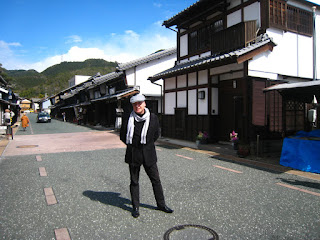
Gifu Prefecture is also appealing in the sense that it preserves traditional Japanese culture such as the nationally-famous Mino washi paper (Japanese Paper) and the streets where traditional houses built in the Edo and Meiji periods still exist as they were. In a corner of Mino City, which once flourished as a key junction of transportation and a shopping district, there are still rows of houses built in the Edo and Meiji periods. In October every year, the city holds a contest called the Mino Washi Akari Art Exhibition, in which artistic lanterns made of Mino washi paper are displayed in the streets of Udatsu. During the contest, visitors can enjoy fantastic scenery.

Gifu was under a warm weather and ravishing orange colored sun when I visited the place thanks to the "Foreign Press Center Japan" http://fpcj.jp/ press tour which always bring the vast Japanese archipelago diversity and realities to my eyes, encountering places and people of Japan. I would have never met this reality should I only have stayed in Tokyo. My last word about Gifu whom I mentioned earlier is about "The Narrow Road to the Deep North". Poet Basho's poem and study in eternity. Well, as I've seen in Gifu prefecture, the region is succeeding in her attempt against the flow of time to keep the place up with trustful renaissance!


A VDO about Gifu Cormorant Fishing

Sources: Foreign Press Center Japan, Gifu prefectural government, Michelin Guide, Unesco , Keidanren, Reporter's notes.