Thursday, June 29, 2006

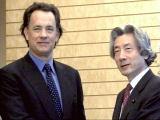
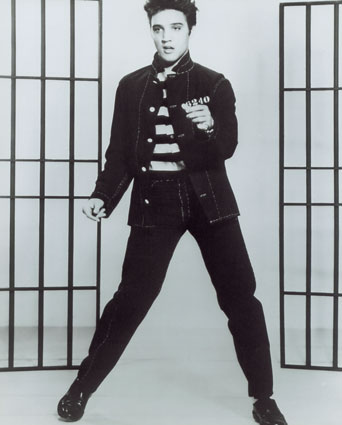
Junichiro Koizumi to the US: " I want you, I need you"


Junichiro Koizumi and President Bush can hang around the
Jungle Room all they want. Japan's prime minister can
even warble another rendition of "I Want You, I Need You,
I Love You," as he did at a birthday party for Bush last
year. But there are some things even presidents and
prime ministers can't do at Elvis Presley's Graceland.
As a guest of the president and first lady Laura Bush,
Koizumi will visit the Presley home on June 30, and
they'll pretty much have the run of the place. Presley's
private bedroom and the adjoining bath where he
collapsed... ...and died in 1977 will remain off-limits,
however. "You can't visit the upstairs at the White
House, either," said Jack Soden, chief executive of Elvis
Presley Enterprises.


Koizumi, a big-time Elvis fan with a suspiciously
Presley-like hairdo, leaves office in September. He and
Bush meet June 29 in Washington, and the Memphis trip is
a farewell gift from the president. For the most part,
Koizumi and the Bushes will see the same Graceland other
visitors see: the shag carpets and ceramic monkeys of the
Jungle Room, which Elvis famously furnished with a
30-minute shopping spree; the glossy black baby grand
piano near the living room's white, 15-footsofa; and
hundreds of gold records, jumpsuits and guitars in
Graceland's museums. Graceland opened in 1982, and each
year, more than 600,000 tourists tromp through its first
floor and basement playrooms and visit Presley's grave
beside the swimming pool. But the home's upstairs is
closed to the public. The tour won't be completely
standard fare, however. It will be led by Presley's only
child and heir, daughter Lisa Marie, and her mother,
Priscilla. Lisa Marie Presley turned over management of
Graceland and sold the rights to her father's name and
image last year to CKX Inc., an entertainment company
that also owns the "American Idol" TV show.


Graceland's new bosses won't be around for the
president's visit because "they didn't want to get in the
way," Soden said. "This is not a photo-op for the prime
minister," he said. "This is truly a heartfelt desire to
tour Graceland, and the president and the first lady want
the prime minister to have that experience."


Bush and Koizumi are the first sitting heads of state to
visit Graceland, but Soden's staff is accustomed to
dealing with high-profile visitors, including foreign
ambassadors, movie stars and rock 'n' rollers paying
homage to Presley. "We're always ready for visitors
great and small," Soden said. "Every hour of every
daywe're fulfilling somebody's dream. They dream of
coming and seeing Graceland and this is their moment. And
that's true for the prime minister." The visit would be
such a moment, too, for many of Koizumi's countrymen.
Presley has been one of Japan's most popular American
entertainers since the 1950s and more than 2,000 Japanese
tourists visited Graceland last year.


The Elvis Presley Fan Club of Tokyo boasts more than
3,000 members, and The Elvis Presley Society of Japan
lists 2,000. Four years ago, Japanese fans quickly
bought all 200,000 copies of a limited-edition Elvis CD
featuring 25 songs selected by Koizumi. Yoko Hika,
president ofa club called C'mon Elvis Fans, said many of
the Japanese faithful are getting old, however, and the
prime minister's Memphis trip may encourage more young
people to give Elvis a try. "I hope the attention from
Koizumi's visit to Graceland makes them curious and want
to listen to his music," Hika said. (Agency)


The Koizumi-Bush chemistry has been very important to
both men and to the strength of U.S.-Japan relations.
Bush and Koizumi are therefore sure to discuss how to
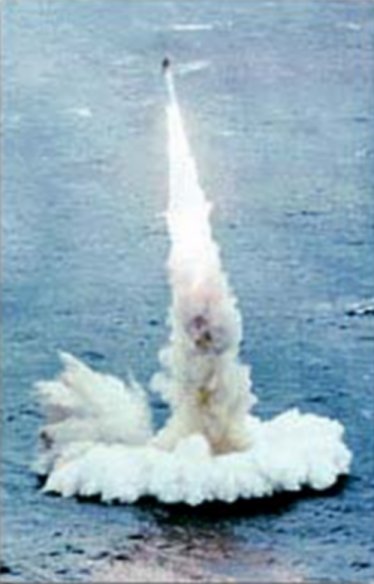
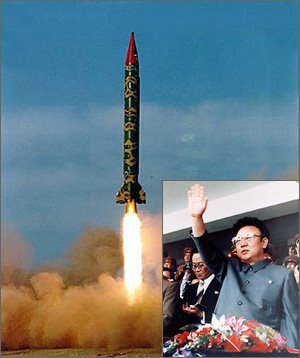
respond if North Korea, which declares that it has
nuclear weapons, tests a long-range missile. Japan is
within range of North Korea's missiles, and its
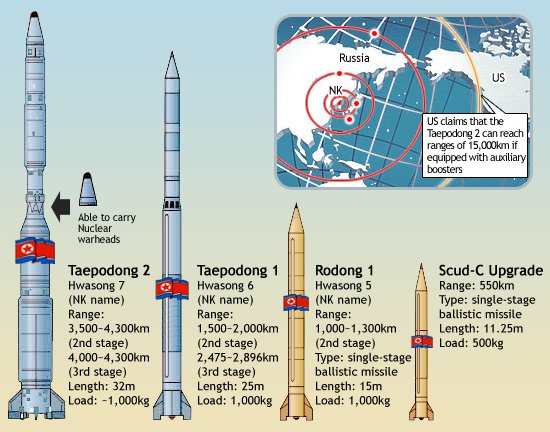
Taepodong-2 missile also is believed to be capable of
reaching parts of the United States. North Korea has
refrained from long-range missile tests since 1999.


A defense official said Wednesday that while some
intelligence analysts believe the North Koreans fueled
the missile last week, others have concluded that they
didn't. U.S. intelligence agencies rely heavily on
satellite images of North Korea, and while they can show
missiles being moved to launch pads and fuel hoses being
connected, they don't show whether any fuel was pumped
through the hoses. The U.S.-Japan alliance has
guaranteed stability in the Asia-Pacific region for
decades, and the two countries want to preserve that
power as China grows. If China can't be contained, and if
China and the United States have to compromise on
everything there are serious reasons to worry about the
future of East Asia.

Tuesday, June 27, 2006

Haste makes waste!


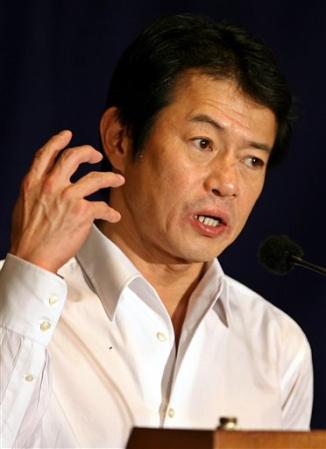
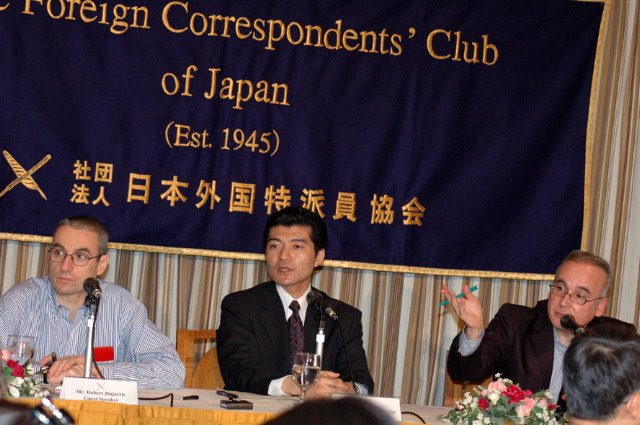
Japan's Agriculture Minister Shoichi Nakagawa spoke to
the press at the Foreign Correspondents' Club of Japan
during his press conference in Tokyo Friday, June 23,
2006. Cabinet Minister Nakagawa, Tokyo University
graduated and long time veteran politicians elected in
Hokkaido, called a U.S. proposal to impose sanctions on
Tokyo if it doesn't resume imports of American beef soon
"nonsense." "The fact that the senators have chosen this
moment to submit the bill I think is nonsense,"
Agriculture Minister Shoichi Nakagawa said. He added
that safety procedures must be properly examined, saying
"haste makes waste." The U.S. Senate is considering
legislation that contains a nonbinding call for trade
sanctions unless the imports are restarted by the end of
the summer.


Japan says it wants to ensure the facilities measure up
to Japanese food-safety guidelines amid fears of mad cow
disease, but some U.S. lawmakers accuse Japan of another
stall tactic after months of negotiations. Japan plans
to send three inspection teams the United States on
Saturday, but Health Ministry official Kenichi Watanabe
would not say what meat-processing facilities would be
their first stops. Each team will consist of three
officials from either the health and agriculture
ministries. The ban, first imposed in 2003 over concerns
that U.S. beef might be infected with mad cow disease,
was lifted at the end of last year. But in January,
Japan again halted imports of American beef after one
shipment was found to contain prohibited parts of cows
believed at risk of the disease.

At stake is a trading relationship that was worth $1.4
billion annually to the U.S. beef industry when Japan
banned American beef in response to the first U.S. case
of mad cow disease in 2003. Nakagawa said he and his
U.S. counterpart, U.S. Agriculture Secretary Mike
Johanns, "both realize there are still issues that must
be addressed" in the inspections. The one-month audit
will tour 35 meat-packing plants to ensure the facilities
comply with Japanese import regulations. Inspectors will
also review procedures at ranches, feedlots and mills.


Mad cow disease is formally known as bovine spongiform
encephalopathy, or BSE. In humans, eating meat
contaminated with BSE is linked to variant
Creutzfeldt-Jakob Disease, a rare and deadly nerve
disease.

A study of an epidemic caused by cannibalism indicates
the human form of mad-cow disease may incubate for more
than 50 years before developing into the fatal illness,
researchers said in a medical journal.

The findings suggest the eventual size of a variant
Creutzfeldt-Jacob disease epidemic may be much bigger
than previously thought, U.K. researchers including John
Collinge of the University College London wrote in this
week's The Lancet.

Bovine Spongiform Encephalopathy, or mad-cow disease, was
first found in the U.K. in 1986. Humans catch the
disease through meat from cattle that have eaten feed
mixed with ground-up parts of infected animals. About
160 U.K. residents have been diagnosed with the disease,
with cases also reported in the U.S. and Japan.


"A human BSE epidemic may be multiphasic,'" Collinge
said in The Lancet. "Recent estimates of the size of
the variant Creutzfeldt-Jacob disease epidemic based on
uniform genetic susceptibility could be substantial
underestimations."

The disease is caused by abnormal prions, a type of
protein that damages the patient's central nervous
system. The prions unfold in the brain, creating vast
dead spots.

The researchers studied kuru, a disease caused by
cannibalism that reached epidemic proportions in some
areas of Papua New Guinea. The cannibalism, which was a
ritual mourning practice, was stopped by Australian
authorities in the 1950s. The researchers identified 11
patients with kuru and found that estimated incubations
periods were as long as 56 years and may have been seven
years longer.

The incubation period for BSE prions in humans may be
even longer because infection between species typically
takes longer than within species, the researchers wrote.
The patients identified so far may "represent a distinct
genetic subpopulation with unusually short incubations
periods for BSE," Collinge said.


A scenery of the Hokkaido landscape, region of Japan
known for its agriculture and its environmental
protection.

Wednesday, June 21, 2006

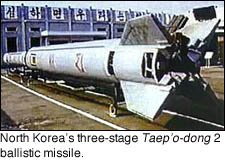
Taepodong 2 : New missile crisis ?


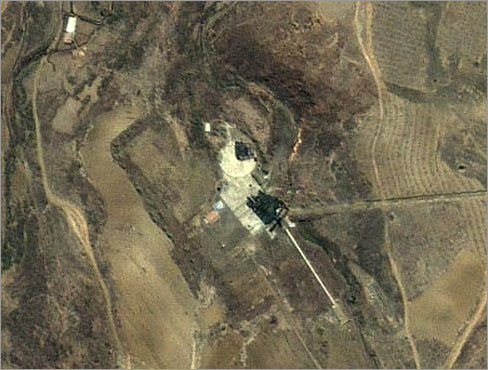
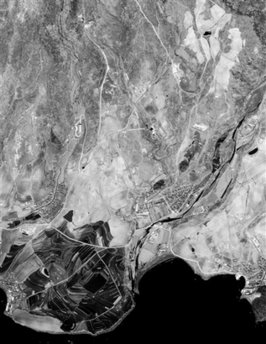
Taepodong missile launch complex in North Korea,
Musudan-ri, image in May 2006.

North Korea declared Tuesday it has a right to carry out
long-range missile tests, despite international calls for
the communist state to refrain from launching a rocket
believed capable of reaching the United States. The
bristling statement from North Korea to Japanese
reporters in Pyongyang came as France and the U.N.
secretary-general raised the alarm over what are believed
to be the reclusive nation's preparations for a test of
the Taepodong-2, with an alleged range of 6.000 km.


The rhetoric could sour hopes that North Korea might
scuttle the test in the face of international criticism.
But it was unclear whether the comments indicated a
willingness to go ahead with the launch, or reflected
North Korea's penchant for threatening bluster as a
bargaining tactic. The international campaign to block
the launch widened Tuesday, with the French government
and U.N. Secretary-General Kofi Annan calling for a halt
to test preparations. "I hope that the leaders of North
Korea will listen to and hear what the world is saying.
We are all worried," said Annan, who was in Paris. He
called for all parties in the standoff to avoid an
escalation of tensions.


Experts believe North Korea is preparing to test launch a
new missile which could reach the United States. In
1998, it test launched an earlier model which flew over
Japan and landed in the Pacific Ocean. North Korea
reportedly rejected Tuesday any outside criticism of its
actions. Valerie Niquet, head of the central Asia
department at the French Institute for International
Relations in Paris, says the international community can
put economic and other pressure on impoverished North
Korea to give up its program. "The possibility of
putting pressure on North Korea is not very high in
military terms - nobody would want to envision the risk
of war for whatever motive. But economic pressure can be
inflicted on North Korea, and it's very effective," he
said. Niquet says it is also essential that Japan be
included in any negotiations with North Korea. Concerns
about North Korea may be raised Wednesday, when U.S. and
European leaders meet in Vienna.


(French M-4 missile, 4000 km range for M-4A and 5000 km
for M-4B) French Prime Minister Dominique de Villepin,
speaking after talks with Annan, said any North Korean
missile test must draw a "firm and just" international
response.


(Eurocopter Tigre France)

Former South Korean President Kim Dae-jung has canceled a
trip to Pyongyang planned for next week because of
tensions over apparent preparations by North Korea for a
ballistic missile test, an official in Seoul said on
Wednesday.


"It is practically impossible for him to visit in late
June because of the unexpected circumstances," South
Korean official Jeong Se-hyun, who was negotiating the
trip. Kim, who orchestrated an unprecedented summit with
North Korean leader Kim Jong-il in 2000, had hoped to use
the meeting to help restart stalled six-country talks on
ending Pyongyang's nuclear programs.

Kim, who was president from 1998 to 2003, won the Nobel
Peace Prize in 2000 for orchestrating the meeting in
Pyongyang. His visit began a rapid warming of ties
between the two Koreas, which are still technically at
war because only a truce was declared at the end of the
1950-53 Korean War. Kim Jong-il has yet to reciprocate
with a visit to the South.

The Bush administration is weighing responses to a
possible North Korean missile test that include
attempting to shoot it down in flight over the Pacific,
according to US defense officials.


China's foreign ministry spokeswoman Jiang Yu dodged
questions concerning North Korea's possible trial of a
new long range ballistic missile on Tuesday.

Jiang made her debut as a Ministry of Foreign Affairs
spokesperson last week and appears not to have a complete
grasp or confidence in articulating the bandwidth of
policy information the PRC is willing to make public at
its twice weekly press briefings. Her answers were
either terse one sentence statements or boilerplate
commentary that did not address the questions being
asked; her responses were usually a combination of both,
contributing to uncertainty at possibly a critical time.

The Chinese foreign ministry spokeswoman said her country
had "heard of reports" about the impeding North Korea
missile test, but repeatedly refused to offer details on
when and where China had first learned about the planned
trial.

Any launch, successful or otherwise, would ratchet up
tensions in the ongoing crisis over North Korea's
ambitions for nuclear weapons. U.S. Secretary of State
Condoleezza Rice warned the test was "a very serious
matter and a provocative act," saying Washington's stance
on the matter was of the "utmost seriousness."


There was an intense flurry of diplomatic activity over
the weekend, with Secretary Rice discussing the
possibility of a North Korean missile launch with her
Japanese and Chinese counterparts, pressuring the PRC in
particular to have its client state put a halt to the
test.

When queried about China's reaction to Rice's comments,
the spokeswoman sidestepped by giving a bland statement
about her government wanting "peace on the Korean
peninsula and working with relevant parties" towards that
end.


The U.S. rebuffed a North Korean offer made in early
June for its chief nuclear negotiator, Christopher Hill,
to visit Pyongyang for discussions. The North insists a
resolution to the nuclear crisis can come about only
through direct talks and a non-aggression pact with
Washington.

The Bush administration continues to support the six
party process -- sponsored by China and involving the
United States, North and South Korea, Japan and Russia --
as the best means to resolve the key multilateral crisis
facing East Asia.

Talks have bogged down since the North has refused to
return to the table after an American crackdown on banks
in Macao dealing with the North Korean government and
companies suspected of laundering drug money and
counterfeiting U.S. currency.

Analysts believe the silence shown by the PRC on the
issue is an effort to downplay reports North Korea has
fueled its Taepodong-2 missile and stands on the
precipice of testing a weapon system that in its most
advanced three stage version would be capable of reaching
most of the United States.


The test would break a moratorium on North Korean missile
tests that has held since 1999. The last test of a
long-range missile, a Taepodong-1, was fired over Japan
in 1998.

Members of the American intelligence community believe
the missile on the launch pad is a two stage version
rocket which has the capability of hitting Alaska.

Some U.S. and Japanese officials believe North Korea is
poised to launch because the Taepodong-2 missile has been
fueled. It has been five weeks since the first satellite
imagery showed launch preparations underway at the
Musudan-ri missile facility in North Hamgyong province in
northeastern North Korea.

Bad weather at the launch site delayed any test of
missile system on Tuesday June 21st.

U.S. experts think that North Korea has sufficient
plutonium for a minimum of six nuclear weapons and is
continuing to beef up its atomic arsenal. Defense
specialists say it is plausible the North might be able
to build a nuclear warhead small enough to be fit on a
missile.

A western diplomat speaking on condition of anonymity
told United Press International the North Koreans "were
putting on a show of brinksmanship and bluster," but did
not think an actual launch would take place for fear of
"alienating the regime's big brother."

Despite recent efforts by South Korea to help its
brethren north of the 38th parallel, North Korea remains
wholly dependent upon China for its security against any
possible U.S. use of force targeting either its nuclear
or missile facilities. The PRC also offers multiple
forms of economic support to keep its communist neighbor
from disintegrating.


When reporters asked what China's response would be if
North Korea conducted its missile test and why her
answers on this urgent issue were so brief, spokeswoman
Jiang retorted by saying she "wouldn't discuss
hypothetical situations" and that "this is a press
briefing, not a symposium."

Because North Korea is secretive about its missile
operations, U.S. officials say they must consider the
possibility that an anticipated test would turn out to be
something else, such as a space launch or even an attack.

Thus, the Pentagon is considering the possibility of
attempting an interception, two defense officials said,
even though it would be unprecedented and is not
considered the likeliest scenario.

The officials agreed to discuss the matter only on
condition of anonymity because of its political
sensitivity.

Pentagon spokesman Bryan Whitman said he could not say
whether the unproven multibillion-dollar U.S.
anti-missile defense system might be used in the event of
a North Korean missile launch. That system, which
includes a handful of missiles that could be fired from
Alaska and California, has had a spotty record in tests.


Although shooting down a North Korean missile is a
possibility, the Pentagon also must consider factors that
would argue against such a response, including the risk
of shooting and missing and of escalating tensions
further with the communist nation.

Even if there were no attempt to shoot down a North
Korean missile, it would be tracked by early warning
satellites and radars, including radars based on ships
near Japan and ground-based radars in Alaska and
California.

Robert Einhorn, a senior adviser at the Center for
Strategic and International Studies, said a U.S.
shootdown of a North Korean missile on a test flight or a
space launch would draw "very strong international
reaction" against the United States. He saw only a small
chance that the U.S. would attempt a shootdown.

Signs of North Korean preparations to launch a long-range
ballistic missile, possibly with sufficient range to
reach U.S. territory, have grown in recent weeks,
although it is unclear whether the missile has been fully
fueled. U.S. officials said Monday the missile was
apparently fully assembled and fueled, but others have
since expressed some uncertainty.

Bush administration officials have urged the North
Koreans publicly and privately not to conduct the missile
test, which would end a moratorium in place since 1999.
That ban was adopted after Japan and other nations
expressed outrage over an August 1998 launch in which a
North Korean missile flew over northern Japan.


At the time of the 1998 launch, the United States had no
means of shooting down a long-range missile in flight.
Since then, the Pentagon has developed a rudimentary
system that it says is capable of defending against a
limited number of missiles in an emergency ? with a North
Korean attack particularly in mind.

The Government Accountability Office, Congress'
investigative arm, says the Pentagon has spent $91
billion on missile defense over the past two decades.

The 1998 event turned out to be a space launch rather
than a missile test; U.S. officials said the satellite
failed to reach orbit.

U.S. and international concern about North Korea's
missile capability is heightened by its claims to have
developed nuclear weapons. It is not known whether they
have mastered the complex art of building a nuclear
warhead small enough to fit a long-range missile,
although in April 2005 the director of the Defense
Intelligence Agency, Vice Adm. Lowell Jacoby, told
Congress that North Korea was capable of arming a missile
with a nuclear warhead. U.S. officials have since
called it a "theoretical capability."

No administration official has publicly raised the
possibility of bombing the North Korean missile before it
can be launched. Jan Lodal, a senior Pentagon policy
official during the Clinton administration, said in an
interview Tuesday that he would not rule out a
preemptive strike. He said it would be the surest away
of eliminating the threat of being surprised by the
launch of a Taepodong-2, an intercontinental ballistic
missile that some believe has enough range to reach U.S.
territory.

David Wright, a senior scientist at the private Union of
Concerned Scientists, said he strongly doubts that the
Bush administration could back up its claims of having
the capability to shoot down a North Korean missile.

"I consider it to be rhetorical posturing," Wright said.
"It currently has no demonstrated capability."

The last time the Pentagon registered a successful test
in intercepting a mock warhead in flight was in October
2002. Since then, there have been three unsuccessful
attempted intercepts, most recently in February 2005.

Rick Lehner, chief spokesman for the Pentagon's Missile
Defense Agency, said the next intercept test is scheduled
for the August-September period, to be followed by
another before the end of the year. Lehner said that
beginning about a year ago, the system has periodically
been placed in "operational status."

Baker Spring, a Heritage Foundation analyst and strong
advocate of U.S. missile defenses, said he believes that
"in theoretical terms" the U.S. system is a capable of
defeating a North Korean missile. And he thinks that if
the North Koreans launched on a flight pattern that
appeared threatening to the United States, the
administration "would be well within its rights" under
international law to shoot down the missile.

The Washington Times reported Tuesday that the Pentagon
has placed its missile defense system in an active status
for potential use.

Officials in France and elsewhere called Tuesday for a
strong response by the international community to any
possible missile test by North Korea. A senior U.S.
official says the possible North Korean missile test is
raising alarm in Asia as well.

(Mirage 2000)

Wednesday, June 14, 2006

Rafale et Typhoon : Comment cibler les marches asiatiques


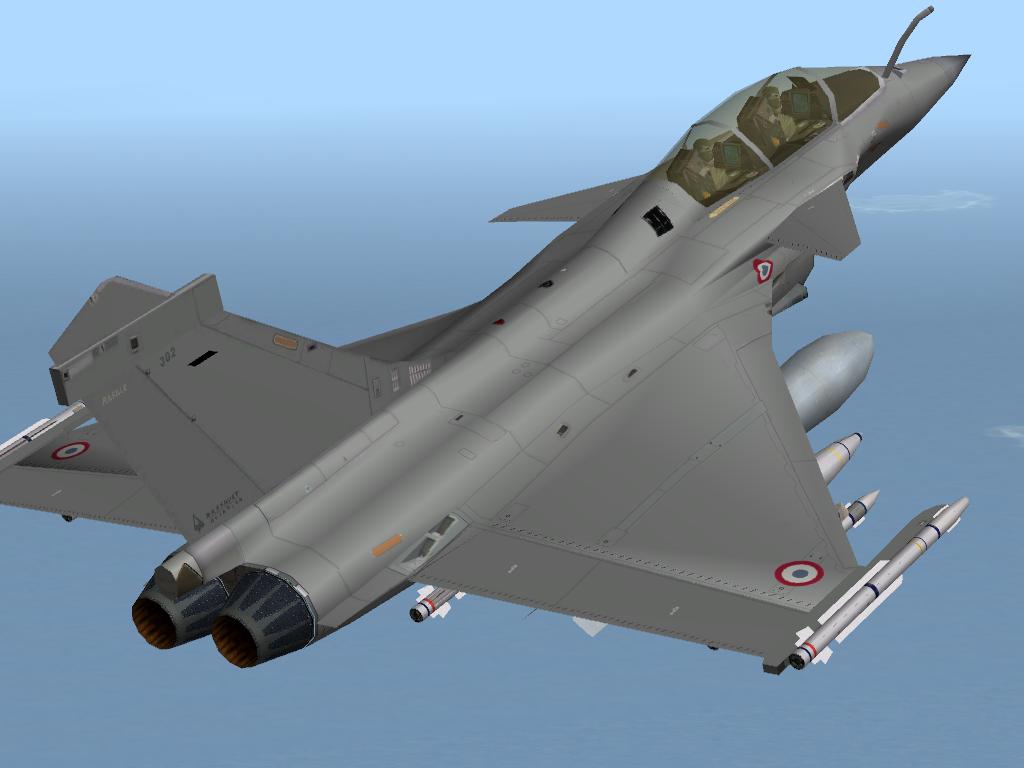
(Rafale)

Rafale et Typhoon, le Sukhoi discounté pose problème :

Rafale et Typhoon, les deux avions de combat fournis par
l'industrie européenne, constituent, à en croire les
experts, les meilleurs compromis possibles en matière de
performances, de technologies et de capacités
d'évolution.

Contrairement à leurs compétiteurs américains, les F-22
et F-35, le choix de la furtivité, plus adapté à l'époque
de la guerre froide qu'à la situation présente ou
imaginable à moyen terme, n'a pas pesé plus que
nécessaire sur la conception des deux avions européens.
Lesquels seraient ainsi parfaitement adaptés aux besoins
actuels et prévisibles.


(Rafale)

Néanmoins, les perspectives des ventes export du Rafale
et du Typhoon s'avèrent aujourd'hui minimalistes.
L'Europe, en matière d'avions de combat, entrevoit
aujourd'hui un paysage paradoxal. Son marché domestique
constitue actuellement le seul au monde à même d'offrir,
dès le lancement d'un programme, des effets de série
comparables à ceux dont bénéficient les produits
d'outre-Atlantique.

Ainsi, ce ne sont pas moins de 992 Tornado qui sont
sortis des chaînes italiennes, allemandes et
britanniques. Et les partenaires du Typhoon ont prévu
d'en acquérir, à eux quatre, pas moins de 620 (dont 392
déjà commandés). Des quantités plus qu'honorables.


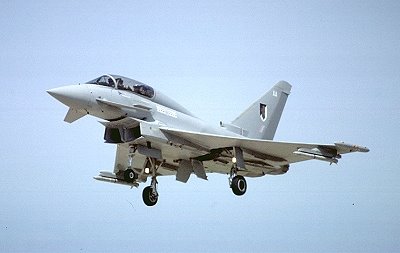
(Typhoon)

Même au regard du marché américain : l'USAF peine en
effet à trouver le budget nécessaire à la commande de 183
F-22 Raptor ! Et pourtant, loin de consolider ce marché
domestique, l'Europe continue à se tourner vers les
produits américains. C'est ainsi que des pays ne
participant pas aux « grands » programmes d'avions de
combat européens ont encore récemment acquis des F-16
tandis que même les nations phares, telles la
Grande-Bretagne et l'Italie, ont intégré le programme
F-35, acceptant de la sorte de basculer au profit de
l'industrie américaine des budgets de R&D qui auraient
probablement pu mieux servir, s'ils avaient été employés
sur d'autres programmes, les intérêts européens.

Mais là n'est pas l'unique paradoxe de cette Europe qui
s'offre le luxe de développer en son sein plusieurs
programmes concurrents dont des systèmes d'armes parmi
les plus évolués au monde... (Sources: Défense)


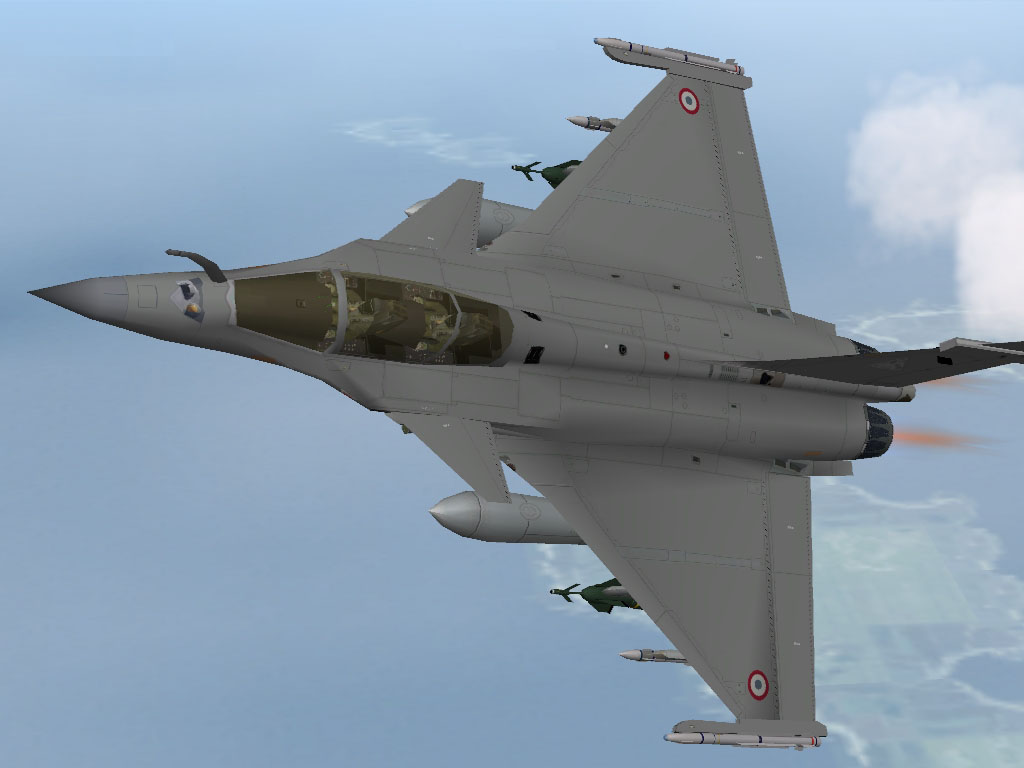
(Rafale B)

Cela dit les marchés potentiels ont évolué, et il n'est
pas sans risques de proposer du matériel militaire
sophistiqué a des pays aux gouvernements déconsidérés
prêts a disparaître au profit du nouveau panarabisme, ce
qui signifie que subsistent 2 marchés désormais :
asiatiques et européens, sans oublier l'Amérique du Nord
(bien qu'assez limité). Mais des problèmes de paiements
existent dans bien des pays, et de sécurité des équipes
de maintenance (2/3 a 3/4 d'un contrat)

Le volet financier n'est pas le critère essentiel des
marchés ciblés, qui disposent de très forts potentiels
technologiques, matériels et humains s'entend. Sur ces
marchés ciblés actuels ne faudra t il pas alors se
défendre devant de nouvelles menaces par le jeu
d'alliances sur les hommes, sur les régimes et le
matériel ?

C'est ainsi qu' intervient le facteur "interoperabilité".
Tout cela ne dénote t il pas que de nouveaux
impérialismes sont décelables dans un futur proche?

A lire (en anglais)

Citations : (Cliquer le titre pour accéder a l'article de
Patrick Cronin du IHT (15 Juin2006)

The return of Japan

"Prime Minister Junichiro Koizumi is preparing to leave
office with a bang. Capping five and a half years of
assertive Japanese leadership - hitherto an oxymoron -
Koizumi's cabinet is proposing legislation that would
create a real defense ministry, and thereby bid farewell
to the existing Japan Defense Agency. After renouncing
the right to wage war as a means of settling disputes
following its defeat in World War II, Japan has been
seeking to gradually become a normal power again. The
rise of China and America's post-9/11 focus on terrorism
and the greater Middle East has provided further impetus
for Japan to put this element of its history behind it."

Ce que j'ai fait observer il y a déjà quelques temps
(années) dans mes reportages dans la presse écrite, sur
les Radios et TV françaises.

./.

Monday, June 12, 2006

Ceinture de Feu : Le réveil des volcans


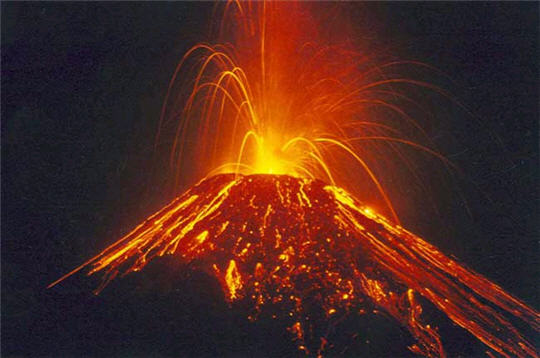
Les tremblements de terre et éruptions volcaniques sont
fréquents en Asie, en particulier en Indonésie et au
Japon, immenses archipels formés de milliers d'îles et
d'îlots, situés sur la "ceinture de feu" du Pacifique.


Le 26 décembre 2004, un tremblement de terre d'une
extrême violence survenu au large d'Aceh avait provoqué
un tsunami, qui avait ravagé les côtes de l'océan Indien,
tuant plus de 220.000 personnes.


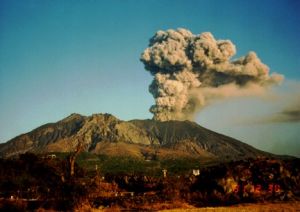
Le volcan japonais Sakurajima, qui avait craché des
nuages de cendres la semaine dernière, présente des
signes de nouvelle éruption. L'Agence a publié un
bulletin spécial faisant état de la forte probabilité
d'une nouvelle éruption volcanique sur l'île de
Sakurajima, dans la préfecture de Kagoshima (sud de
l'Archipel nippon).


Le mont Sakurajima (1.117 m) est considéré comme l'un des
volcans les plus actifs du Japon. Il a une activité
permanente sur le flanc sud depuis un demi-siècle, mais
l'éruption de mercredi dernier était la première sur son
côté oriental depuis soixante ans. Les milliers de
petites éruptions annuelles du Sakurajima en font une des
attractions touristiques favorites de la région.


Les autorités de la grande ville de Kagoshima, située à
quelques kilomètres, organisent régulièrement des
exercices d'évacuation. Depuis 1955, le volcan est entré
en éruption de 100 à 200 fois par an, occasionnant des
nuages de cendres sur l'agglomération de Kagoshima.


D'autres cratères sont récemment entrés en activité au
Japon, parmi lesquels le volcan Oyama, situé sur l'île de
Miyakejima (dans l'archipel d'Izu) à 180 km à l'est de
Tokyo et le Meakandake qui se trouve sur l'île
septentrionale de Hokkaido. L'Archipel japonais se situe
sur un arc volcanique, baptisé "le cercle de feu". En
2000, une forte éruption du Mont Oyama avait provoqué
l'évacuation de tous les habitants de l'île de
Miyakejima.

Friday, June 09, 2006

"Le Japon est un marché précurseur stratégique", pour le luxe!


Louis Vuitton a présenté mercredi 7 juin à Tokyo sa
collection féminine automne-hiver 2006/2007 lors d'un
défilé exceptionnel, le tout premier organisé par le
maroquinier et accessoiriste de luxe français hors de
Paris. "C'est la première fois qu'un tel show est
exporté", a souligné une porte-parole du groupe avant la
présentation, exacte réplique de la collection dévoilée
en mars dernier à Paris.

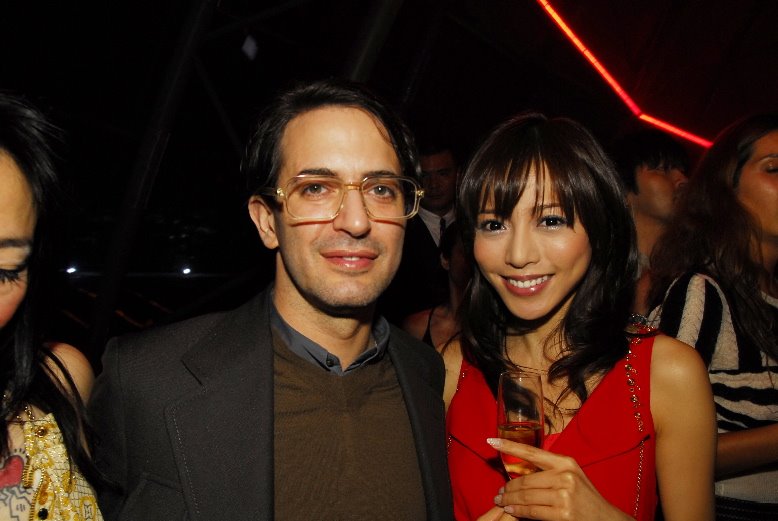
Créé et présenté par le directeur artistique de Louis
Vuitton, Marc Jacobs, ce défilé était organisé sous une
grande tente en forme de dôme spécialement dressée au
milieu du grand parc de Yumenoshima ("l'île de rêve") à
Tokyo.


En fin de soirée, la reine du disco Grace Jones a fait
une apparition "surprise", entraînant le tout Tokyo de la
mode sur la piste de danse.

"Le défilé est un moment vraiment important, celui où
Marc Jacobs catalyse l'énergie du studio de création pour
exprimer son point du vue sur la mode à un instant
donné", a déclaré le PDG du groupe, Yves Carcelle, à
l'issue de cette première.


Une cinquantaine de mannequins --les mêmes qu'à Paris--
ont présenté la collection au rythme d'un mixage techno,
chacune arborant un sac en toile, en vison ou autres
matières assorties à la tenue, devant Bernard Arnault, le
patron de LVMH, et plusieurs centaines d'invités triés
sur le volet.

"Marc Jacobs ne suit pas les tendances, il les invente,
parfois à contre-courant. Il a voulu créer une rupture.
Après le 11 septembre 2001, le monde de la mode était
gris, noir, triste. Il voulait ramener de la gaieté dans
cet univers, de la couleur. Il a choisi un artiste
peintre-illustrateur et designer de renommée
internationale, (le Japonais) Takashi Murakami, avec son
style particulier, son influence manga, pour faire passer
ce message", a raconté M. Carcelle.


"Le défilé est une manière de féconder Louis Vuitton, de
faire avancer le vocabulaire de la maison. A chaque
fois, Marc met au point des thèmes qui parfois
deviendront permanents, comme la toile multicolore créée
avec Murakami", a expliqué le PDG de Louis Vuitton.

"Cette présentation à Tokyo reste toutefois une
exception. Il se peut que ce soit la seule. Nous
n'avons pas envie de faire quatorze défilés dans le
monde. Car cela deviendrait une déclinaison commerciale
de ce qui doit rester un point du vue instantané sur la
mode", a-t-il précisé.

Le Japon est un marché précurseur stratégique pour Louis
Vuitton dont la griffe est particulièrement prisée par
les jeunes nippones, qui s'arrachent les sacs, devenus
objets fétiches, mais aussi par les hommes.

"Nous avons choisi le Japon parce qu'il traverse une
phase de renouveau de la créativité, de l'inventivité, de
la sophistication, du haut-de-gamme. Je pense que ce
pays est le laboratoire de ce qui nous attend ailleurs
dans le monde", a conclu M. Carcelle, qui connaît bien
le Japon, en faisant référence aux innovations
technologiques mais aussi à l'inéluctable vieillissement
de la population.


Louis Vuitton espère se développer encore sur l'archipel,
tant par l'expansion de son réseau que par
l'élargissement de sa gamme de produits, déclarait
récemment le nouveau directeur général de Louis Vuitton
Japon, Kiyotaka Fujii.

Ainsi, la marque au célèbre monogramme dit vouloir
s'adapter aux mutations d'une société japonaise
grisonnante afin de répondre à la demande de produits de
plus en plus sophistiqués.

Louis Vuitton Japon refuse de donner des chiffres précis
quant à ses objectifs de croissance au pays du Soleil
Levant, marché phare pour la marque.


La maison-mère, le groupe LVMH, réalise 14% de ses ventes
au Japon (262 magasins) sur un chiffre d'affaires total
de 13,91 milliards d'euros en 2005.

Saturday, June 03, 2006

" Kuro "


-In Tokyo, journalists think.

" I assume there is a guy at the Japanese ministry of
Finance who can say if yes or no, Chirac had a bank
account in Japan, and there is an other guy who has
access to birth certificate registrations at one
Kuyakusho and who might have heard about the alleged
child of a foreign Chief of State who visited Japan more
than 50 times. " (News coverage and collateral damage of
the Clearstream fake or real Files issue)

-Cela a t il de l'importance ?

"Les exportations françaises en armements dépasseront, en
2006, la barre des quatre milliards d'euros ", a affirmé
lundi la ministre de la Défense, Michèle Alliot-Marie,
devant l'hémicycle, citée par France-Info. " Quoique la
France ait échoué dans la vente de ses chasseurs Rafale à
Singapour, ses chars blindés Leclerc en Arabie séoudite,
et son sous-marin Scorpion au Portugal, elle a été,
pourtant, active sur le marché mondial des armes ", a
expliqué Mme Alliot-Marie aux députés.

./.

A suivre...

Thursday, June 01, 2006

Tokyo Sowa Bank : A legacy of disgrace


Tokyo Sowa Bank : A legacy of disgrace

-Feuilletage (in English)

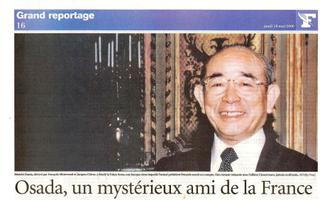
Jacques Chirac was a friend of Shoichi Osada, boss of the
defunct Tokyo Sowa Bank, but he would prefer to forget
him now that the banker has returned to haunt him in the
Clearstream affair. According to a subplot leaking from
France's present political scandal, Chirac was suspected
in the past of holding a well-stocked account at the Sowa
bank. The establishment crashed in 1999, landing Osada
with a suspended jail sentence.

When Figaro needed a picture of the banker for a report
this week, it picked one of him in a handshake with his
friend in the presidential office at the Elysée palace in
1995. Loath to cause offence, the newspaper took Chirac
out of the picture, not just cropping it, but blacking
him out and disguising the Elysée décor. The wheeze was
rumbled by Le Canard Enchaîné, which hardly needed to
remind readers that Figaro is owned by Serge Dassault of
the aircraft and armament firm, a close Chirac ally...

Nicolas Beytout, Figaro's editor, explained to Le Canard,
that the original picture featuring Chirac could have
"misled readers because it did not correspond to the
content of the article." Chirac, an admirer of Japanese
culture who has made dozens of trips to Japan and who
promoted Osada from chevalier to officier de la Légion
d'Honneur, strongly denies ever holding a bank account in
Japan.

-La presse et les blogs sur l'affaire Osada, "l'ami
banquier de Chirac" selon le Canard Enchaine.

"L'ex-PDG de la banque japonaise Tokyo Sowa Bank,
récemment évoquée en marge de l'affaire Clearstream, a
été condamné jeudi 25 mai 2006 à Tokyo à verser à son
ancienne société 18,9 milliards de yens (135 millions
d'euros) correspondant à une fausse augmentation de
capital dans les années 1990. L'ex-banquier et 17 autres
anciens cadres de la Tokyo Sowa Bank, traduits en justice
par les liquidateurs de la banque, ont été condamnés à
rembourser le montant d'opérations illégales réalisées en
1997 et 1998. A l'époque, la TSB, en grande difficulté
et croûlant sous les mauvaises créances, peinait à
remplir son obligation légale consistant à avoir un
coefficient de suffisance de capital supérieur ou égal à
4%. Ce ratio des actifs sur les capitaux mesure la
vigueur financière d'une banque et son risque de
faillite. C'est pourquoi les gouvernements imposent
toujours aux institutions financières de détenir un
capital minimum, équivalant à un certain pourcentage de
leur actif. Souhaitant effectuer une augmentation de
capital pour éviter la banqueroute, mais incapables de
trouver des souscripteurs, les dirigeants de la Tokyo
Sowa Bank avaient fait acheter les nouvelles actions par
des filiales de la banque, au moyen d'argent prêté par la
banque elle-même. Ils avaient par la suite maquillé les
comptes pour camoufler cette opération illégale, a
reconnu le tribunal de Tokyo." (Agences)

Saturday, May 27, 2006

Clearstream, le PIEGE


Seiryu, mon intrépide chasseur de nouvelles, me faisait a
nouveau ses confidences ce soir après une remise de
décoration très sympathique et réussie a l'ambassade de
France, a Tokyo ou cette affaire Clearstream, compte en
banque de Chirac (après tout c'est peut être au gosse
japonais de Chirac ce foutu compte, un président a des
économies devant lui non?) l'histoire des relations
d'affaires avec des mafieux de la finance et des VIP
arrosés commencent a agacer tout le monde tant on
mélange bien des choses. Les faits et les légendes alors
que la réalité est peut être beaucoup plus simple.

Mais c'est cet article d'un hebdo français qui suscite le
plus de questions :

"... D'un côté on voit un juge d'instruction qui
rencontre, a 3 heures du matin, Jean-Louis Gergorin, l'un
des personnages clefs de cette histoire, puis se fait
porter par un avocat de vraies-fausses lettres
anonymes... De l'autre, se profile un général,
conseiller de la ministre de la Défense, qui tente de
suivre, et même d'anticiper, l'instruction du juge Renaud
Van Ruymbeke..."

Alors entre deux sashimis et une bonne bière fraîche,
Seiryu se sent très inspiré et me livre a une terrasse,
devant une jeunesse japonaise insouciante, ses
observations sur ce dossier Clearstream et ses critiques
sur cet article.

"Quand on piège quelqu'un on ne se dévoile pas aussi
facilement. Or actuellement c'est plus haro sur Gergorin
+ Rondot que sur le juge Van R."

-Sa rencontre a 3 heures du matin ?

"Supputant les horaires d'un juge "star" en pleine
instruction et d'un no 2 d'EADS, toujours en visites ou
en conférences, je crois que c'est tout a fait
compréhensible. Entretien sans notes ou sans citation?
C'est mal connaître le droit français et ce que
représente un juge en cours d'instruction; et les langues
se délient souvent sur l'assurance de ne pas être
dévoilées, et ce qu'elles apportent est souvent
essentiel. Avez vous entendu parler des "indics"?

-Rencontres surréalistes?

"Le numéro 2 d'EADS (110.000 personnes - 32 Md d'EUR de
CA / ventes en 2004) vous propose un entretien a 3h00 du
matin: vous n'y allez pas, vous en tant que journaliste?"

-Oui évidemment, et les lettres anonymes?

"Les dénonciations sont souvent anonymes, et si elles
vous sont présentées par le no 2 d'EADS, vous les lisez
au moins 2 fois. Et puis, comment déterminer d'avance le
contenu des lettres sans les recevoir et les lire? Et
puis, le fait qu'elles soient anonymes ou reconnues ne
signifie pas que leur contenu soit inepte, non?"

-Mais que penser des faux listings Clearstream?

"En recevant les listes, le juge les a étudiées et a
déterminé qu'elles lui semblaient fausses.

-Et pour l'interrogatoire de Gergorin?

"Pourquoi tant de précipitation? Ce n'est pas un
feuilleton haletant que font les juges, c'est une
instruction. On convoque pour poser des questions
auxquelles on ne sait pas ou mal répondre.... Il existe
des règles procédurales pour les instructions... que les
juges appliquent. Pourquoi tant d'agressivité vis a vis
d'un système judiciaire, auquel sont destinées toutes les
personnalités corrompues, pour les punir (selon les
journalistes de l'hebdo en question)

-Alors un parfum révolutionnaire "a la lanterne, les
corrompus?"

"Quelle agressivité chez les journalistes français c'est
effrayant, ça, non? Le seul intérêt, c'est le lien
logique proposé avec l'affaire des frégates de Taiwan...
Voila qui donne des éléments moins romantiques mais bien
plus logiques que ceux de naguère."

-Bidon?

"Toutes ces boites ont été des vaches a lait pour la
France, avec Taiwan elles se sont fait de l'argent de
poche. Les commission ce n'est pas illégal. Les dons
non plus. Ce qui est anormal c'est si il y a intention
de nuire ou de corrompre au départ... les fameuses
rétrocommissions".

-Corrompre? Mais... qui?

./.

On nous écrit de la région Parisienne, celle-ci vaut qu'on la cite :
(Je lui confère l'anonymat vu les temps actuels)

Citation :

"To: asiangazette
Subject: Au nom et aux frais de qui ?
Date: Thu, 25 May 2006 14:39:10 +0200

Bonjour Monsieur Legendre,
 
Je viens de découvrir votre blog et je suis heureux de voir que dans le microcosme français de Tokyo il y a des personnes qui maintiennent intacte leur acuité intellectuelle et leur sens critique ; j'ai vécu à Tokyo de 1996 à 2003 et j'ai eu bien souvent l'impression que mes concitoyens expatriés étaient  anesthésiés  par le Japon et ses douceurs fallacieuses.
En voici donc un qui n'est pas un « nippo-béat » !
J'ai longtemps cru que J. Chirac en était un, mais je réalise maintenant que ses liens paradoxaux avec le Japon peuvent avoir un substrat qui n'est pas fait que de fascination intellectuelle.
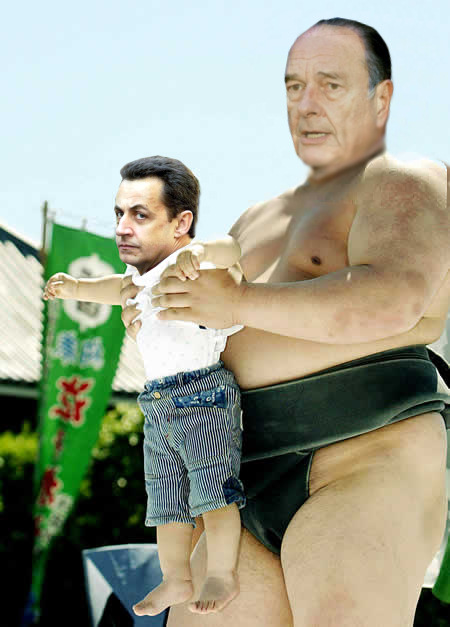
Je voudrais discuter avec vous des tenants et aboutissants d'une manie présidentielle qui certes n?est pas (si on la traduit en chiffres) un bien grand péché, mais qui choque l'individu armé de rigueur républicaine. J'ai eu l?occasion de vérifier de mes propres yeux, en allant à l'arène de Ryôgoku au printemps 2003, que les tournois de sumo de niveau national sont comme on me l'avait dit dotés d'un prix « du président de la république française ».
Cela donne l'occasion d'assister à une scène d'une grande cocasserie lorsque le malheureux Ambassadeur de France doit monter sur le dohyô après avoir ânonné un discours en japonais dont il n'est pas certain qu?il soit l'auteur?
Mais trêve de plaisanteries ; cela pose quelques questions sur les principes :
-       ces prix sont-ils le fait de la personne Chirac ou de Chirac agissant ès qualité ?
-       si c'est de M. Chirac personne privée et admiratrice du sumo qu'il s'agit, pourquoi cette référence à la « république française » et pourquoi la présence de notre honorable ambassadeur sur un podium où (hormis un ambassadeur venu de la péninsule arabique et celui de la république tchèque) on voit plutôt défiler les représentants d'entreprises japonaises aussi obscures que traditionalistes ?
-       si c'est ès qualité qu'il agit, à quelle politique concertée cela se rattache-t-il ? Le sumo est-il à ce point connu et goûté des Français qu'il faille s'en émouvoir et l'englober dans notre politique d'échanges culturels ou sportifs ? Je crois qu'on en est bien loin et que ce faisant Chirac divague...
-       et finalement, sur quelle cassette sont prélevées les dépenses qui permettent cet acte munificent et déplacé ?


./.

A suivre...