Tuesday, February 07, 2006

Biotechnology : wide threats spectrum


"Much broader risks than what is categorized by
government and international organizations",
Asian Gazette sources say. Meaning : Be careful and
check what is in your yoghurt or when you cut your beef
or deer steack.

Why?

Could have a dual use.


(Photo : February 2006. Scientists have found
disease-causing proteins known as prions in the muscle
tissue of deer in 11 states and two Canadian provinces.
This is the first time prions have been found outside
the brain and spinal cord of deer, and the discovery has
raised concerns about human consumption of deer meat.)

I ) Quote from The Sunshine Project News Release - 7
February 2006 :

"US BARDA's Biggest Secret is the Public's Loss:

Are Biodefense Labs and National Security Agencies
Arriving at a Secrecy Agreement?

The biggest casualty of a conflict between scientists
and security agencies may be open research institutions
and the public's right to know about dangerous
experiments with biological weapons agents. With
proposed new secrecy, lab accountability will diminish,
leading to more accidents, less accountability, and a
decline of international confidence in US biodefense
research.

In a proposed law on the Senate floor, a giant new
biodefense "sensitive but unclassified" (SBU) hole would
be torn in the Freedom of Information Act, creating new
secrecy at labs across the country. It is a ham fisted
attempt to resolve conflicts between secretive spies and
cocky scientists who disagree over the risks posed by
research on biological weapons agents.

BIODEFENSE BOOM & SECURITY: Since 2001, scores of US
universities and biotechnology companies have benefited
handsomely from billions of dollars in biodefense cash.
Across the country, biodefense labs are sprouting up
like weeds. The unrelenting spigot of federal money has
put thousands of scientists and technicians in the
business of studying bioweapons agents. Almost all of
them are novices in the field.

Contrary to what some might expect, US national security
agencies have not been altogether pleased with the
defense boom. It has created many new risks in many new
places. A major concern that the agencies have is that
dangerous dual-use technologies (such as
genetically-modified poxviruses) and the skills needed
to create bioweapons will proliferate, thereby
undermining security.

Defense priorities and obsession with secrecy at the
security agencies, however, makes them ill-suited to
intervene in bioscience policy. But, generally for
different reasons than the spies, some public interest
groups are also concerned that the essentially
unregulated biodefense labs are not interested in, or
capable of, adequate self-policing, and that this
problem may lead to a disaster.

BIOSCIENCE FAILS TO ADDRESS ITS PROBLEMS: Yet biodefense
labs have generally responded to the proliferation and
accident concerns with a disinterested yawn and an
outstretched hand (for more money). In sum, their reply
has consisted of little more than inconsequential
verbiage about voluntary codes of conduct and
perfunctory bioethical genuflection.

Rather than stepping forward with serious proposals for
mandatory oversight of dangerous dual-use research,
science has gone on taking the federal money and
pleading "scientific freedom". Stalling, the cash-flush
biodefense labs are hoping that security is just a
passing fad. This is evident, for example, at the
National Science Advisory Board on Biosecurity (NSABB),
a newly-minted but flaccid body that, despite heavy
responsibilities, can't even find enough substance to
make itself look busy for a one day meeting.

SECRET MODUS VIVENDI?: But these radically different
institutions - the spooks and the scientists - may be
moving toward a modus vivendi. Unfortunately, the
secretive "solution" that has been proposed would make
things worse. It is to tear a hole in the Freedom of
Information Act by creating a new exemption for
"sensitive but unclassified" (SBU) biodefense research.
The proposal is found in a bill on the US Senate floor
(S.1873) sponsored by Richard Burr (R-NC), the same bill
that would create a new Biomedical Advanced Research and
Development Agency (BARDA).

The proposed legislation takes a radically wrong tack.
The exemption is so broad that it could make all
substantive aspects of practically every biodefense
project funded by BARDA a secret. According to Sunshine
Project Director Edward Hammond, "Two alpha male
elephants are colliding, and you don't need a microscope
- or a wiretap - to find out who's being squished in the
middle: The public and its right to know are getting
pancaked between these two beasts."

ALTERNATIVE PROPOSAL: It needn't be this way, says the
Sunshine Project. "It's easy to sympathize with Senator
Burr's aim, in the sense that many agree that labs with
bioweapons agents need strong new regulation," says
Hammond, "but this ham fisted proposal is the worst of
both worlds - all secrecy and no openness. It would
create mistrust and reduce accountability, which will
encourage both accidents and poor judgment."

"Instead of punishing the public for offenses by
science," says Hammond, "the Senator should be sticking
a fork in those that are profiting from the biodefense
boom yet refusing to come to terms with their
responsibilities. A 'sensitive but unclassified'
accident is still an accident, just one that nobody
learns from. Disturbing discoveries will still seep
into the public domain. Covering things up would worsen
the problems and could build a false sense of security."
Publishers have rejected 'sensitive but unclassified'
reasoning.

The Sunshine Project is calling for the proposed Freedom
of Information Act exemption to be removed in its
entirety from S.1873. Instead, and for all biodefense
projects, the Congress should make compliance with
federal lab safety guidance a matter of law, rather than
an unenforced suggestion. Congress should also block
the self-interested institutions that take biodefense
cash from overseeing themselves, given their refusal -
and probable inability - to self-regulate.

"Transparency is critical to everyone's safety and
security," says Hammond, "A mountain of SBU or
classified information will do more to obscure emerging
threats than to resolve them. Secrecy will heighten the
chances of a catastrophic lab accident and increase the
possibility of biodefense labs veering off-course into
prohibited areas of research. We need more
accountability, not less."

End of quote from The Sunshine project.


II ) What follows comes from sciences lab. To be taken
cautiously for some of them... Cash needed.
For what exactly, hmmm?

"Because the life-science revolution that began with
deciphering the genetic code has launched biological
research into an unprecedented period of productivity.
Parallel advances in computational techniques and the
widespread use of global computer networks have
contributed to the pace of biological research.

Within less than 30 years, the entire genomes of many
hundreds of organisms, from viruses to bacteria to
humans, have been sequenced, and partial sequences from
many thousands more organisms have been deposited into
databases freely accessible to scientists around the
world. Modern biological research is a thriving
international enterprise with enormous potential to
benefit society. The synergy created by increasing
knowledge and open exchange of ideas and information is
accelerating the advance of medicine, industry, and
agriculture.


Emerging details about the interplay between pathogenic
microorganisms and their hosts will allow scientists to
continue to develop and deliver new and improved
vaccines, stronger infection-fighting drugs, and
more-precise diagnostic tools. However, with its
promise, biological research presents a "dual-use"
dilemma, in that its technologic advances could also be
applied for destructive purposes in acts of bioterrorism
or war. Results that have immediate implications for
pathogen enhancement or weapons development have been
called "contentious research"


Quote : from " Globalization, biosecurity, and the future
of the life sciences" (www.nap.edu)


... "Biomedical advances have made it possible to identify
and manipulate features of living organisms in useful
ways -- leading to improvements in public health,
agriculture, and other areas. The globalization of
scientific and technical expertise also means that many
scientists and other individuals around the world are
generating breakthroughs in the life sciences and
related technologies. However, coordinated global
efforts are needed to reduce the growing risk that new
advances in these areas will be used to make novel
biological weapons or misused by careless groups and
individuals, says a new report from the National
Research Council and Institute of Medicine of the
National Academies. The report recommends
multidisciplinary measures to identify and mitigate such
dangers over the next five to 10 years.


"Our increasingly interdependent global society needs a
broad array of integrated, decisive actions to
successfully anticipate and manage the potential misuse
of biomedical research and the technologies it
generates," said Stanley M. Lemon, director, Institute
for Human Infections and Immunity, University of Texas
Medical Branch, Galveston, and co-chair of the committee
that wrote the report. "The opportunities to inflict
harm are unparalleled."

As a start, the entire scientific community should
broaden its awareness that bioterrorism threats now
include, for example, new approaches for manipulating or
killing a host organism or for producing synthetic
micro-organisms, the report says. "U.S. national
biodefense programs currently focus on a relatively
small number of specific agents or toxins, but gains in
biomedical understanding have raised major concerns
about the next generation of biowarfare agents," said
committee co-chair David A. Relman, associate professor
of medicine and of microbiology and immunology, Stanford
University, Stanford, Calif. "We need to expand our
thinking about the nature of future biological threats,
as well as more fully exploit advances in the life
sciences to create a global public health defense that
is agile and flexible."



An independent advisory body should be established to
analyze and forecast the fast-changing science and
technology landscape in partnership with U.S.
intelligence officials and government leaders -- helping
them to stay abreast of developments in the life
sciences that could be used for both peaceful and
destructive aims, the report says. Although the U.S.
Department of Health and Human Services recently formed
the National Science Advisory Board for Biosecurity to
advise the government on "dual use" biological research
activities, the proposed advisory group would focus
exclusively on analyzing science and technology to
anticipate future biological threats.

The report adds that the national security and
intelligence communities should bring greater scientific
and technical expertise to their decision-making and
other activities in biosecurity-related areas.


Continuing advancement in the life sciences is essential
to thwarting bioterrorism, the report says; vaccine
development, for example, depends on cutting-edge
biomedical research. The open exchange of scientific
data and concepts is the linchpin of these advances, and
the results of fundamental research should remain
unrestricted except when national security requires
classification of the information. U.S. policymakers
also should promote international scientific exchange
and the training of foreign scientists in the United
States. Both measures have contributed to the
productivity of America's scientific enterprise.


Promoting a shared sense of responsibility as well as
ethical behavior throughout the world's scientific
enterprise is important. S&T leaders and practitioners
should develop explicit national and international codes
of ethics and conduct for life scientists, the committee
said. Additionally, decentralized groups of scientists,
government leaders, and other authorities are needed
around the world to collaboratively monitor the
potential misuse of biomedical tools and technologies --
and intervene if necessary.

The committee said that even if fully implemented, its
recommendations would not guarantee that biomedical
advances would be used solely for peaceful purposes.
Therefore, steps should be taken now to strengthen
America's public health infrastructure by improving its
ability to quickly detect biological agents and
recognize disease outbreaks, and respond to emergencies
such as bioterrorist attacks or rapidly spreading
pandemics. In addition, greater coordination of
federal, state, and local public health agencies is
sorely needed." End of quote.



The attacks on September 11, 2001, and the later deadly
anthrax letters have focused increased national and
international attention on the threat of terrorism. On
October 8, 2003, the US National Academies released a
report, Biotechnology Research in an Age of Terrorism
(NRC, 2003a), which examined the dual-use problem in
life-science research. The author committee, chaired by
Gerald Fink of the Whitehead Institute, offered
recommendations on how to confront the potential for
misuse of biological agents and technologies without
unduly limiting progress in the life sciences.

The report proposed modifications of the system of
review of biological experiments and stressed the
importance of addressing research in subjects of concern
early and of educating scientists to be aware of the
risks and benefits associated with their research and
how to balance them responsibly.


The committee recognized the importance of open
communication in scientific research as a fundamental
practice crucial to continued progress despite the fact
that it might make the data accessible to those intent
on misuse. A reliance on self-governance by scientists
and scientific journals to review publications for their
potential national security risks was recommended, and
a number of major journals that publish life-science
research have already committed to implementing such a
review process.

End of quote

... and You have been warned!

Sunday, January 29, 2006

Davos 2006 : China and the World, scenarios to 2025


Listened to a lot of people lately with Davos 2006. My
guess is if there is no proper understanding of how the
meaning of politics, trade, sciences, security and
diplomacy is changing within Asian and African nations
set for the propagation of freedom, we are destined to
once again experience a collision between 19th century
conventional diplomacy and the 21st century new
diplomacy of the European and United States powers.
Bristling with perplexities, actors of the two thorny
questions of states' rights are to be revealed with
China and Asia power triangle versus the other world.
Mind the gap! Not to repeat the mistakes of EU and US

monoliths.

Davos highlights for Asian Gazette :

I ) The China brain-teaser
II ) Asia's Power Triangle

I ) The China brain-teaser

- Can China implement internal reforms to further its
development?

- How will China's relationship with the rest of the
world affect its development and shape the global
context?

Answers :

"Panellists briefed participants on the World Economic
Forum's "China and the World: Scenarios to 2025"
project, a year-old initiative to develop deeper insight
into China's development by analysing scenarios for the
future of the country. Ged Davis, Managing Director,
World Economic Forum, explained that three scenarios
were constructed after consultations with about 150
individuals including businesspeople, academics and
other experts around the world in workshops in Paris,
Beijing, London, Shanghai, Singapore and Washington DC.


The scenarios are as follows:

Regional Ties: In this case, faced with a global
environment marked by growing protectionism, China
increasingly turns to its Asian neighbours for trade and
investment and for support of its reforms and economic
development. Jean-Pierre Lehmann, Professor of
International Political Economy, International Institute
for Management Development (IMD), Switzerland, said that
this scenario is highly "credible" because key
conditions such as the rise of protectionism are
actually playing out. Lacklustre results from the
recent World Trade Organization (WTO) Ministerial
Conference in Hong Kong show that global integration is
stalled and "the multilateral system is eroding",
Lehmann argued. In addition, he added, in response to
China's emergence, "the trend is to emphasize the
threat, not the opportunity."

Unfulfilled Promise: China's struggle to implement tough
reforms leads to economic, social and ecological
disruptions. Global economic integration, while
proceeding, is hampered by security concerns. Linda
Yueh, Fellow in Economics, London School of Economics
and Political Science, United Kingdom, explained that
this negative scenario would arise because of a lack of
institutional reforms. The hope is that, considering
the consequences suggested by this scenario, China would
move forward with the reforms necessary to produce a
more positive outcome.

New Silk Road: China is well on its way to achieving
balanced development, driven by strong and inclusive
global growth, accompanied by deepening economic
integration and increased trade. Financial, legal and
administrative reforms in China lead to the emergence of
a middle class and a modern market system. Wang
Jianmao, Professor of Economics, Academic Director, MBA
Programme, and Director, Case Development Centre, China
Europe International Business School (CEIBS), People's
Republic of China, said that the new five-year-plan that
is to be approved in March will set the conditions for
this scenario to play out. The plan stresses such goals
as "harmony, sustainability and balance". Reform, Wang
said, "will be more proactive, comprehensive and not
piecemeal."


Analysing these scenarios "allows you to reflect on the
ways to prevent them", said Lehmann. Businesspeople
should "understand the likelihood of each scenario and
make contingency plans for each of them," advised Bai
Chong-En, Mansfield Freeman Chair Professor of Economics
and Chairman, Department of Economics, School of
Economics and Management, Tsinghua University, People's
Republic of China. Facilitator Robert Go, Global
Managing Director, Industry Practices, Deloitte, USA,
asked the panellists what one step they would recommend
to enhance the chances of achieving the most positive
scenario, the New Silk Road. Wang reckoned that much of
the onus is on the Chinese government and the quality of
its governance. Yueh identified innovation and
technological progress as essential ingredients to
promoting reform. A positive outcome depends not just
on what goes on in China, but also how the world
responds, Lehmann said. In China, the rule of law is
crucial; the rest of the world should welcome China's
emergence as an opportunity, not a threat.
In a show of hands, participants rated the Regional Ties
scenario as the most likely to play out."


Picture of Governor of the People's Xhou Xiaochuan, right, gestures
while speaking during a plenary entitled 'China Goes
Global' at the World Economic Forum in Davos.


II ) Asia's Power Triangle, an economy for Asia that
"harmonizes economics and happiness"...?

Answers : "Participants challenged the premise that a
"power triangle" is evolving among China, India and
Japan. Kishore Mahbubani, Dean, Lee Kuan Yew School of
Public Policy, Singapore, argued that a "power
quadrangle" would be a more appropriate diagram ? the
US, "the most important actor in the region," must be in
the picture. The paramount relationship is between the
US and China, but it is unclear in which direction it is
heading, Mahbubani added. India, meanwhile, is being
courted "ferociously" by the US, though Delhi is just as
ferociously refusing to be used as a card.

Harry Harding, Director, Research and Analysis, Eurasia
Group, USA, proposed a schematic of three interlocking
triangles: the US-Japan-China, the US-China-India and an
emerging China-Russia-Japan dynamic focused on energy.
Discussing the two established triangles, Harding agreed
that the US-China relationship is the key. If US-China
ties are good, then both triangular connections should
be positive. But if US-China relations are bad, this
would likely result in aligning the US and Japan
together against China. India, on the other had, would
seek to play the pivotal position of balancing the US
and China.


Japan's real intensions are always hard to discern,
Mahbubani reckoned. Its dispute with China in recent
months, triggered by visits by the Japanese Prime
Minister to a shrine to war dead, suggests that Tokyo
feels that its secure relationship with the US allows it
to take some risks in its relationship with Beijing, he
explained. Still, Japan has clearly deepened its
relationship with China significantly, Makio Miyagawa,
Director, Japan Institute of International Affairs
(JIIA), asserted. Japan is hedging this big bet by
strengthening its ties with South-East Asia, Kenneth G.
Lieberthal, Professor of Business Administration,
University of Michigan, USA, added. Tokyo is also
boosting its relations with India

According to Lieberthal, Asia has become an integrated
manufacturing platform, with China as the final assembly
point for products that are exported to the US and
Europe. Components for these goods are sourced from
across the region. Lieberthal pointed out that, while
India's trade with China is growing rapidly, though from
a very low base, India is focusing on deepening its
economic ties with ASEAN. Yet ASEAN has already gone to
China, which has a trade deficit with most of the
South-East Asian countries. Many ASEAN countries invest
much more in China than China invests in them. "There
is a system that has already gelled in Asia that India
is coming into but is not yet a part of," Lieberthal
observed. India's approach to East Asia suggests "there
is growing convergence in Asia," Miyagawa concluded.

It should be understood that modern diplomacy is not a
zero-sum game, Mahbubani maintained. China has been
purposefully sharing its prosperity with its neighbours,
proposing free trade arrangements. Yuan Ming, Director,
Institute of American Studies and Vice-Dean, School of
International Studies, Peking University, People's
Republic of China, agreed. She noted that, despite
recent sourness in their relationship, China and Japan
have continued to cooperate on major issues such as the
environment.


But does growing economic integration means that
conflict is becoming less and less possible? Harding
warned that some relations in Asia are "particularly
neuralgic". China and Japan share culture and values,
but also have a history of conflict and hostility. The
need for energy security could also cause severe strains
between India and China and between Japan and China.


Responding to a question from the floor, Lieberthal said
that the US should do a better job of coordinating the
management of its bilateral ties with China and Japan
since the US is a key factor in the dynamic between the
two countries. Participants agreed that the crisis over
Iran's nuclear programme is likely to test US relations
with China and India. Mahbubani underscored that all
the countries in Asia value the American presence in the
region as a stabilizing force. Nobody is calling for
the US to withdraw.

During the session, No-rio Yamanoi, Editorial
Cartoonist, Japan, presented a drawing that promoted a
"Buddhist economy" for Asia, one that "harmonizes
economics and happiness".


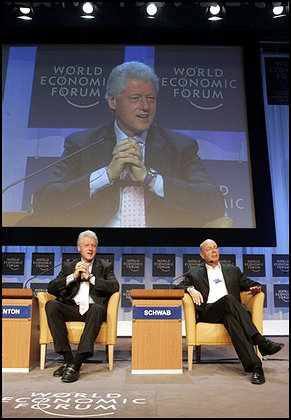
Former U.S. President Bill Clinton, left, speaks during
a special address at the World Economic Forum in Davos,
Switzerland, Saturday Jan. 28, 2006. The World
Economic Forum turned its eye toward politics and the
Middle East Saturday, with visitors and leaders focusing
on Iran's push to develop nuclear power and creating
calm in neighboring Iraq. Seated right is Founder and
Executive Chairman of the WEF Klaus Schwab.


Kunio Nakamura, President, Matsushita Electric
Industrial Co., Ltd., Japan. CEO Nakamura is the man of
the World Economic Forum on East Asia,

Theme? Creating a New Agenda for Asian Integration
Where ? In Tokyo
When ? 15 and 16 June 2006.

The rapid growth of China and India is changing mindsets
and not just trade and investment flows. Some believe
robust intra-Asian trade will eventually offset the
region?s exposure to economic cycles in the United
States. Others see looming challenges linked to
demography and to tensions rooted in history that pose
threats to future growth and stability.

Japan and China face rapidly ageing populations while
India and Indonesia must create jobs for growing numbers
of young workers, mainly from rural areas. Business
must now contend not only with the scarcity of highly
skilled workers but also with the dangers of income
disparities in growing markets. It is clear that Asia
is entering into an era of fresh opportunities and
emerging risks, and requires strategies that anticipate
the region?s evolving agenda.

"It is in this strategic context that a select group of
global leaders will gather at the World Economic Forum
on East Asia to shape the region?s industry, political
and economic agendas. The industry agenda will focus on
the growing convergence, consolidation and competition
across critical regional sectors such as ITC and
finance. The political agenda will highlight the
urgency to deepen regional cooperation in new areas
linked to Asia?s growing demand for energy and raw
materials. It will also focus on building stronger
trilateral relations among China, Japan and Korea,
integrating India further into East Asia and improving
the competitiveness of ASEAN economies."

Thursday, January 26, 2006

Asian passions, a great deal of what reality is


A remarkable article of Pierre Hassner " The revenge of
passions". One of the the most brilliant analysis read.
Published in Commentaire, Summer 2005, the Academic
review created in 1978 by Pr. Raymond Aron, supervised
today by Pr. Jean-Claude Casanova, Membre de l Institut
de France; Professor of Economics, Institute of
Political Studies, Paris.

Application of passion in East Asia, Japan and beyond,
nations enriched with the dialectic (argument) of pride,
fear and greed, or passion? Pierre Hassner has this to
say quoting Hobbes on the indefinite and always
dissatisfied eager hunt for power.

Quote :

"... the central and decisive moment is the
confrontation of the two rival passions, pride and
search of glory (vainglory), with the fear or with the
search of the security. The first drives to war, the
second leads to peace."


I recommend the acquisition of this article, from
Commentaire. It values the debate on the Taiwan China
Japan approach. Positively. The observation of
Schiller on the State (l'Etat) also caught attention of
numerous policy makers at that time.

Intellectual Emmanuel Dubois expressed on the
astonishing NBR forum these excellent ideas on the
passion today inherited to the international political
scene on Asia Land with reference to Pierre Hassner's
philosophy to an australian narrow bandwith non
indigenous scholar, and nevertheless admirable, Dr.
Robyn Lim.


Quote :
"It is not enough to call yourself a realist to grasp
something of the real world. The real world is also
made of fantasies as you call them, and unfortunately
those fantasies happen to shape the policy of many
governements, not only leninist ones. When France, for
example, helped a racist regime in Rwanda at the
beginning of the 90's, it was not for strategic reasons,
but rather because of misplaced pride (the defense of
the influence of French language in Central Africa,
basically).


To deny the role of passions in International Relations
is to deny a great deal of what reality is made of.
Today more than ever, reality is shaped by human
passions. And, as Joel Legendre observed, this is
particularly relevant to what is going on in East Asia.
Would the "Taiwan issue " be as sensible as it is today
if there were no "identity politics", in Taiwan and
elsewhere?The degradation of Sino-Japanese relations is
not a consequence of a rational behavior from both side.
Or is it?


What I was referring to when I talked about the
"normative dimension" of the concept of interest was not
to "constructivism" but more modestly to the thought of
Montesquieu ("And it is fortunate for men to be in a
situation in which, though their passions may prompt
them to be wicked, they have nevertheless an interest in
not being so", L'Esprit des Lois) ) and Adam Smith.


Every students of history of ideas would know that the
concept of interest was a tool in the 17th and 18th
centuries to oppose the reign of passions (Please refer
to Albert Hirschman, even though he is not really a
French marxist, and to his masterpiece "The Passions and
The Interests, Political Arguments for Capitalism before
its Triumph").


By the way, I don't know much about "constructivism" but
I do know that it is quite strange to evaluate the
relevancy of a scientific theory to its audience in the
general public. Do you mean that democracy is a panacea
to evaluate the scientificity of a given theory?


I am not sure about the scientificity of this criterion
itself. Since, according to you, interests can be both
enlightened and not, I suggest for the sake of the
debate that you specify when they are and when they are
not."

Wednesday, January 25, 2006

The Nail Geek


A cabal ? A Geek story or a big thrill for Investments
Funds in Japan from now on thanks to the eternal rivalry
between bureaucracy and advocates of engineering
financial new products in an archipelago where
entrepreneurs better wear dark suits and not drive a
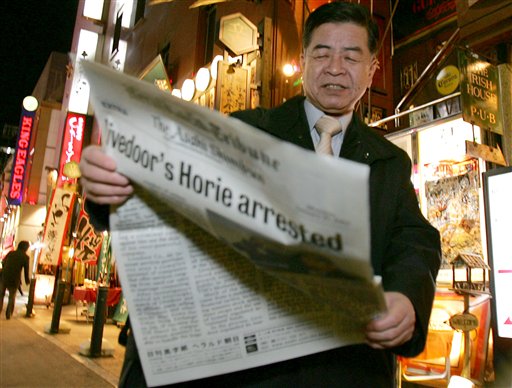
Ferrari ! "Takafumi Horie, 33 arrested late Monday on
suspicion of securities laws violations in spreading
false information about subsidiaries, covering up losses
and inflating stock prices ran one of this nation's most
popular blogs, or Internet journals. Blogging has grown
rapidly in Japan in recent years, especially among
caber-savvy young people whom Horie especially
attracted. After prosecutors raided his office and home
Jan. 16, Horie used his blog inundated with comments.


Bloggers alternately expressed adoration as well as
sympathy. Notes left on the site repeatedly asked
whether Horie was being punished as in the classic
Japanese proverb, "The nail that sticks out gets
hammered in," as is often the case in this conformist
society or if he was merely getting what he deserved.
"You've got to be kidding," wrote one angry blogger.
"Give me back all the money I invested, placing such
hope in you. I hate you and will never forgive you."
"Keep fighting," said another one, with red heart
marks."

Founded in 1997, Livedoor Co. offered software
downloads, ran consulting and finance units, and
branched out into other areas, such as used car sales
and electronic shopping. It rose from a tiny startup to
a high-profile company by gobbling up other companies.
Livedoor also attracted an unusually large number of
individual investors because of Horie's flamboyant
visibility. Blunt and defiant, Horie was a frequent
guest on TV shows and won both fans and notoriety for
trying to buy out a baseball team two years ago and take
over the major media conglomerate Fuji Television
Network Inc. last year. Both efforts failed, as did
his bid to run for office in lower house elections last
year. But many came to view him as the face for a new
generation of business leaders in Japan.


Even after his arrest, it was clear Horie had won some
people's hearts. Prime Minister Junichiro Koizumi on
Tuesday acknowledged his responsibility for supporting
the candidacy of arrested former Livedoor Co. President
Takafumi Horie in the general election last fall. "I
would humbly accept responsibility" if a political party
is to take the blame for backing a candidate who has
been later found to have violated law, Koizumi, leader
of the ruling Liberal Democratic Party, told reporters
at his official residence. But he tried to win
understanding over the difficulty of scrutinizing a
person before deciding to give support in elections. "It
is difficult to check every aspect of a person," Koizumi
said. Koizumi also said the arrest of Horie over
alleged security fraud should be dealt with separately
from his own drive to promote deregulation in the
Japanese economic sector.

The prime minister was apparently referring to
accusations that his structural reform policy has
produced persons like Horie who are said to give the
highest priority to money earned due to removals of
rules and regulations. Koizumi said the government
plans to ask a panel of experts to consider revisions to
Japan's securities-related rules including giving a
stronger authority to the Securities and Exchange
Surveillance Commission. In a press conference earlier
Tuesday, LDP Secretary General Tsutomu Takebe apologized
for having supported Horie in campaigning for the House
of Representatives election but added it was his
personal move. "I supported (Horie) on my own judgment,
without consulting with Prime Minister Koizumi," Takebe
said. "I personally think I should reflect on what I
should do."


Takebe reiterated that the party did not officially
endorse Horie as its candidate because Horie refused to
resign as president of the Internet service firm. As a
result, Horie, who accepted Koizumi's request to vie in
the contest, ran as a pro-LDP independent. Takebe and
other LDP leaders nevertheless gave him pep talks in a
stumping tour in his constituency in Hiroshima
Prefecture, saying, "Mr. Horie is my younger brother or
my son." He challenged old fox Kamei Shizuka, conservative
and ex policeman.


In a meeting Tuesday afternoon of the LDP's
decision-making General Council, Koichi Kato, a former
LDP secretary general, accused Takebe of having
attempted to "invite a person who behaves as if money is
everything." Koizumi, Takebe and other key LDP figures
had until Tuesday refused to take any blame for their
election behavior despite an argument by the main
opposition Democratic Party of Japan that Koizumi as
party head should take "moral responsibility."

In a separate news conference Tuesday, Internal Affairs
and Communications Minister Heizo Takenaka dismissed the
DPJ argument that his and his colleagues' pep talks were
tantamount to government guarantees of Horie. But
voices regretting the behavior rose Tuesday even among
Cabinet members and inside the LDP as the scandal
developed Monday night into the arrest of Horie and
other Livedoor group executives. Yoshitaka Murata,
chief deputy chairman of the LDP's Diet Affairs
Committee, said in a press conference that the party
will have to learn a lesson by reviewing whether it had
supported Horie's campaign based on "careful
discussions."


Agriculture, Forestry and Fisheries Minister Shoichi
Nakagawa said, "I think it was not good as things turned
out," and Health, Labor and Welfare Minister Jiro
Kawasaki said not only politicians but also the media
have to feel responsible for "overrating" Horie. The
LDP, meanwhile, decided to discuss ways to reinforce the
Securities and Exchange Surveillance Commission and
revise the Securities and Exchange Law to prevent a
recurrence of similar frauds. Financial Services
Minister Kaoru Yosano said his agency will consider
increasing the number of employees in the SESC to boost
its monitoring capability, while ruling out making the
securities watchdog independent from the Financial
Services Agency.

Saturday, January 21, 2006

BSE : US cattle at risk, Japan to halt American beef imports


Japan will halt imports of beef from the United States
following the discovery Friday January 20th of a cattle
part considered at high risk of transmitting bovine
spongiform encephalopathy (BSE), decision from
Agriculture minister Shoichi Nakagawa and immediately
endorsed by Prime Minister Junichiro Koizumi.

Japan last night re-imposed a ban on all US beef imports
after discovering a spinal cord in meat imported from a
US farm at Narita airport, near Tokyo. The ban, which
will be a huge blow to US meat producers, comes just a
month after Japan began to re-import US meat following a
two-year import prohibition. US agriculture secretary
Mike Johanns acknowledged yesterday that the US had
breached an agreement with Japan to export beef with no
such animal parts. "We take this matter very seriously
and we are conducting a thorough investigation,"

Concerned is the Atlantic Veal and Lamb, the New
York-based company that shipped the meat to Japan,
Johanns said: " We regret that there was a
misinterpretation of the export requirements and an
honest mistake involving a very small amount of product
that has led to this degree of concern."

The original Japanese ban was imposed in 2003 after the
discovery of a cow on a farm in Washington state
infected with bovine spongiform encephalopathy (BSE), or
"mad cow disease", a wasting disease that can be fatal
in humans.

The ban, which was characterized as unscientific and
protectionist by some US congressmen, cost US farmers
nearly $3bn (Euro 2.5bn). Before it was imposed,
the US was the biggest exporter of beef to Japan but
Australian producers have moved in aggressively during
the past two years.

Junichiro Koizumi, Japan's prime minister, said he
backed the decision by Shoichi Nakagawa, agriculture
minister, to stop all beef imports until the US
satisfactorily explained how potentially dangerous
material had slipped through its safety checks.

The decision comes hot on the heels of Tokyo's move in
December to lift a two-year ban on U.S. beef imports.
The ban was imposed in December 2003 following the
discovery of BSE in the United States. Ministry
officials said spinal column parts were found in three
of 41 boxes of U.S. beef that arrived at Narita
Airport. "If it is indeed a risky portion, it is
against the import program and quite regrettable,"
Nakagawa told reporters.


Nakagawa said his ministry will conduct a thorough
investigation and will lodge a complaint with Washington
if the suspicious portion does indeed turn out to be
from a risky animal part.

Removing high-risk parts, such as the brain, spinal cord
and spinal column, was one of the conditions for Japan
agreeing to a resumption of beef imports. The United
States generally removes risky portions from cattle aged
30 months or older. But Japan's condition for resuming
imports was to remove those parts from cattle of all
ages. Imports have also been limited to meat from
cattle aged 20 months or younger, which is less likely
to be infected.

Nakagawa called Prime Minister Junichiro Koizumi on
Friday to inform him that the ministry plans to halt all
U.S. beef imports. Koizumi agreed, and instructed
Nakagawa to consult the health ministry and to take
"appropriate measures."

But criticism is bound to be directed at the government
for resuming imports in the first place amid continued
consumer massive anxiety over BSE and CJD lethal
disease. To ease concerns, the government has sent
animal and food hygiene experts to the United States to
make sure Japan's conditions are being observed at U.S.
ranches and meat processing facilities.


Wu Yi Member of the Political Bureau of the CPC Central
Committee, vice premier and Agriculture minister (Ex
METI minister) Shoichi Nakagawa of Japan. China has
slaughtered nearly 200 cows and more than 100 sheep to
contain two foot-and-mouth disease outbreaks among
livestock this month, state media reported.

Nonlethal weapons?

Two experts in prion-related fields, Dr. Colm Kelleher,
biotech research scientist, and clinician Dr.
Christopher Green, former CIA forensic pathologist now
conducts brain-scan research at a leading university
medical school expressed the conclusion in a 2003 report
that :


Dr. Colm Kelleher:
Quote : "Because of the sometimes quick, sometimes
delayed time factor involved in prion diseases like CJD,
and the knowledge that they are always fatal, tallies of
the number already dead are meaningless compared to
those who are infected but don?t yet know it. If the
U.S. Government admits to 4.5-million Americans
diagnosed with Alzheimer?s (of whom a large percentage
probably actually have CJD), there could well be fifty
million Americans who are prion-infected. If as many as
fifty million Americans are terminally infected, plus
millions more in Canada and the UK, millions more in
Europe and Asia, we are looking at massive upheaval. As
Britain discovered to its chagrin, lying, deceit, and
disinformation ultimately fail. Denial is not an option
with prions, any more than it is with global warming. We
will look at the potential scenarios. What if the beef
and diary industries collapse, agriculture goes down
with it, the stock market goes into free-fall, the
government is seen to have carried out a
half-century-long program of deceit, and onequarter of
the U.S. population goes insane and dies?"

Link: http://www.colmkelleher.com/

- Christopher Green, M.D., Ph.D. Fellow, Neuroimaging
Harper University Hospital, Wayne State School of
Medicine "Dr. Kelleher uses forensic medicine to
explore one of the most complicated medical enigmas of
the past 100 years and wrests from it some frightening
conclusions. A remarkable and very important book."

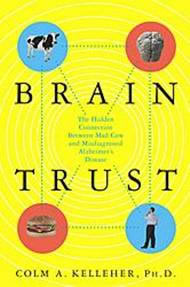
Brain Trust : The Hidden Connection Between Mad Cow and
Misdiagnosed Alzheimer's Disease (Hardcover) by Colm A.
Kelleher

Link: http://tinylink.com/?Jy4tZTEN9a

Saturday, December 03, 2005

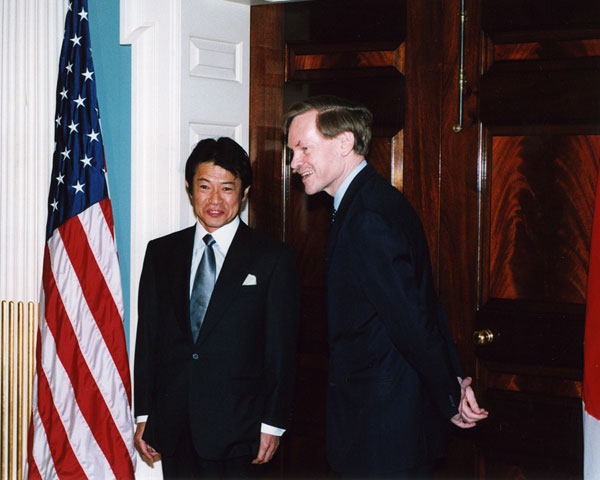
Koizumi Gekijo


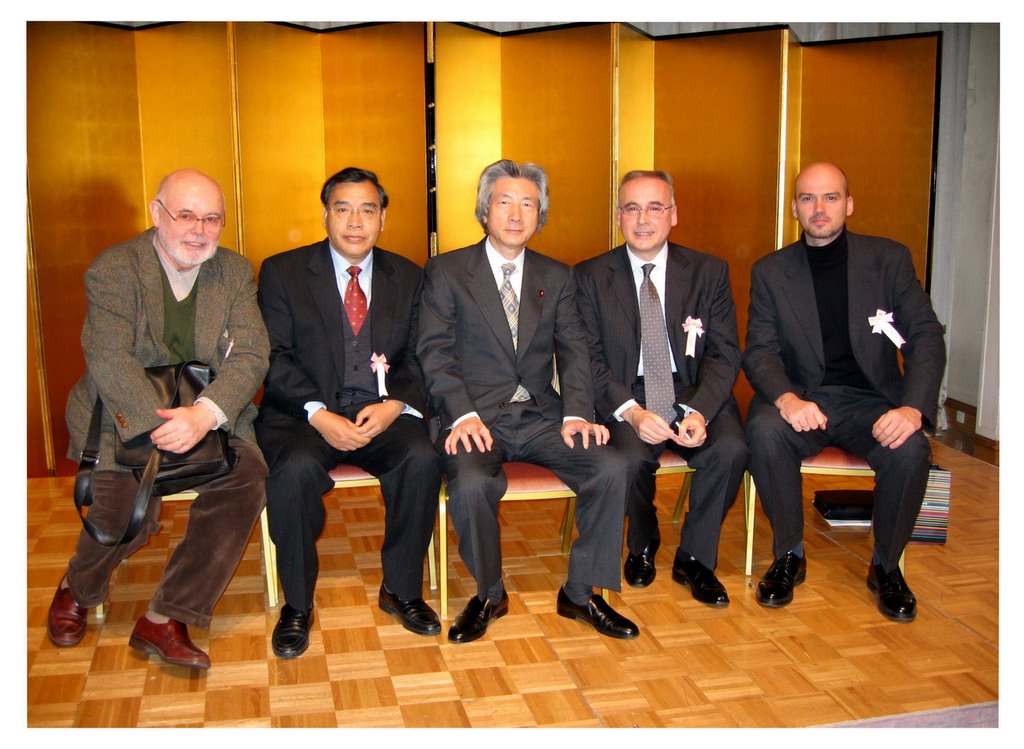
On this photo, the Prime Minister with a few Tokyo based
foreign correspondents including the author of this blog.
Junichiro Koizumi remains a fascinating enigma for the
world media and for Japan s watchers.

Prime Minister Junichiro Koizumi s authority, as LDP
leader and Prime Minister of what Keidanren calls " a
reborn Japan", has been strengthened by september 11th,
2005 election result. His term of office as party
president only has twelve months to run : In the run-up
to the election, there are some in the LDP ruling party
who want to see his term extended following his victory.

This was perhaps the first Japanese election fought on
the basis of policy rather than personality. Both major
parties had detailed manifestos covering most
significant political issues.

Nonetheless, Koizumi and the LDP focused on a single
issue, and Koizumi s personality was at the forefront of
electoral choice of Japanese populace.

The LDP had a program of 120 promises, but they were all
single sentences, most were vague and two key issues
namely Japan s bid to become a permanent member of the
UN Security Council and increasing consumption tax were
not mentioned.

Relations with Japan s neighbors are unlikely to change :

The LDP program (manifesto) promised to improve and
strengthen relations with South Korea and China and
cooperate to facilitate Asian unity.

However, Koizumi may interpret his election victory as
endorsement for his periodic visits to the Yasukuni
shrine, which arouse hostility in China and Korea.


China s ambassador to Japan Wang Yi, told the foreign
press November 24th in Tokyo that Koizumi s visit to the
Tokyo war shrine was like "pouring salt into an open
wound" and said a Japan-China summit should take place
but "political obstacles" must first be overcome. "When
it comes to Japan s top leader paying respects at a
place where Class - A war criminals are enshrined, this
revives the bitter memories of those who suffered during
the war. It is like pouring salt into an open wound.
When the top leader does this, the people of China, the
biggest victim of the war, find this difficult to
overlook." Wang said, speaking in Japanese.


Washington, which has worked out closer security ties
with Japan in part to counter China s growing influence
in the region, will be pleased with the scale of Koizumi
s victory.

Koizumi can now claim to be the leader of a 'new' LDP,
in which his authority will be difficult to challenge at
a time when LDP ruled without nearly no interruption for
the last 50 years since 1955.

However, in the longer term, the LDP party s ability to
capitalize on the dramatic improvement in its political
fortunes will depend on who it chooses next year, in
2006, to succeed Koizumi or if Koizumi chooses to remain
the Prime Minister to deliver further more his reforms
not yet deeply rooted in the archipelago.

Much remains to achieve, indeed, and most Japanese
politics analysts wonder who else could transform Japan
and project the nation on the path of a stronger world
democracy and... appreciated as such a democracy.

Thursday, September 22, 2005

Vote shows Japan needs a stronger democracy

Quote : Asahi Shimbun

" ... One key is to understand the motives of voters.
Most have fears for the future..."

Click on the title to access the commentary

Sunday, August 28, 2005

Warrior's Tale in the Land of Harmony


"Warrior's Tale in the Land of Harmony"

[This is a tale initiated by a Japan watcher, historian and
consultant, Asian Gazette does not endorse neither reject
the words used in this invention]

A Cenacle of old men, rich and thick, consider that
Japanese prime minister transmutes into an embarrassment
to Japan Inc. Their meeting in spring 2005 is crucial
as they adjudicate that it is time to obliterate Lion
Heart quietly off the sophisticated rulers exchequer.

Koizumi misanthropy towards plenteous postmen who did
not service him at his prior electoral attempts turns
sour and emotional. Here comes the prey for Koizumi
hates the unwilling to pay heed to his crusade.

Back to the future, in 1993 and 1995 daze. Japan LDP
manipulated the Socialists to apologize to the noisy
world on WWII and kicked off reforms to clean up the
financial bad habits. Soon the belligerent Gung Ho is
named Ryutaro Hashimoto.

2005, like in a feudalistic Japan where things do not
have to change too much as the old boys said, it is time
to clean up the politics in Japan. China and Russia are
two big Devils. US hand is fallible these days. Koizumi
thinks that he is capable of survival and win the power
struggle in his LDP Sengoku era. "No change, I can't
change".

The wise men cast a gloom on his endeavor. One tool is
to use the Jean Baudrillard's theory on Integral
Reality: "Everything is technically conceivable and
attainable."

9.11 HOR elections. Koizumi's clan let go . One more
political realignment with harbingers, precursors,
heralds and their Shin - to wrack old resistance.

Late 2005 early 2006, Koizumi finally out. Exit Abe
Shinzo. Next swerve within the decade, gets nurtured
and goes breeding.

Denouement with a refurbished ambiance for Japan Inc.
XXI Century, instrumental to Uncle Sam. New carriage
set for Fukuda inscribed with new cool breezed apparel
for months thanks be to the Mori factory.

End of Chapter I


Atsumori

The Atsumori story is drawn from The Tale of the Heike,
an epic narrative about the late 12th century clan wars
between the Minamoto (the Genji clan) and the Taira or
the Heike. If our knowledge of precious little prince
Genji s romantic escapades is any indication, his clan
ought to lose the war, but it is the Genji who wins the
day against the Heike (1185), and of course, at the end
of the war, all the Heike chieftains kill themselves or
are killed.

The incident referred to in the play Atsumori describes
how Lord Atsumori of the Heike was executed by Kumagai,
a decent Genji warrior, whose sense of guilt about
executing a kid his son s age turns him toward
contemplative life. In the play, Kumagai, now named the
Monk Rensei, returns to Ichinotani to pray for Lord
Atsumori s soul. On the way he has an encounter with
young reapers, and later, with the ghost of Lord
Atsumori himself, both of them still unable to free
themselves from a mortal s obsessions of victory and
defeat. In the play, the two warriors, one dead and the
other who has actively renounced the world, find
reconciliation and their lives move toward
enlightenment.

Characters :

- THE PRIEST RENSEI (formerly the warrior Kumagai).
- A YOUNG REAPER, who turns out to be the ghost of
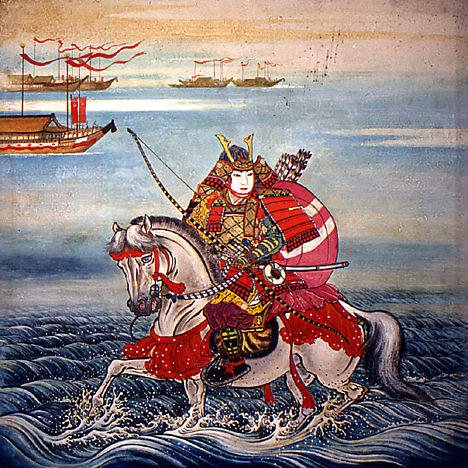
- Atsumori. (image of Atsumori as a warrior.)
- HIS COMPANION.
- CHORUS

PRIEST:

Life is a lying dream, he only wakes who casts the World
aside. I am Kumagai no Naozane, a man of the country of
Musashi. I have left my home and call myself the priest
Rensei; this I have done because of my grief at the
death of Atsumori, who fell in battle by my hand. Hence
it comes that I am dressed in priestly guise. And now I
am going down to Ichi-no-Tani to pray for the salvation
of Atsumori's soul. (He walks slowly across the stage,
singing a song descriptive of his journey.) I have come
so fast that here I am already at Ichi-no-Tani, in the
country of Tsu. Truly the past returns to my mind as
though it were a thing of to-day. But listen! I hear
the sound of a flute coming from a knoll of rising
ground. I will wait here till the flute-player passes,
and ask him to tell me the story of this place.

REAPERS (together).

To the music of the reaper's flute No song is sung But
the sighing of wind in the fields.

YOUNG REAPER.

They that were reaping, Reaping on that hill, Walk now
through the fields Homeward, for it is dusk.

REAPERS (together).

Short is the way that leads from the sea of Suma back to
my home. This little journey, up to the hill And down
to the shore again, and up to the hill,-- This is my
life, and the sum of hateful tasks. If one should ask
me I too would answer That on the shores of Suma I live
in sadness. Yet if any guessed my name, Then might I
too have friends. But now from my deep misery Even
those that were dearest Are grown estranged. Here must I
dwell abandoned To one thought's anguish: That I must
dwell here.

PRIEST. Hey, you reapers! I have a question to ask
you...

End of quotes

Conclusion :

[It certainly contains valid elements, enought to
generate a dispair into Fukuda's ranks a few months
late and pertains to the making of a political tale.
Asian Gazette will therefore quotes Machiavelli's view
on a prince's morality :

"How praiseworthy it is for a prince to keep his word
and live with integrity rather than by craftiness,
everyone understands; yet we see from recent
experience that those princes have accomplished most
who paid little heed to keeping their promises, but
who knew how to manipulate the minds of men craftily.
In the end, they won out over those who tried to act
honestly."

Various political analysts prior to Machiavelli based
their counsel on the assumption that for a ruler to
succeed, he must be ethically sound; as if power was
earned by integrity. Machiavelli?s approach was much
more pragmatic and sharply contrasted with the ideals
preached by the Church. Although he does not
completely exclude ethics, he minimizes their role in
a prince?s actions, because he believes that a prince
has a unique role, and should therefore let his goals
justify the means of achieving them. He introduced
the theory that morally wrong actions are sometimes
required to achieve morally right outcomes.
Machiavelli gives the masses one identity, the
subjects of a prince?s authority. This entity must be
controlled by the prince because they ultimately
decide the fate of a prince.

More later, inevitably.

Sunday, August 14, 2005

Who and what constituted the WW2 Kamikaze?


Quote:
"... nothing was more terrifying than a kamikaze attack.
Grainy black-and-white footage of Japanese fighter
aircraft plunging into the decks of aircraft carriers,
shown repeatedly on television, also formed the most
enduring images of the war for several postwar
generations of Americans...


Such fanatical resistance on the part of kamikaze pilots
convinced many Americans in the military at the time,
and many American civilians afterward, that an invasion
of Japan would lead to equally fanatical suicide attacks
by ordinary Japanese, resulting in millions of
casualties on both sides...


who were the kamikaze pilots? What motivated them, and
what were they thinking and doing in their final hours
before they took off in their bomb-laden planes? What
did their families, friends and those in the local
villages near the kamikaze bases think...


The pilots were usually kids, farm boys who joined not
only out of patriotic duty but for the adventure. One
boy, Iwao Fukugawa, would receive training, watch his
friends fly off to death, but survive and go on to a
successful postwar business career. Fukugawa came from
an exceptionally close family, who would visit him while
he was in training, bringing him food, which he readily
shared....


The story of the girls of Chiran, the Nadeshiko unit, is
little known, even among World War II history buffs, and
is here exceptionally well told. The girls, who were
only 14 or 15 years old at the time, were ordered to
work at the Chiran base. They cleaned the base and
prepared meals for the pilots, most of whom were only a
few years older than themselves.


It was a experience of unimaginable trauma for the
Nadeshiko girls, who spent days befriending the pilots,
watched them fly off to their deaths, and then turned
around to welcome another fresh batch of young men that
they knew would soon be dead. Like the pilots who
survived, the girls remained close-knit friends after
the war. A few of these girls, now grandmothers in
their 70s, continue to meet regularly in Tokyo...."
End of quote.


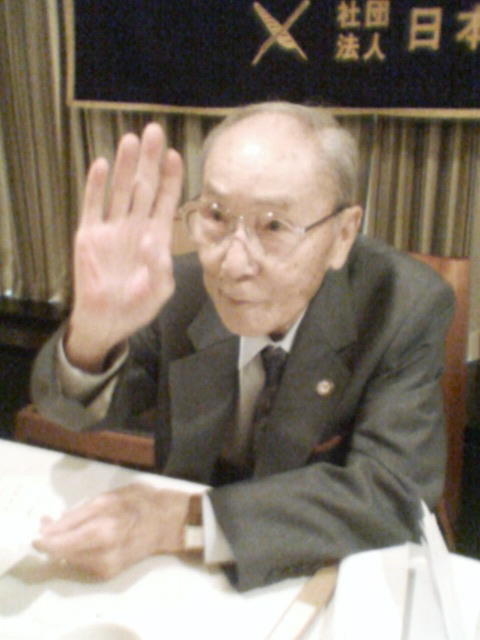
This photo of Zenji Abe, "in the morning hours of Dec.
7, 1941, Lt. Zenji Abe took off from the flight deck of
the aircraft carrier Akagi bound for the U.S. naval
base at Pearl Harbor. Abe, now 89 and battling cancer,
could not have known that he would play a part in one of
the most important historical events of the 20th
century. He is believed to have taken part in the
sinking of the "Arizona," which, more than any other
ship that went down, symbolized the enormity of the
event. Japan's attack on the base at Pearl Harbor would
become the rallying point for America's entry into the
war and would be remembered for decades as a day of
infamy."

Book :
BLOSSOMS IN THE WIND: Human Legacies of the Kamikaze, by
M.G. Sheftall. NAL Caliber, 2005, 480 pp.