Tuesday, January 02, 2007

155 Journalists "Put to the Sword" in 2006


Déclaration des Droits de l'Homme et du Citoyen 1789

Article 4. - La liberté consiste à pouvoir faire tout
ce qui ne nuit pas à autrui : ainsi, l'exercice des
droits naturels de chaque homme n'a de bornes que
celles qui assurent aux autres membres de la société
la jouissance de ces mêmes droits. Ces bornes ne
peuvent être déterminées que par la loi.

Article 10 - Nul ne doit être inquiété pour ses
opinions, mêmes religieuses, pourvu que leur
manifestation ne trouble pas l'ordre public établi par
la loi.

Article 11 - La libre communication des pensées et des
opinions est un des droits les plus précieux de
l'homme ; tout citoyen peut donc parler, écrire,
imprimer librement, sauf à répondre de l'abus de cette
liberté dans les cas déterminés par la loi.


2006 was one of tragedy for the world's media as
killings of reporters and media staff reached historic
levels, according to the International Federation of
Journalists.

Quote :

The International Federation of Journalists (IFJ) said
today that 2006 was a year of tragedy for the world?s
media as killings of reporters and media staff reached
historic levels with at least 155 murders,
assassinations and unexplained deaths.

?Media have become more powerful and journalism has
become more dangerous,? said Aidan White, IFJ General
Secretary. ?2006 was the worst year on record ? a
year of targeting, brutality and continued impunity in
the killing of journalists.?

During the year the numbers began to accumulate with
civil strife and resistance to military occupation in
Iraq. The IFJ says media became prime targets of
terror attacks or victims of poor soldiering. By the
year?s end, 68 media staff had been killed, bringing
to 170 the number killed in the country since the
invasion in April 2003.

Elsewhere, the IFJ says continuing violence in Latin
America, particularly Mexico, Colombia and Venezuela,
claimed the lives of 37 media staff while in Asia
relentless attacks in the Philippines and Sri Lanka
pushed the total of killings to 34.

The only positive sign came in the final days of the
year, says the IFJ, when the United Nations, for the
first time ever, issued a statement condemning
targeting of journalists and calling for prosecution
of the killers of media staff.

In a resolution passed on December 23 the UN Security
Council unanimously called on governments to respect
international law and to protect civilians in armed
conflict. The Council called for an end to impunity
and for prosecution of the killers of journalists and
agreed to prepare annual reports on the risks facing
media.

?This was the only bright spot in a year of
unremitting gloom,? said White. ?For the first time
the United Nations has put the focus on a deepening
media crisis. It is long overdue. We want to see
action against countries that allow impunity in the
killing of journalists.?

The IFJ totals for 2006 are as follows: Murders,
Targeted Killings and Unexplained Deaths: 155 Not
included -- Accidental Death while on duty: 22

The previous high was last year when the IFJ recorded
154 deaths, a number inflated tragically by the deaths
of 48 Iranian journalists on a military assignment.
But this year there were many fewer accidents ? just
22.

The full details are set out in the IFJ report
?Journalism Put to the Sword ? to be published in the
middle of January. The report also covers the work of
the IFJ Safety Fund, which provides humanitarian aid
to the victims of violence and their families.

The focus once again is on Iraq, where the IFJ has
been campaigning vigorously over impunity in the
killing of journalists. For the last three years the
IFJ has organised a day of protest on April 8 ? the
day in 2003 when three journalists died under US fire
in Baghdad. There have been 19 such killings in Iraq
and in all these cases media organisations and
victims? families are still waiting for independent
and credible reports about what happened.

In October a judge in the United Kingdom said one of
the victims, ITN journalist Terry Lloyd, was
unlawfully killed by American soldiers outside Basra.
His interpreter Hussein Osman was also killed and
cameraman Fred Nerac is missing believed dead. There
have been calls for prosecution of US servicemen
involved in this and many other cases.

Nevertheless, during 2006 the vast majority of
killings have been at the hands of terrorists and
sectarian gangs who have made the streets of Baghdad
and other major cities no-go areas for many news
teams.

But the IFJ says that the crisis of impunity is not
confined to conflict zones.

On December 12 the Federation joined with other
international press support groups to launch an
International Commission of Inquiry into the killings
of journalists in Russia. The action follows the
assassination of investigative journalist Anna
Politkovskaya in Moscow on October 7. Her death was
the latest in more than 200 killings of journalists in
Russia since 1993. Many of these have been explained,
but since President Vladimir Putin came to power
around 40 killings of journalists have taken place and
none of them have been satisfactorily resolved.

Second only to Iraq among the most dangerous spots in
the world for active journalism is the Philippines,
says the IFJ, where 13 journalists died in 2006,
bringing to 49 the number of media staff murdered
since Gloria Arroya came to power in 2001 ? surpassing
the numbers killed under the 14-year Marcos
Dictatorship.

And in Latin America journalists in Mexico moved ahead
of Colombia as the deadliest country for journalists
covering crime and corruption with 10 deaths, many of
them investigative reporters.

In Africa countries wracked by internal conflict also
proved to be the most dangerous for journalists.
Swedish freelance Martin Adler was shot while filming
a demonstration in Mogadishu and veteran journalist
Mohammed Taha, a Sudanese editor, was kidnapped and
killed.

?It has been a year in which small steps have been
taken to confront this media catastrophe,? said White,
?The issue will figure strongly at the IFJ World
Congress to be held in Moscow in May. But we must do
more, particularly to help the victims of violence and
to bring the killers of our colleagues to justice.?

The IFJ represents over 500,000 journalists in more
than 100 countries worldwide.

End of quote
Thursday, December 21, 2006

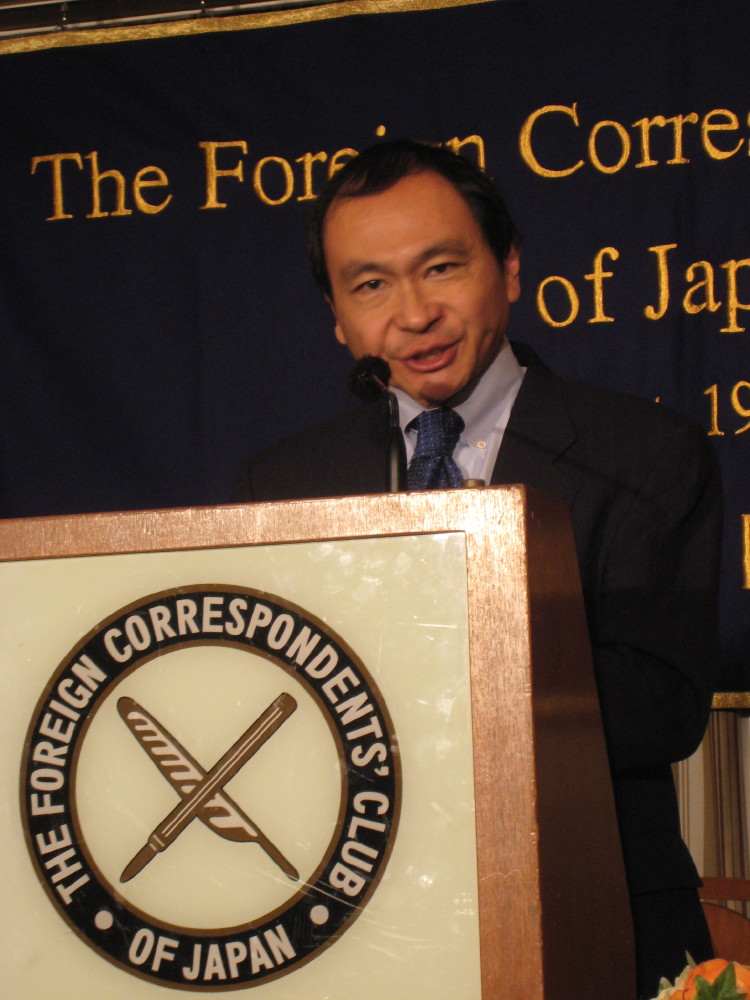
Fukuyama : breach of credibility and flawed assumptions since Iraq war


Francis Fukuyama, a former leading light of the US
neoconservative movement, said that the mishandling of
the Iraq war led Iran and North Korea to pursue
nuclear programs. "I think both of those countries
saw what happened in the messy aftermath of the Iraq
war and they decided they would be safer having a
nuclear weapon rather than not," Fukuyama told a press
luncheon in Tokyo at the FCCJ. " And we are now living
with those consequences."

Fukuyama is best-known for his 1992 book "The End of
History and the Last Man", which argued that the end
of the Cold War showed the growing universal
acceptance of Western-style liberal democracy. But he
has since distanced himself from Washington s
so-called "neoconservatives," who led the
controversial invasion of Iraq in 2003 in the name of
remaking the Middle East. Fukuyama said that
President George W. Bush s administration relied on
flawed assumptions.

"You see similar arguments now being made with regard
to Iran - that Iran is not deterrable and therefore
you need to take other active preventive measures," he
said. "Pre-emptive war is not the answer." Both Iran
and North Korea - labeled by Bush as members of an
"axis of evil" with Saddam Hussein s Iraq - have
defied international calls to give up nuclear weapons.
North Korea tested an atom bomb on October 9.

Fukuyama said that lingering emotions from the
September 11, 2001 attacks prevented US foreign-policy
makers from "reasonably" addressing the terrorism
threat. "Even to this day the threat of terrorism
with weapons of mass destruction is overstated, and
it is extremely difficult to articulate a position
that says: "Well, calm down a little bit about this",
he said. Plummeting US public support for the Iraq
war has spurred Bush to undertake a major Iraq
strategy review. (Quotes & agencies)

Wednesday, November 22, 2006

Japanese Navy confesses its submarine collided with tanker.


"All through your Army careers, you men have bitched
about what you call "chicken shit drilling". That,
like everything else in this Army, has a definite
purpose. That purpose is alertness. Alertness must
be bred into every soldier. I don't give a fuck for a
man who's not always on his toes. You men are
veterans or you wouldn't be here. You are ready for
what's to come. A man must be alert at all times if
he expects to stay alive..."

General Patton, England June 5th, 1944.


- After the Ehime Maru* dramatic events off Hawaii, an
other emerging sub, a JMSDF this time, spurs a
civilian vessel in south Japan seas. One cannot be
that much surprised with this sequel to the "In the
Japanese Navy recent episodes".

Lots of work to do to train the Japanese Navy, one can
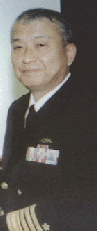
therefore understand the reason why the JMSDF Admiral
Saito succeeded to General Massaki as new Chief of
Staff, Joint Staff Office of the Japan's Self-Defense
Forces (Japanese Armed Forces) instead of the normal
go that was to offer the Japan top military job to a
Japan Air Self Defense Force General.


Now, the story :

"A Japanese military submarine collided with a
civilian vessel during exercises off southern Japan on
Tuesday, November 21st, officials said. The Maritime
Self-Defense Forces submarine brushed against a tanker
carrying chemicals as it surfaced about 30 miles (50
kilometers) off the southeastern coast of Miyazaki, on
the southern island of Kyushu, a defense agency
spokesman said on condition of anonymity by protocol.

The civilian vessel was later identified as the
Panamanian-registered 4,000-ton Spring Auster, en
route to China, Coast Guard spokesman Takatoshi
Nagasaki said. None of its crew of 16 Philippine
nationals and a South Korean was hurt, but the extent
of the damage was not immediately known, he said. No
injuries were reported among the 75 crew on the
submarine Asashio. It apparently hit the ship's hull
while surfacing, and the top part of the submarine's
aft fin had been dented by the impact, the defense
spokesman said.

The cause of the accident was not immediately known.
The submarine had re-submerged and was expected to
enter a nearby defense port for inspection, he said.
Coast Guard officials made radio contact with the
Spring Auster, whose crew reported feeling a small
impact. They maintained course because no other
vessel was in sight, Nagasaki said. No leakage was
reported from the tanker, which would be inspected by
Coast Guard officials at a nearby port, the defense
spokesman said" (Agencies)

- * About the Ehime Maru tragedy :


Quote :

On 9 February 2001, while hosting a "Distinguished
Visitor" cruise for several civilian guests,
Greeneville conducted an Emergency Main Ballast Tank
Blow, a dramatic maneuver that brings the boat to the
surface so rapidly her bow rises high out of the
water. Two of the civilian guests were at the
submarine?s controls during this maneuver.

At about 1350 HST, Greeneville?s rapidly-rising stern
struck the aft port quarter of Ehime Maru, a Japanese
fishing and high school training vessel, operated by
the Ehime Prefectural Uwajima Fishery High School.
The specially reinforced upper blade of Greeneville?s
rudder sliced through Ehime Maru?s engine room. Ehime
Maru sank in less than ten minutes. Nine crewmembers
of Ehime Maru drowned, including four high-school
students.[1] Eight days after the sinking, 17
February, the Supervisor of Salvage and Diving
(SUPSALV) and Submarine Development Squadron 5
(SUBDEVRON 5) located Ehime Maru in 2000 ft (610 m) of
water. The Navy contracted the Dutch company Smit
International and Crowley Maritime Corp.,
headquartered in Washington, to salvage the wreck of
Ehime Maru. It was lifted and carried, still
submerged, closer to Oahu. On 14 October 2001, the
wreck was set down in 115 ft (35 m) of water. This
operation was the first time such a massive object was
recovered intact from such a depth. On 15 October,
the first team of divers from Mobile Diving and
Salvage Unit 1 (MDSU 1) began assessing the sunken
vessel. Working in low-to-zero visibility conditions,
divers from MDSU 1, aided by Japanese divers,
conducted 534 dives over 29 days, searching the wreck.
The divers recovered the bodies of eight of the nine
missing crewmembers, many personal effects, and
several items unique to the ship, such as its
nameplate, bell, and helm.

The Ehime Maru memorial is located in Kakaako
Waterfront Park in Honolulu, Hawaii. On 25 November,
Ehime Maru was again lifted, towed back out to sea,
and scuttled in 8,500 ft (2,600 m) of water south of
Barbers Point, witnessed by three of the crewmembers'
families. The total cost of salvage operations was
about U.S. $60 million. A memorial [pict.] in Hawaii
to Ehime Maru and her dead has been constructed.

Commander Scott Waddle, who commanded Greeneville
during the collision, accepted full responsibility for
the incident. A court of inquiry found that there had
not been a sonar or periscope scan of the immediate
vicinity before surfacing. Waddle was reprimanded,
but Navy officials decided against a court-martial and
let him retire honorably with his rank and pension
intact. Waddle's apology to the victims' families was
delayed, because, as he wrote in The Right Thing
published in 2003, "the [Navy's] settlement process
... would have been interrupted. It was decided
while I was on active duty before I retired in October
of 2001 that visiting Japan was not in the best
interest. After I retired in October, it took me some
time to find employment. I finally found employment
in August and from that time, the resources were not
available to get me to Japan. But at the earliest
opportunity I did make that trip when I could ..."

End of quotes.

Thursday, November 02, 2006

Japan's Potential Military Threat...? Paper tiger or serious ?


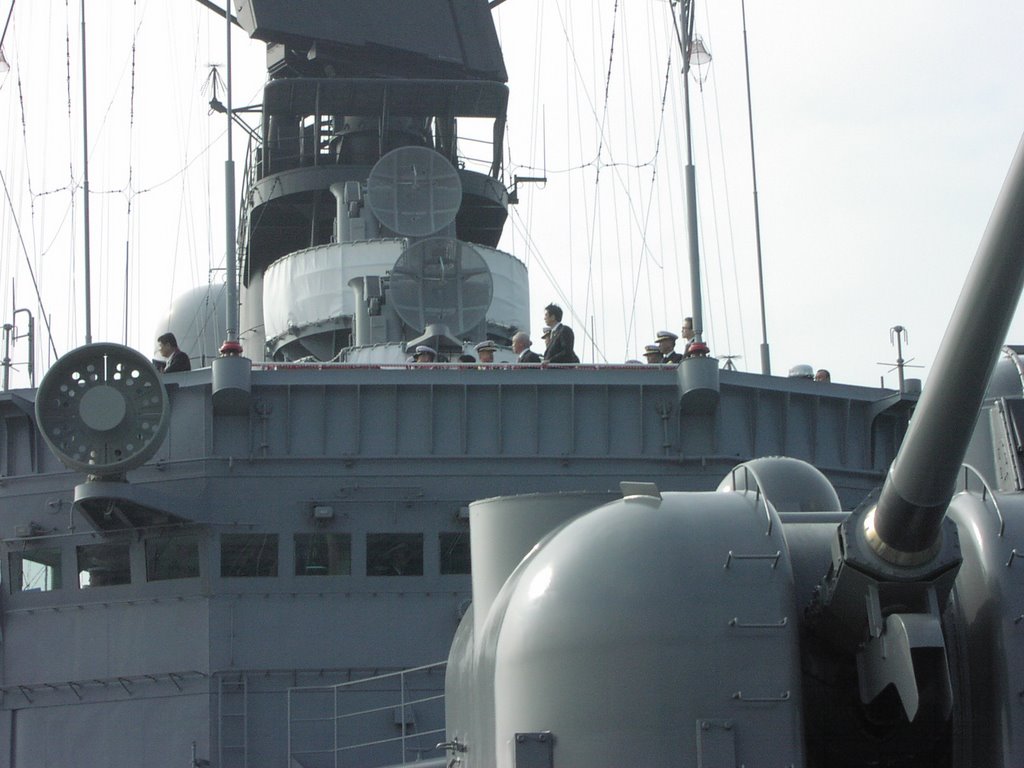
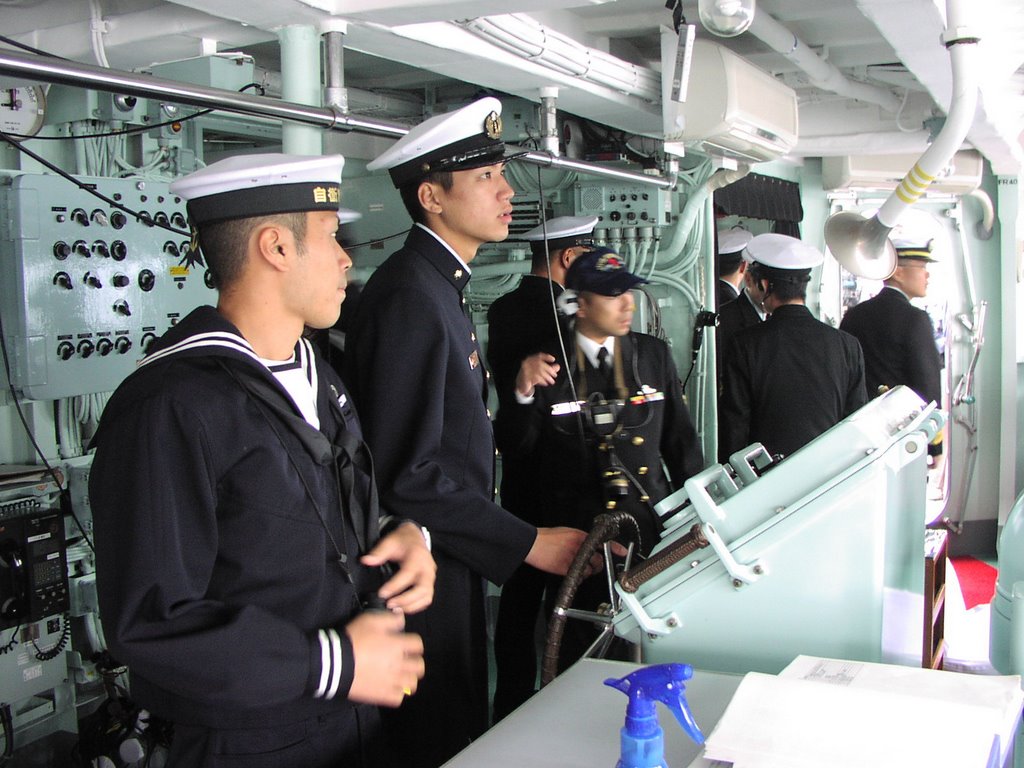
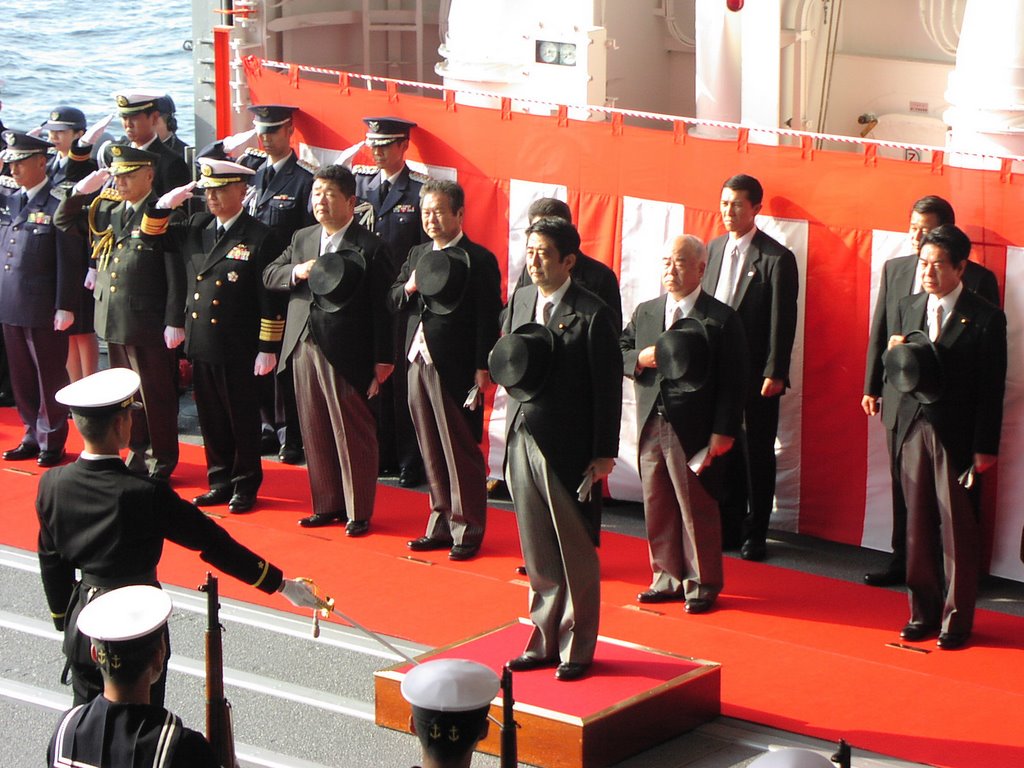
Aboard the JMSDF Kurama with Prime Minister ABE
Shinzo -- The Maritime Self Defense Force, Japan's
navy, held its annual fleet review on Sunday
October 29, 2006, with destroyers lining the seas
and missiles roaring through the air in a major
display of this country's military power. More than
8,100 troops and 48 ships -- including
Aegis-equipped destroyers and state-of-the-art
submarines -- took part in the review, which was
held in waters just south of Tokyo in Sagami Bay.

"Our country's Self-Defense Forces are being called
upon to play a more crucial and varied role," Prime
Minister Shinzo Abe said in an address to the
sailors aboard the Kurama, a destroyer that served
as flagship during the maneuvers. Abe singled out
North Korea as a major threat to Japan, saying its
recent ballistic missile test launches and its
claim to have exploded a nuclear device on Oct. 9
are "grave and unforgivable." Though planned well
before North Korea's nuclear test, Sunday's review
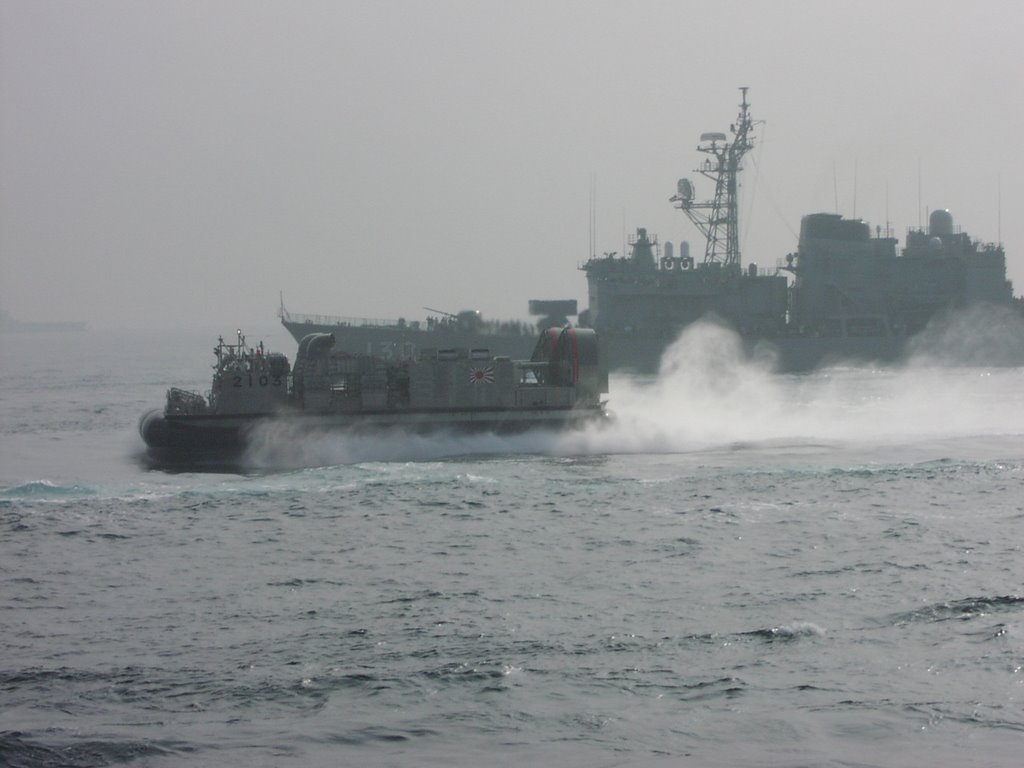
put the Japanese navy's best ships on display, from
vessels rigged with the advanced Aegis radar system
to new, conventionally powered submarines and
high-speed hovercraft capable of quickly putting
heavy vehicles or hundreds of troops ashore in
difficult-to-reach locations. "I believe this is an
excellent opportunity to demonstrate our
readiness," Abe, who assumed office last month,
said in his address.


While limited by the post-World War II Constitution
to a strictly defensive role, Japan's military is
one of the largest and best equipped in the world.
Largely in response to the North Korean threat, and
concerns over the growth of China's military, it is
getting stronger. Last week, lawmakers began
discussing a plan to boost the Defense Agency to a
full-fledged ministry, giving it greater clout in
budget and policy negotiations. The transformation
is expected to come over the New Year's holidays,
though it still requires a final vote in the Diet.
Concerns over North Korea have also led Japan to
step up efforts to strengthen its missile defenses.
Japan launched its third spy satellite earlier this
year, and is rapidly moving ahead on plans to
deploy missiles around the country in an ambitious,
multibillion dollar missile shield project with the
United States. Soon after Pyongyang's nuclear test,
Japanese warships were dispatched to the Sea of
Japan to monitor activity on the Korean Peninsula.
Japan also currently has warships in the Indian
Ocean providing logistical support for coalition
forces in Afghanistan. The Diet last week approved
an extension of that mission for one more year.
(Wire news)

"... Japanese re-armament is probably the biggest
X-factor in East Asia, and one that has the
potential to make a lot of people nervous.


Since surrendering to the United States in 1945,
Japan has chosen to take minimal steps towards
military matters, choosing a strictly defensive
posture. In fact, their military is not a military
at all - they are referred to as self-defense
forces. Japan only spends about 1% of its Gross
Domestic Product on its self-defense forces. In
2005, this came out to roughly $42.1 billion. This
is slightly less than the United Kingdom spent in
2005 ($48.3 billion) - but the UK was spending 2.8%
of its GDP.


What did Japan get on this 1% approach? Arguably
the best Navy in East Asia. Japan has 40
destroyers, 18 of which have entered service since
1995, with at least two more modern vessels (of the
Atago-class) on the way. Japan has acquired eight
new submarines (the Oyashio-class), with at least
two others on the way. Japan is also building a
new class of helicopter destroyer to replace an
older class currently in service. One of the
designs for this 13,500-ton new helicopter
destroyer features a flat deck with an offset
superstructure, similar to the small "Harrier
carrier" like those used in several European
navies.


Japan's Air Self-Defense Force is also equipped
with modern aircraft. The backbone of this force
is 225 F-15J/DJ fighters, roughly the equivalent to
the F-15C Eagle, an air superiority fighter used by
the United States Air Force. Japan has designed
the F-2A/B, which is a variant of the F-16, and
currently has about 49 in service, with plans to
get up to 130. The F-2 is best described as an
F-16 that took steroids, with thirteen hardpoints
for carrying weapons to the F-16's nine, and about
50% more payload than the F-16. Japan also has 70
F-4EJ fighters in service.


Now, imagine if Japan were to increase its defense
spending to the same level of GDP as the UK or
South Korea. That would push Japan's defense
budget to the range of $109 to $124 billion a year.
The latter figure is fifty percent larger than
China's present defense spending. If Japan went to
spending the same amount of its GDP as China did,
it would be spending $190 billion, well over twice
China's military budget.


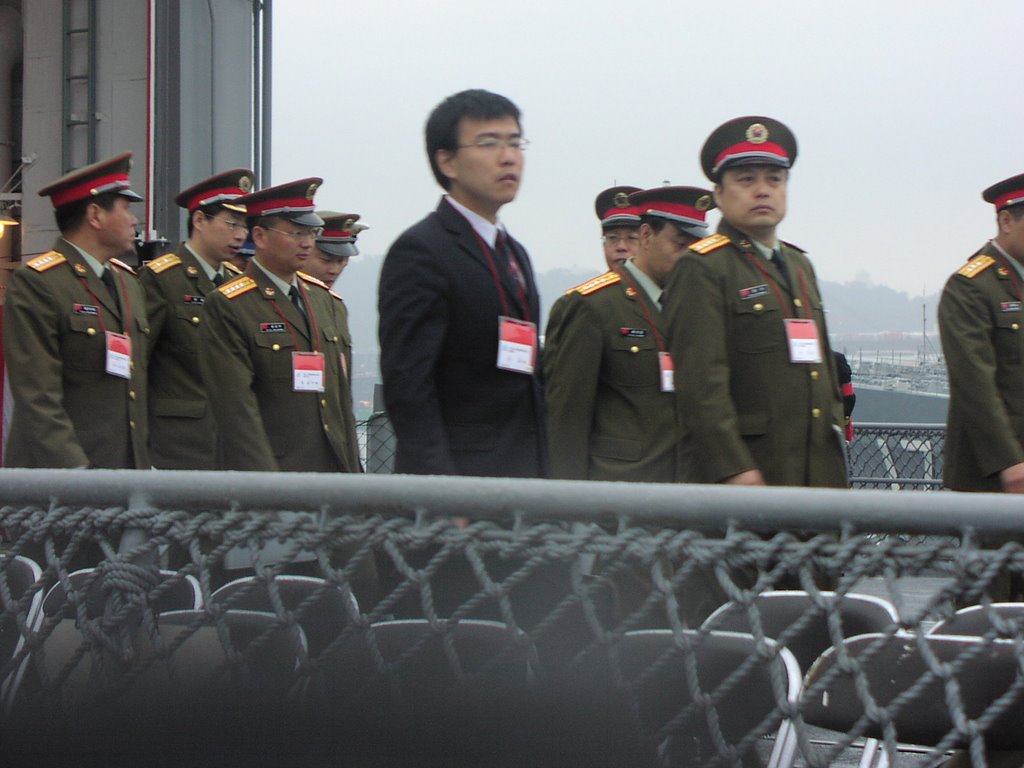
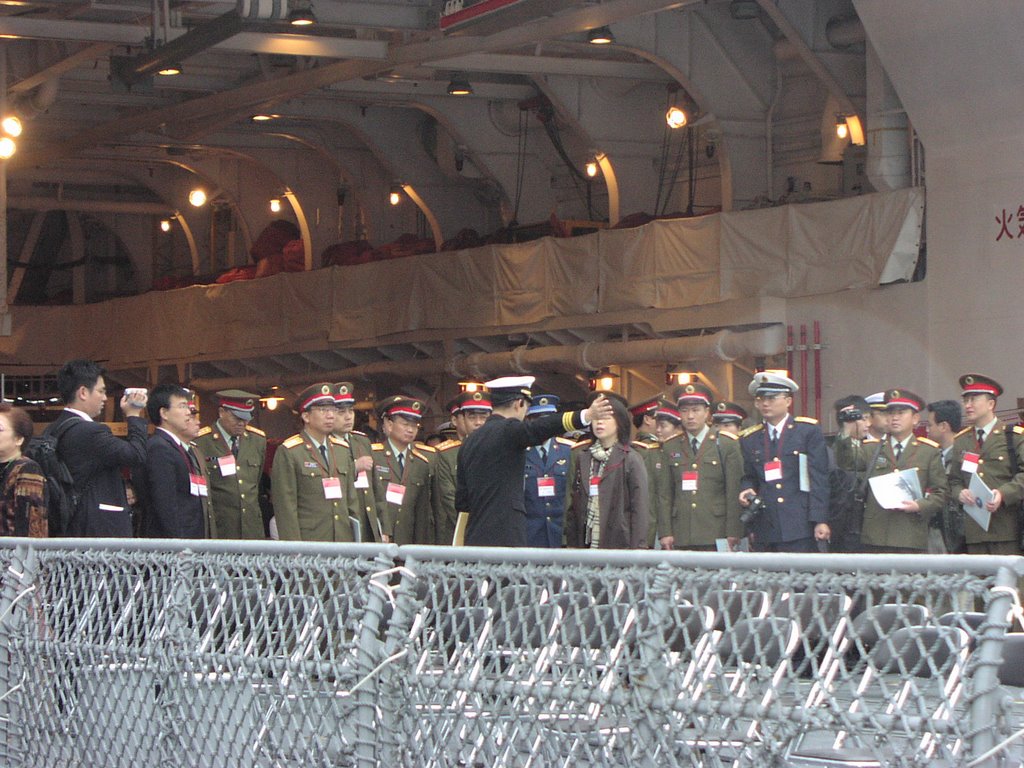
(Chinese Military VIPs' on JMSDF vessels)


What could Japan get for that? Figure that a major
part of any Japanese buildup would be an increase
in its Maritime Self-Defense Force. What would
that increase entail? They could easily increase
the JMSDF by at least 50%, and this would largely
consist of destroyers from the Atago and Takanami
classes, the latest destroyers in service with the
JMSDF.


The JMSDF would also acquire more
Oyashio-class submarines, and the new light
carriers. Japan could even buy the F-35B (the
replacement for the AV-8B Harrier). Japan would
probably also buy more F-2s and probably also buy
the F-22. If Japan really felt they had to, they
could even develop and start deploying nuclear
weapons within six months of Prime Minister Abe
giving the order to start.


Japan has the potential to become one of the top
military powers in the world. All it really needs
to do is to make the decision. Given that in the
past ten years, East Asia has become a much
touchier and more dangerous neighborhood, that
decision may be closer than many people realize.
H. Hutchison" End of quotes


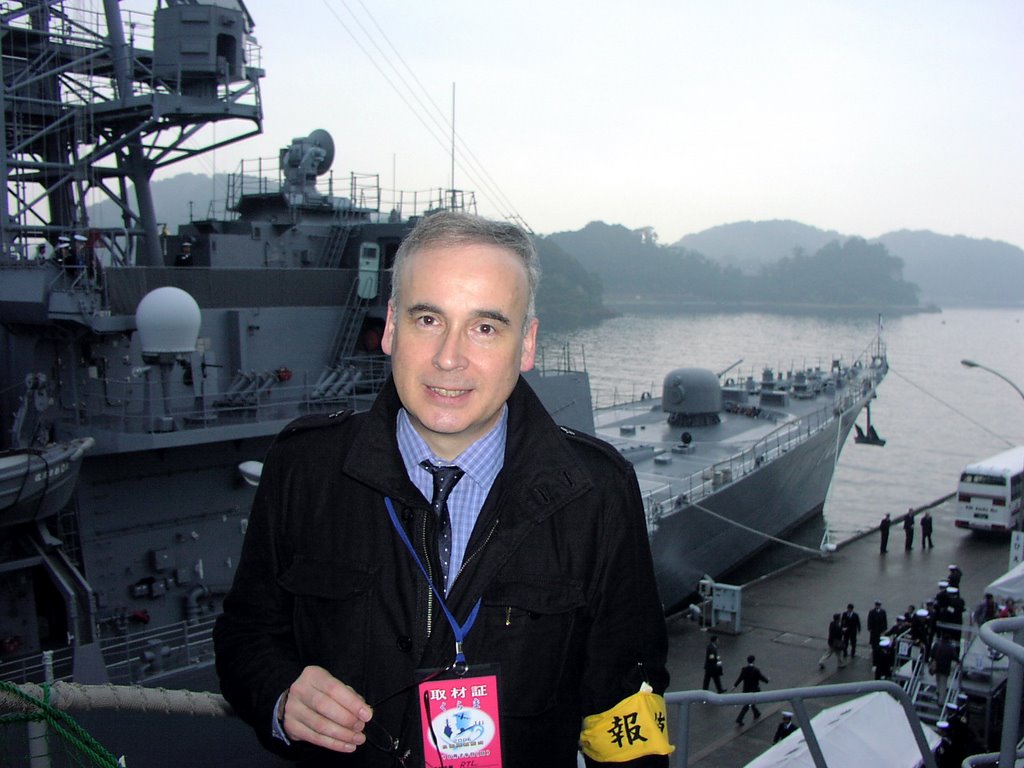
===> S P E C I A L Press Harassed By JMSDF NAVY POLICEMEN :


Violence and suspicion on Foreign Journalists in
Japan :

This JMSDF Navy Police man behaved with brutality
and acted in a vicious manner. His Navy Police
colleagues acted in the same way on the Kurama
admiral boat. Following, disturbing, monitoring
journalists'movements with hand guns despite we,
foreign press, are accredited on the flagship and
at the JDA, Yotsuya, Tokyo. Ndjlk : Could the
Japanese armies and security in general avoid
brutality, showing muscles, viciousness and
roughness with accredited journalists? The author
complained to the French Embassy in Japan, for the
roughness of Japan armies personal, and the embassy
investigated with regrets for the unacceptable
pressures exercised on a French press accredited
representative in Japan whose job is to report and
gather facts for his offices and audiences. The JDA
has a weak and selective memory and seems to have
forgotten my comprehensive reports on JSDF
including the interview of General Massaki ex
Chairman Joint Staff Council, Japanese Self Defence
Forces and ex minister of Defense Ohno broadcasted
in 2006 on France Television but never committed to
seriously and professionally improving the coverage
of the JDA forces for Foreign Correspondents in
Japan. _ NB : A Foreign Correspondent is a
journalist, a strange creature who asks questions
and quotes, records, films, his interviewees for
his audiences and public. He sometimes manages
foreign languages such as English in his duty.


2006 Reporters Sans Frontieres Barometer
of the Freedom of Press :
65 Journalists killed

Journalists killed in:
- 2005 (63)
- 2004 (53)
- 2003 (40)
- 2002 (25)
29 Media assistants killed
131 Journalists imprisoned
3 Media assistants imprisoned
61 Cyberdissidents imprisoned

<===


Text + Images + Quotes by Jlk Asian Gazette Blog

Saturday, October 07, 2006

The enigma of Japan based consumers banks!


Quote : "Japan consumer credit companies in fiscal
2005 received 13.4 billion yen in life insurance
benefits taken out on customers when the cause of
death was unknown, according to results of a survey
released Friday by the Financial Services Agency. The
figure is 44% of the roughly 30 billion yen in life
insurance payouts received at the 17 moneylenders.

In agreements between consumer lenders and insurers,
death certificates are not required for payouts under
a set limit. This situation highlights the murkiness
surrounding life insurance policies taken out on
borrowers. With 14 of the firms using the same
application forms for loans and policies, there have
been claims of inadequate explanations.

The moneylenders have been criticized for using a
person's life as collateral without their knowing. On
top of this, strong-arm techniques to collect funds
have been pointed out as leading to suicides. The FSA
survey, the first on this issue, shows that the
moneylenders received around 43 billion yen, about 14%
of the total, when the cause of death was suicide."
End of quote.

Sunday, October 01, 2006

Those toys are expensive : realignment of US forces will cost Japan 12,6 billion euro !


In early May, former defense chief Fukushiro Nukaga,
who is liked by the US, said the realignement would
cost less than 2 trillion yen. "He worked well" and is
not reassigned by PM Abe Shinzo, so, "now Kyuma san is
back in charge" some defense experts said.

Quote:

"Japan's Defense Agency has estimated that Tokyo will
need to pay nearly 12,6 billion euro (US$16 billion) to
help cover the costs of a realignment of U.S. forces
stationed in the country, a newspaper reported Sunday.

Japan's Cabinet in late May approved plans for a
sweeping realignment of U.S. troops in Japan _ the
largest such move in 50 years _ that will give Japan
greater responsibility for security in Asia.

Japan and the United States agreed on the plan in
April, saying it would streamline U.S. forces based in
Japan and alleviate some of the grievances of people
in Okinawa, a cramped southern island which hosts
about 23,500 U.S. troops, nearly half the 50,000
stationed in Japan.

The estimated 1.86 trillion yen (US$15.8 billion) bill
reported by Japan's Yomiuri newspaper Sunday includes
Tokyo's share of the cost of transferring 8,000
Marines from Okinawa to the U.S. Pacific island
territory of Guam.

The Defense Agency is estimating that transfer will
cost Japan 676 billion yen (US$5.7 billion), the
Yomiuri said. The figure is just under the 60 percent
Japan has been expected to shoulder of the estimated
US$10.3 billion tab to move the Marines. The remaining
1.19 trillion yen (US$10.1 billion) in the estimate
covers Japan's share of the cost of shuffling and
consolidating other U.S. forces in the country, the
newspaper said.

Defense Agency officials were not immediately
available to comment on the report Sunday. Tokyo has
not yet formally announced how big Japan's share of
the costs of the realignment will be.

The planned realignment will leave about 15,500 U.S.
troops in Okinawa, but has met some opposition. Local
governments and civic groups argue that the top
priority should be reducing U.S. forces and returning
bases to Japanese control. " (Agencies)

Saturday, September 30, 2006

Japan makes people insane, sometimes.


"More than 80 percent of major companies across the
country have employees who are taking sick leaves
because of mental illnesses, a government survey has
shown. Commenting on the survey results, an expert
urges employers to improve working conditions for
employees to prevent them from suffering from mental
diseases. "Companies should keep in mind that no
employees have any concern about their mental health,
and avoid excessive workload and long working hours
that could cause such problems," said Yasuji Imai, a
senior researcher at the Japan Productivity Center for
Socio-Economic Development.


The Health, Labor and Welfare Ministry has conducted
the survey, the first of its kind, on 12,051 companies
with 10 employees or more throughout the country in a
bid to compile basic statistics aimed at preventing
work-related accidents. Of them, 8,543 firms
responded.

Of the respondents, 3.3 percent said they have
employees who are taking sick leave due to mental
problems. Fully 82 percent of the firms with 1,000
employees or more responded that they have workers who
have been absent from work as a result of mental
diseases.


Most of them, 97.3 percent, have been away from work
for one month or more. Smaller percentages of small
and medium-sized enterprises have employees suspended
from work due to mental problems, with 66.3 percent of
the firms with 500 to 999 employees 40.9 percent of
those employing 300 to 499 replying so. Only 1.5
percent of small businesses with 10 to 29 workers have
workers who have been absent from duty because of
mental sickness.


In the same survey, 13.4 percent of the firms said
some of their employees work 100 hours or more in
overtime per month. More than 40 percent of firms
with 1,000 employees or more and those with 500 to 999
workers said they have such employees. Some 22.9
percent of companies employing 300 to 499 workers and
12.7 percent of firms with 10 to 29 employees replied
that some of their workers work for 100 hours in
excess of their regular monthly work hours." (Click
Title for article URL)

Saturday, September 23, 2006

"Biggest hurdle with be the Upper House election 2007"


Quote :

"Commentary by critic Tetsuya Miyazaki on the election of Shinzo Abe:
Biggest hurdle with be the Upper House election

My initial direct reaction was that now the hard part starts. Becoming
prime minister was easy, but it is difficult to hold on to that seat.
The biggest hurdle will be the election for the House of Councilors next
summer. If the opposition camp gains a majority of seats, calls for the
Liberal Democratic Party (LDP) president to take responsibility will be
unavoidable. I also fear that the trend will be to leave things as is.
The next ten months, everyone will have to prepare for the election, so
I would say that only when there is a victory in the Upper House would
things get moving.

The presidential election was a one-sided game with Abe always winning,
but it should have been a proper election with a real competitive match
going on. And despite Abe never having articulated his political
principles, many lawmakers bet on the winning horse unquestioningly. It
was as if even the grass and trees were bowing to Abe.

Ozawa's Minshuto (Democratic Party of Japan) will now come in with such
buzzwords as income disparity, economic recovery, the pension issue, and
Asia diplomacy. The LDP should have been expending every effort on
policy debate in order to meet the enemy in battle. In that sense, one
can only say that the LDP was left out of the race.

As a result of the bandwagon effect, it will not likely be avoidable for
President Abe to make personnel appointments simply as rewards for
supporting him. If he doesn't do that, the lawmakers who supported him
that were not appointed will be disgruntled and turn against him. This
could create trouble in the party as a whole.

On the foreign policy front, he seems to want to carry out a positive
diplomacy toward East Asia. There's a high probability of the mood
shifting toward favoring a thaw in Japan's relations with China.
Although the political forces backing Abe want him to visit Yasukuni
Shrine, he will have to decide whether such a visit should come after
his China diplomacy is on track.

Perhaps the biggest challenge for his administration will be maintaining
the good economic climate. With the absence of Heizo Takenaka [who
resigned from the Diet], the leading force for economic policy in the
Koizumi administration, there is a possibility that the bureaucracy, led
by the Finance Ministry, will regain its policy clout. "
End of quote MAINICHI Shinbun September 21, 2006

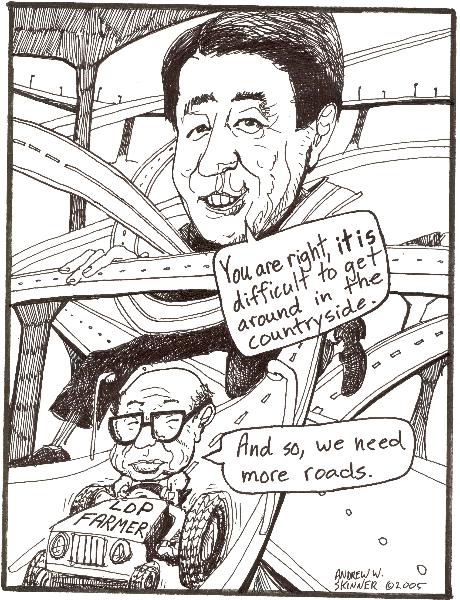
(Image, this is how the foreigners see him...)

Tuesday, September 19, 2006

Abe Shinzo : " persons of excellent caliber " to be in charge.


Japan LDP ruling party presidency election on
September 20th 2006

Shinzo Abe, candidate to LDP presidency and PM job

about the 2007 Upper House election : "The purpose is
not to win the Upper House election," Abe said, "We
should let persons of excellent caliber take part in
our work of building an ideal country." Nikkei
September 5, 2006.

Friday, September 01, 2006

About a Boy


[Update 06 September 2006 08h30 am]

Princess Kiko, wife of Prince Akishino, gave birth to
a boy at 8:27 a.m. Wednesday September 6th 2006 at
Aiiku Hospital in Minato Ward, Tokyo, where she was
hospitalized and underwent a cesarean section, the
Imperial Household Agency said. The newborn prince is
the third in line to the Imperial throne, next to
Crown Prince Naruhito and Prince Akishino. It was the
first birth of a prince since 1965, when Prince
Akishino was born. The baby weighed 2,558 grams and
was 48.8 centimeters in length, according to the
agency. Both Princess Kiko and the baby are in good
health, according to the agency.

The Imperial Household Agency had initially announced
in February the baby was expected to be born in late
September. Princess Kiko had placenta previa
partialis--the partial clogging of the orifice of the
uterus--and doctors were concerned she might suffer a
hemorrhage. To ensure a safe delivery, Masao
Nakabayashi, head of Aiiku Hospital and the physician
in attendance for the princess, conducted the cesarean
section. Prince Akishino was at the hospital at the
time of the birth. The Emperor and Empress were
informed of the baby's birth by the prince himself.
The name of the newborn prince will be announced at
the Meimei no Gi, the Imperial naming ceremony, to be
held next Tuesday. The new prince is the couple's
third child following Princess Mako, 14, who is in the
third year at Gakushuin Girls' Junior High School, and
Princess Kako, 11, who is in the sixth year at
Gakushuin Primary School. The baby boy is the fourth
grandchild for the Emperor and Empress. With the
prince's birth, the Imperial family now has 23
members. In the Imperial family, nine female members
were born in a row since 1969, when Princess Sayako
was born as the only daughter of the Emperor and
Empress. Princess Sayako relinquished her royal
status on Nov. 15 last year by marrying Yoshiki
Kuroda, a Tokyo metropolitan government official.

Article 1 of the Imperial House Law stipulates that
the Imperial throne is succeeded by male heirs of the
male line of the Imperial family. As the new prince
is third in line to the throne, the positions of
Prince Hitachi, Prince Mikasa, Prince Tomohito of
Mikasa and Prince Katsura, who were previously third
to sixth in line, respectively, have been lowered by
one. Since 1779, when the 119th emperor ascended the
throne, the Imperial throne has been succeeded from
father to son--from Emperor Kokaku to Emperor Ninko,
Emperor Komei, Emperor Meiji, Emperor Taisho, Emperor
Showa to his majesty today. If the crown prince
ascends the throne and is survived by Prince Akishino,
the throne will shift to the bloodline of the younger
brother, as long as the Imperial family makeup does
not change. A recent case in which a royal throne was
transferred from an elder brother to a younger brother
occurred in Belgium in July 1993. After King Baudouin
died, his younger brother, Albert II, succeeded to the
throne. (Press DY)


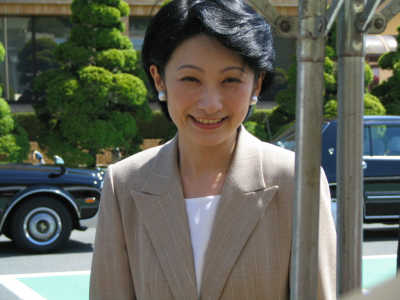
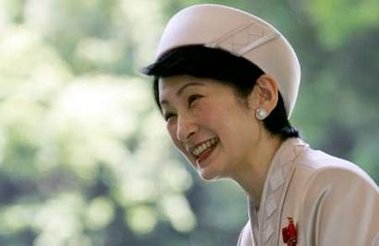
Image : Princess Kiko of the Japan Imperial family.

Date: 8/26/2006 2:10:00 PM

From: Joel J. Legendre

Subject: NBR'S JAPAN FORUM (POL) Japan Imperial family
childbirth

Dear Japan forum members,

The question burns every news-desks. Explanations and
comments from scholars and experts would be most
appropriate regarding the royal pregnancy of Princess
Kiko.

What consequences if Princess Kiko does not give birth
to a baby boy?

What will happen if Princess Kiko gives birth to a
baby boy?

Regards,

Joel J. Legendre
Tokyo
www.rtl.fr

"Agences Tokyo, 31/08 La princesse Kiko, belle-fille de
l`Empereur du Japon, va très bientôt accoucher d`un
garçon, le premier héritier mâle au sein de la famille
impériale depuis plus de 40 ans, susceptible de monter
un jour sur le trône du Chrysanthème, affirme jeudi un
hebdomadaire populaire.

Selon le Shukan Bunshun, souvent bien informé sur les
affaires de la famille impériale, l`époux de Kiko, le
prince Akishino, a confié à l`un de ses amis proches
que sa femme attendait un garçon.

La nouvelle, que le Japon attend avec impatience, est
un secret très bien gardé depuis trois mois. Mais les
cercles politiques, les spécialistes d`obstétrique et
les journalistes qui tiennent les rubriques de la Cour
sont persuadés qu`il s`agit d`un garçon."

Wait and See! Anyhow the next in line is Crown Prince
Naruhito the husband of Princess Masako. Then the
Prince Akishino. Should the royal baby to be born be
a baby boy, he will be a royal dynastic back up, third
in line, securing the royal linage! But a kind of
disillusion for many women who expected the Princess
Aiko, daughter of the Crown Prince Naruhito to become
the first Japanese Empress of the 21st Century, as a
symbol of respect for gender equality.


Prince Akishino & Princess Kiko

National debate ? Not much.
Occasionally, equal primogeniture has won in
historical cases of Japanese succession: While it is
true that most succession events in Japan had since
time immemorial went in favor of a male heir, not
necessarily the eldest of the sons themselves, it
nevertheless is established by two precedents [of 1629
CE and of 642 CE] that an imperial princess may ascend
the throne in preference and prior to her younger
brothers. In 1629, the imperial princess Okiko
ascended the Japanese throne as Reigning Empress
Meisho tenno, as successor of her father, prior to her
younger half-brother and other males. Only after her
abdication 14 years later, her brother Tsuguhito
(Emperor Go-Komyo tenno) ascended. However, her
offspring would never have been allowed to ascend the
throne.

- Commentary :
Arguments in favour of primogeniture

Primogeniture prevents the subdivision of estates and
diminishes internal pressures to sell property (for
example, if two children inherit a house and one
cannot afford to buy out the other's share). In
Western Europe most younger sons of the nobility,
having no prospect of inheriting land or property,
were obliged to seek careers in the Church, the Armed
Forces or in Government. Wills often included
bequests to a monastic order who would take the
disinherited. Many of the Spanish Conquistadors were
young sons who had to make their fortune in war. In
the late 17th and early 18th Centuries, many
specifically chose to leave England for Virginia in
the Colonies. Most, if not almost all, of the early
Virginians who were plantation owners were such
younger sons who had left England because of
primogeniture laws. These Founding Fathers of the
United States of America were nearly universally
descended from the landed gentry of England, with many
being descended from English Kings of the late 14th
and early 15th Centuries, especially through the
prodigious offspring of Edward III of England.
William Shakespeare's King Lear can be seen as an
argument in favor of primogeniture as the tragically
flawed action of Lear is dividing his country into
three amongst his daughters. The division of his land
marks the beginning of the unraveling of everything
else in the play.

Arguments against primogeniture

The fact that the eldest son "scooped the pool" often
led to ill-feeling amongst younger sons (and of course
daughters). Through marriage, estates inherited by
primogeniture were combined and some nobles achieved
wealth and power sufficient to pose a threat even to
the crown itself. Alternately, one might think that,
as with most property, the land will go to its most
useful purpose no matter what the initial distribution
(the Coase Theorem). Finally, nobles tended to
complain about and resist rules of primogeniture
(though this opposition might indicate primogeniture
among nobles was good for the king).


A case of agnatic primogeniture is exemplified in the
French royal milieu, the Salic Law (attributed to the
Salian Franks) forbade any inheritance of a crown
through the female line. This accounts for the
dispute over the legitimate successor of Charles IV of
France (Edward III of England or Philip VI of France),
the separation between Hanover (where Ernest I
succeeded) and the United Kingdom upon the accession
of Queen Victoria in 1837, the separation of the
(arch)ducal house of Luxembourg from the royal house
of the Netherlands, and partially explains the role of
Carlism in Spain.

Now... this is the 21st century... right?