Friday, July 29, 2005

Japan and China ready to debate their Historical Great Leap and Diplomatic Polyphony?


"There are 2,000 years of (friendly) exchanges between
China and Japan. The history of the exchanges was much
longer than that of confrontations," Zhao Qizheng,
minister of the Chinese State Council Information
Office, said at the opening ceremony of the photo
exhibition in Tokyo describing the past 60 years of
history between Japan and China, after WW2. "We hope
people, especially the young people in both countries,
will gain confidence in our future" through the event."
Also that day the words of the Diet HOR Speaker Mr.
Yohei Kono who analyzed the situation in Europe between
France and Germany were very important, I think, as an
image of what ex-foes can do to forgive and prepare
future generations to live in peace and development.

I mentioned to Minister Zhao that I still study Chinese,
he seemed very enthusiastic, or at least, happy to speak
a few words of Chinese In Tokyo with a French European
journalist and foreign correspondent. A rare Gaijin
present on that day.

Actually and it is an academic view, the only way to
consider history is to open debates. By debating and
confronting in a positive manner all elements and try to
reach a majority of agreements is the long and fruitful
way which would avoid any form of impeachments based on
discriminations or confrontations. It is largely
admitted that the last stage of discrimination has one
word : genocide. It is to be firmly addressed. In France
too, politicians have serious difficulties to address
history and among many topics, the colonization. There
is not much debate about it in France, is there?

By being able to attend this remarkable and intelligent
event where I felt very comfortable, I also had the
delectation to be in interaction between the 2
communities and witness debates and frank exchanges. An
idea came to my mind immediately with one certitude :
the day when Japan and China will become two friends,
the planet Earth will never be the same! The Heavens and
the Sun, after all, are made to merge... I therefore
strongly hope that my perceptions of understanding and
manhood I felt today with Chinese and Japanese
societies, are a landmark on the road of fellowship and
to be repeated.

But! There were one bad and one good news on that day of
July 28th :

Quote :

Tokyo's education board adopted a history textbook on
Thursday that critics say whitewashes past Japanese
militarism for use at 26 junior high schools in the
capital, a decision that could anger China and South
Korea. Japan's Education Ministry approved the new
edition of the textbook, written by nationalist
scholars, in April, sparking protests from China and
South Korea where bitter memories of Japan's aggression
before and during World War II persist.


The six-member Tokyo education board adopted the
textbook for use at four state-run schools and 22
schools for the blind and deaf and the physically and
mentally handicapped, said an official at the Tokyo
metropolitan government. "The decision was reached
unanimously," he said, adding that the textbooks would
be used for four years starting next year.


The board also adopted a civics textbook, produced by
the same group of scholars, that has upset South Korea
as it reiterates Tokyo's claim to two tiny islands
disputed with Seoul, for use at the 22 schools for the
handicapped. Because of a complex administration system,
the board has power to approve textbooks for only a
handful of the hundreds of junior high schools run by
public authorities in Tokyo. Earlier this month, the
education board of the city of Otawara in Tochigi
prefecture, 150 km (90 miles) north of Tokyo, became the
first municipal government to adopt the latest versions
of the two disputed textbooks.
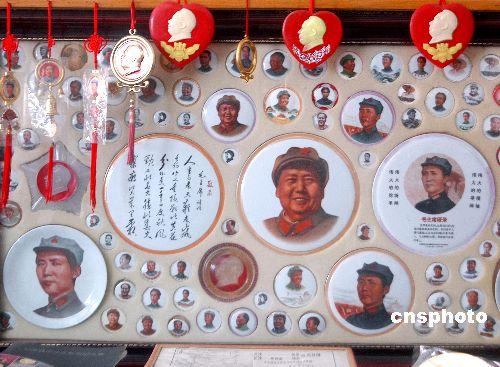


Critics say the history textbook, sponsored by the
Japanese Society for History Textbook Reform
(Tsukurukai), plays down the 1937 Nanjing Massacre in
China, ignores the sexual enslavement of women for
Japanese soldiers and depicts Japanese wartime actions
as aimed at liberating other Asian countries. A previous
version of the history textbook, approved in 2001, was
adopted by less than 1 percent of school districts
nationwide, but Tsukurukai and its supporters hope to
increase that to 10 percent with the new edition.
Opponents of the textbook are worried that given a rise
of nationalism in sections of Japanese society, many
state schools may adopt the textbook. The authors and
supporters of the textbook argue that the history text's
approach corrects a "masochistic" view of history which
they say has deprived Japanese of pride and patriotism.
The government has said the text does not represent the
official view of history. The Tsukurukai praised the
Tokyo board's decision and said it hoped other school
boards would follow suit.

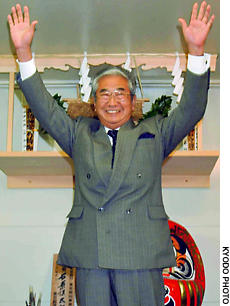
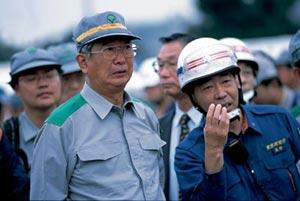
(Zhao Qizheng)

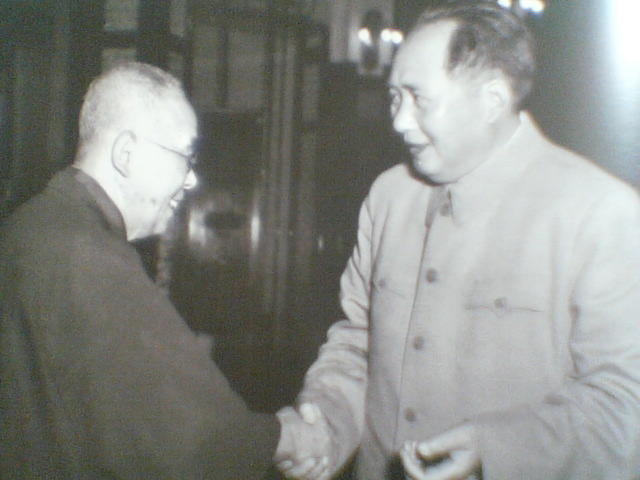
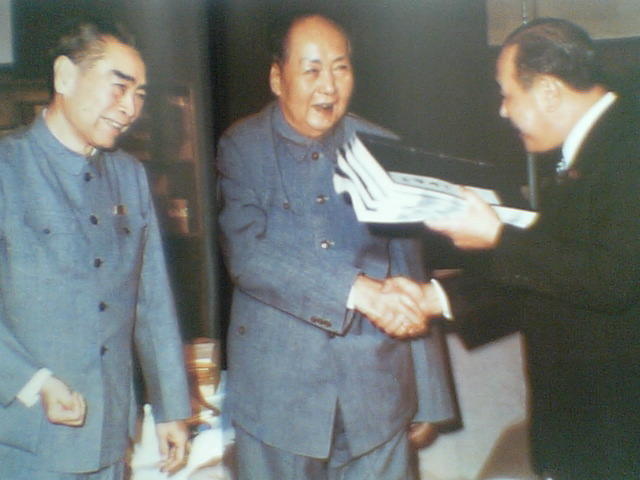
On the same day fortunately the Chinese government held
a ceremony at Mori Art Museum at Tokyo Roppongi Hills
superb location for an exhibit on the country's
relations with Japan after World War II from July 28 to
Aug. 7 at the Roppongi Hills commercial complex in
Tokyo, the State Council Information Office said
Wednesday. The exhibit will feature 220 pictures, chosen
from about 1,000 contributed by the two governments as
well as the private sector, which will be shown
according to themes such as 60 years of governmental and
grassroots-level exchanges, according to the office.
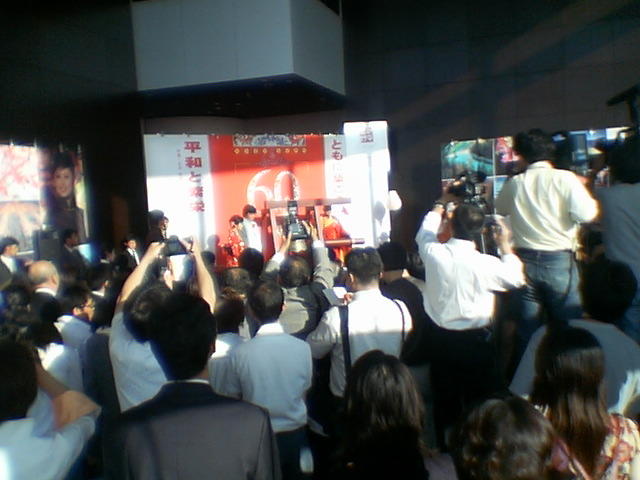


Japanese teenage table tennis star Ai Fukuhara, who
plays for the Chinese Super League club Liaoning, and
Hong Kong action star Jackie Chan attended the opening
ceremony on the first day of the photos exhibition.
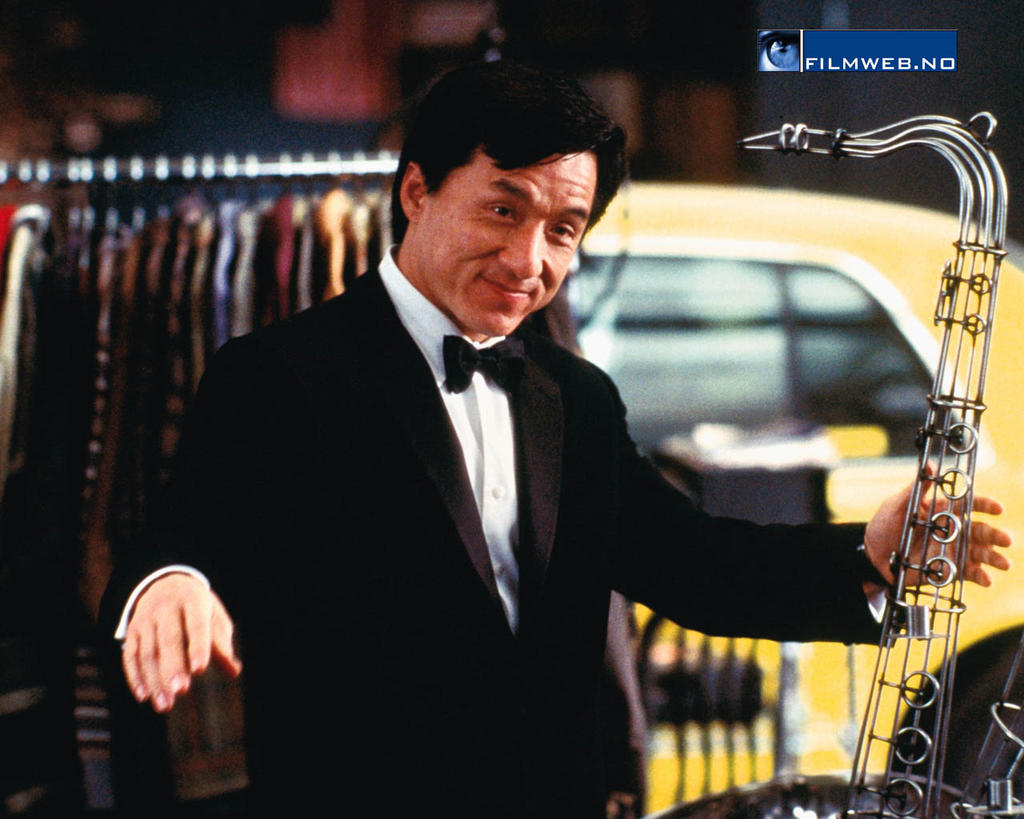

(Jackie Chan)

"It is important for us to remember all aspects of
friendship, war and history," said Zhao Qizheng,
minister at the office. "We hope that the Japanese side
will also host a similar exhibit."

end of quote

Sunday, July 24, 2005

Tokyo Governor Ishihara tells France: Check the bill and Pay !


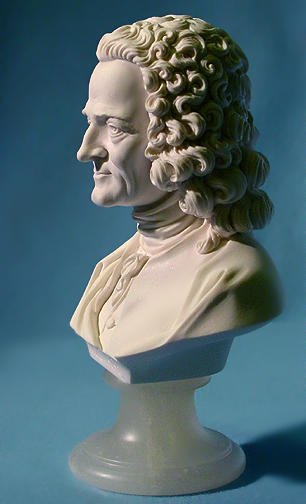
Francois Marie Arouet dit "Voltaire"


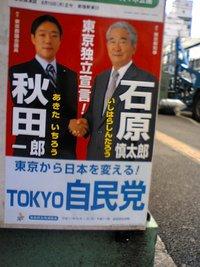
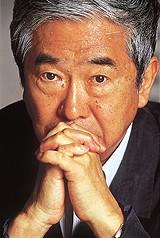
Tokyo Governor Ishihara Shintaro


The Tokyo Metropolitan Government has ordered a
Tokyo-based French school operated by the French
government to pay about 100 million yen in taxes as the
school is not eligible to receive tax exemptions.
Ishihara recently claimed that French language was not
capable of counting appropriately...


Quote :

"The move comes a week after a French-language teacher
and 20 others sued Tokyo Gov. Shintaro Ishihara over
what they claim were disparaging remarks about the
French language.

Following the issuance of an order by the metro
government in May 2004, Lycee franco-japonais de Tokyo,
based in Chiyoda Ward, had agreed to pay the amount,
which was levied as a fixed-asset tax and urban planning
tax for the 2000-2004 period, the officials said.

The school has yet to obtain the status of a legally
incorporated educational institution, a condition for
receiving tax incentives from the metro government, they
said.

"France does not have the idea of 'incorporated
educational institution,' " said Takehiko Anan of the
metro government's bureau of taxation.

Anan said that was why it took several years before the
French side agreed to apply to be authorized as an
incorporated educational institution and to pay the
taxes before the school gets the authorization.

Most schools catering to foreign children in Tokyo have
the metro government authorization as incorporated
educational institutions, which are exempt from the
fixed property tax and the city planning tax, he said.

The metro government had accorded the school exceptional
tax-free treatment, accepting its claim that it was
simply behind schedule in applying for the status.

However, the school did not take prompt action in
obtaining the status and the metro government decided to
impose the taxes in May last year, citing a need to
ensure taxation fairness.

Lycee franco-japonais de Tokyo was founded in 1975. It
stands on a site owned by the French government.


Last week, Malik Berkane, 46, principal of a
French-language school in Tokyo, filed a suit at the
Tokyo District Court, along with 20 other French and
Japanese, demanding an apology and 500,000 yen in
compensation for each plaintiff over remarks made by
Ishihara on Oct. 19.

Ishihara said French did not qualify as an international
language as it was a language in which you could not
count. "


- By Japan Zone : Portrait of Mr. Ishihara

Ishihara Shintaro (1932- ) The Ishihara brothers, Yujiro
and Shintaro, made their very considerable mark on Japan
in the middle of the last century. The younger Yujiro
died in 1987 but still lives on as one of the country's
biggest cultural icons (something like Japan's Elvis
Presley). The elder Shintaro first achieved fame while
still in university when his novel Seasons of the Sun
(Taiyo no Kisetsu) won the Akutagawa Prize in 1955. When
Yujiro made his cinematic debut in the hit movie
version, it made big stars of both young brothers.


Shintaro's reputation grew after he entered the world of
politics in 1965. He was often outspoken and critical
even of members of his own party, the long-dominant
Liberal Democratic Party (LDP). Like his brother, he was
often referred to as a nationalist. The most famous
example of Shintaro asking his fellow countrymen to
stand up to the US was the 1989 book A Japan That Can
Say No, co-authored with Sony chairman Morita Akio. He
also angered Chinese leaders by making a statement that
their claims about the Rape of Nanking were exaggerated
or worse, fabricated, while also attacking their
policies on Tibet. In another incident, an Ishihara aid
was arrested for defacing posters of an opponent in
Ishihara's electoral constituency in 1983 (Arai Shokei
was a naturalized North Korean and the Ishihara office
was accused of spreading rumors that he would act as a
spy).

Ishihara's populism ensured that he rose through the
political ranks, but his maverick style meant that he
failed to establish any real power base. In particular,
he failed to form his own faction in the LDP. His
highest post was Minister of Transport in the 1980s. He
dropped out of national politics in 1995, disenchanted
with the lack of vision which was bringing the country
to the brink of financial ruin. But he could not stay
out of the limelight for long, and he ran for the post
of Governor of Tokyo in 1999. In his campaign, among
other things Ishihara called for the return of the US
airbase at Yokosuka, near Tokyo, for use as a civilian
airport. This certainly appealed to many people due to
Tokyo's reliance on the inconvenient Narita
International Airport. His "Tokyo That Can Say No"
slogan and attacks on his former party, by now suffering
the effects of scandals and a prolonged economic slump,
ensured him a landslide victory.

After his election, Ishihara continued to fan the flames
of controversy, for example by including in an address
to the security forces that they should be ready to
defend the country against rioting foreigners in case of
a major natural disaster. In particular, he used the
term "sangokujin", literally people from a third
country, but usually meant as a derogatory word for
people from Japan's prewar colonies of Taiwan, China and
Korea.

He doesn't apologize for what some critics call
xenophobia. "I am a nationalist," he said. "I like sumo
and I like kabuki, but I don't necessarily have
ethnocentric ideas that everything Japanese is better.
In the Japan-U.S. relationship, what I hate most is
Japan. It can't speak up. It has no national strategy.
Japan should design is own financial products that even
Americans will want to buy. But when America says no,
Japan just gives up."

Tokyo Governor Shintaro Ishihara recently fired a
broadside at Korean President Roh Moo-hyun, saying his
criticism of Japan was "a third-rate political
technique" to recover popularity at home. Appearing on a
Fuji TV interview program, Ishihara said Roh's repeated
criticism of Japan over its colonial abuses and the
Dokdo Islets was "a stopgap measure for President Roh to
recover some of his popularity." He added, "For a
politician it's a third-rate technique."


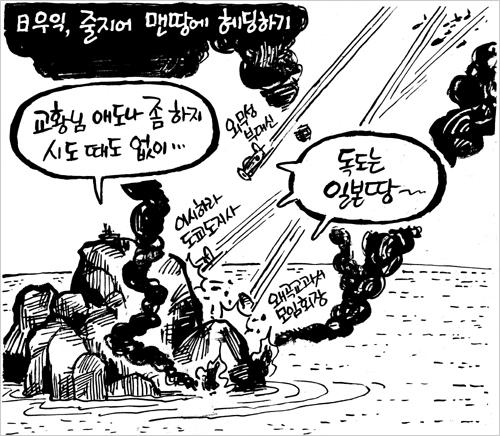
Cartoon : Kamikaze pilots including Tokyo Governor
Shintaro Ishihara and Senior Vice Foreign Minister
Ichiro Aisawa cry, "Dokdo is Japanese territory!" as
they slam into the rocky islets. The Korean police
guarding the island say, "Can't they just shut up and
mourn the pope?


- Profile of Shintaro Ishihara


Shintaro Ishihara (born September 30, 1932), author,
outspoken Japanese nationalist, populist, and current
governor of Tokyo, was born in Hyogo Prefecture in
Japan. After winning the Akutagawa Prize (Japan's most
prestigious literary prize) when he was a 23-year-old
college student, he and his now deceased brother Yujiro
Ishihara, who was Japan's most popular movie star,
became the center of a youth-oriented cult. Ishihara has
stayed in the public limelight since then.

In the early 1960s, he concentrated on writing,
including plays, novels, and a musical version of
Treasure Island. He was involved in directing, ran a
theater company, traveled to the North Pole, raced his
own yacht, and crossed South America on a motorcycle.

He entered politics in 1965 via the long-dominant
Liberal Democratic Party (LDP), but was often critical
of it. In 1973, he joined with thirty other LDP
lawmakers in the anti-communist Seirankai, or Blue Storm
Group; the group gained notoriety in the media for
sealing a pledge of unity in their own blood.

In 1989, Ishihara came to the attention of the West
through his book, A Japan That Can Say No, co-authored
with then-Sony chairman Akio Morita. The book called on
his fellow countrymen to stand up to the United States.
He dropped out of national politics in 1995, but remains
a national political figure.

In 1999, he ran on an independent platform and was
elected governor of Tokyo. Since then he has undertaken
a number of bold and popular moves at the metropolitan
government level, such as imposing a new tax on banks'
gross profits and holding up a bottle of diesel soot as
he restricted the operation of diesel-powered vehicles.
At the same time, he has gained notoriety for statements
referring to Tokyo-based Chinese and Koreans as
sangokujin , an old term literally meaning
"third-country person" which is now considered to be
derogatory. Ishihara also declared in a 1995 Playboy
interview that the Nanjing Massacre "never happened" and
was a "Chinese creation".


Governor Ishihara wanted to study the French language
when he was a school kid and asked his authoritarian
father to enter the Imperial university of Kyoto, but
his father denied this dream and obliged him to study
accounting (konin kaikeshi). Today, Governor Ishihara is
regarded as a potential future Prime Minister.

(Comments on the record from Tokyo Governor Ishihara
during an interview for TBS at Tokyo City Hall July 15th
2005, 22h35 PM)

Friday, July 22, 2005

Japan and his neighbors: " Problem" a former Tokyo cabinet minister says.


I recently wrote a column for my news station in Paris about Japan's difficulties facing China and other Asian neighbors. My point was among others balanced and I tried to focus on strategical issues including the assistance of US forces in Japan. I got this comment from a Kantei (Prime Minister bureau) official :

Extract

"It is overstatement to say Japan is badly liked of Asia
as the issue you have mentioned is mostly about Japan's
relationship with China. Asia consists of many more
countries and the title gives wrong impressions
concerning Japan in Asia.

Moreover, the reporting does not give any regard to the
fact that Japan is now a pacifist country which has not
engaged in a war or combat for past sixty years. This is
quite a feat for any country in this region. There is no
glorification of imperial past either.

I am disappointed with the reference to the American
forces in Japan as they are in other area of world as
well and does not merit special attention in this
context as this particular anchor does.

As a fast developing country China needs Japan and Japan
needs China in many ways. This is a view shared by both
country leaders and I believe your viewers would not be
served well by overemphasizing conflict between two
countries in this manner."

End of quote of this Japanese official who prefers to
remain anonymous...

Now... the real facts:


Born in 1935, Taichi Sakaiya was a bureaucrat of the former Ministry of International Trade and Industry before he became a novelist. He served as Minister of State for Economic Planning in the administrations of Keizo Obuchi and Yoshiro Mori

Quote :

"Meanwhile, no country in the world has more serious
political and diplomatic problems with its neighbors
than Japan.

The root cause of these problems lies in the way
politicians leave foreign policy to bureaucrats. There
is also the problem of sectionalism by ministries that
are determined to protect their turf. The Yasukuni
problem is no exception.


The government leaves it to the Foreign Ministry to
provide explanations about Koizumi's Yasukuni visits to
China and other neighboring countries. As a result,
Japan seems to be giving different explanations to
audiences at home and abroad.


In foreign policy, political judgment to choose what is
more important to the nation and give in to other
countries on other points is indispensable. Such
judgment is lacking in Japanese diplomacy.


The situation is so critical that I am reminded of a
comment by U.S. President Franklin D. Roosevelt on the
eve of the Pacific War. He said that Japan refuses to
compromise on anything.

Koizumi has remained adamant about making the shrine
visits since he first publicly pledged to make them when
he was campaigning for the Liberal Democratic Party
presidential election. If that is the case, he should
squarely face the Yasukuni problem as a religious
problem and not a political one.


He should explain his thoughts on Yasukuni Shrine and
make a concerted effort to win the understanding of
neighboring countries. Doing so would also be the first
step in sloughing off the practice of leaving diplomacy
to bureaucrats and recovering strategic foreign policy."


(IHT/Asahi: July 21,2005) end of quote
click the title to access the column

Wednesday, July 20, 2005

The making of a China-EU world


The president of the European Union Commission, Jose
Barroso, has just completed a visit to China, which this
year celebrates the 30th anniversary of the
establishment of diplomatic relations with Brussels.

"Fifteen to 20 years from now the EU, enlarged further
eastwards, more integrated and more independent, might
prove to be the model for the governance of
macro-regions, paving the way for a global political
architecture that can cope with technological, economic
and business globalization.


In the post-Cold-War world, the relationship between
Europe and China has gained momentum. However, as the
world dramatically changed for a second time in a decade
in the fall of 2001, Beijing, a model for developing
countries (paving the way to poverty reduction), and
Brussels, a model for cooperation between countries
(paving the way to articulate sovereignty and
globalization), have to take greater responsibilities to
work as the main architects of a cooperative Eurasia.

In the post-September 11 world disorder, the EU and
China have to conceive a genuine strategy to act as
Eurasia's structuring poles, making them into the
pillars, with the US, of a stable world order.


To face the challenges of this "grand chessboard",
Brussels and Beijing have to agree on a grand strategy.
They have both the material and cultural resources to
become sources of stability for our dangerous and
volatile "global village".

Fundamentally, this will require a common foreign and
security policy reflecting a united and independent
Europe and conducted by a far-sighted strategist. In a
move whose consequences in scope could be compared to
Henry Kissinger's "triangulation", which restructured
the strategic landscape, the EU would decide to
massively support China's economic development, to
invest in trans-continental infrastructure projects -
road, rail, energy, telecommunication, water management,
and to lift the arms embargo on China.


With the handover of Hong Kong (1997) and Macau (1999) ,
there are no more substantial disputes between China and
Europe. In the process of globalization, trade is
booming between a more independent and assertive EU and
an opening China. Both Brussels and Beijing have
clarified their intentions in official documents.
Beijing made an historic move: China in October 2003
released its first-ever policy paper on the EU.


An enlarged Europe is coming closer to an open China,
while Russia is creating the objective conditions to act
as a genuine and constructive bridge. In the 17th
century, German philosopher, physicist and mathematician
Gottfried Leibniz already saw the potential
complementarities between Europe, Russia and China -
Novissima Sinica, but today growing interdependence on
the Eurasian crescent is a reality.

The attitude of Central Eurasia's rising power,
Kazakhstan, and of a democratic Mongolia - whose
intellectual and political elite understands better than
others Eurasian dimensions - complete also the picture
of a Eurasian arc where a momentum for closer
cooperation is gathering.


It is within that context that China and the EU have to
act as two structuring poles of a cooperative Eurasia.
While the EU is a model for cooperation between
countries, China is a model for developing countries.
They are potentially engines for Eurasia's stability and
development.

Fully aware of this potential, a strongly united Europe
and a post-Maoist China should make refocused use of the
Organization for Security and Cooperation in Europe
(after Japan, Korea, Thailand and Afghanistan, China
should become a "partner for cooperation"); the Shanghai
Cooperation Organization (the EU should become at least
an observer); and the Asia-Europe Meeting (needs as soon
as possible to include Mongolia and Kazakhstan).


Brussels and Beijing have to show by their vision and
concrete actions that Eurasia has become genuinely
post-imperial and that under the driving force of their
common strategy they can become, with the US, pillars of
a stable world order.

Reflecting on the relationship between Europe and China,
it is ultimately necessary to take a real measure of
their unique historical-philosophical contexts and to
use these "invisible" factors to ensure the "visible"
interactions. "

end of quotes

Click the title to access the entire article

Tuesday, July 19, 2005

Skepticism on claims of national security.


President Bush said that he would fire anyone in his
administration who had leaked the identity of a CIA
officer, if the leak broke the law. "If someone
committed a crime," Bush said speaking to reporters
after a meeting with visiting Indian Prime Minister
Manmohan Singh, "they will no longer work in my
administration."

Might be waiting long. But this event, in addition to
send Judith Miller a journalist of the New York Times
to jail while Bob Novak is free and non supportive


of his colleague, brings in others problems :

Quote : The debate over the leak of CIA operative
Valerie Plame's identity has caused a curious about-face
by Washington politicians, with Democrats who have long
favored a laissez-faire attitude toward leaks of
classified information now decrying them, and
Republicans who once wanted to criminalize every such
leak suggesting that the one involving Ms. Plame wasn't
so terrible.

"This is just shameless," a former Justice Department
official, Bruce Fein, said. He said the political
posturing on both sides may actually encourage more
leaks. "It really is staggering. It undercuts their own
claim that it's serious business, because it makes
people in the bureaucracy think the only issue is
whether you have enough politicians lined up behind
you."

Those who track government classification policy were
left spinning by last week's political developments, as
Democrats moved to take advantage of the disclosure that
President Bush's top political adviser, Karl Rove,
apparently played some role as a source for news stories
that exposed Ms. Plame's employment at the CIA.

Several Democratic senators, including Senator Schumer,
pushed for a new law stripping security clearances from
leakers. The Senate's Republican leadership countered
with a proposal aimed at denying clearances to lawmakers
who release classified FBI reports or make comments that
are used as propaganda by terrorist organizations.

" It teaches us to be a little bit more skeptical of
claims of national security," said a leading authority
on government secrecy, Steven Aftergood of the
Federation of American Scientists. "Our classification
policies are inevitably filtered through a political
lens... " (end of quotes The New York Sun)

Click title to read the article

Saturday, July 16, 2005

Hokkaido art and nature : a day with sculptor Isamu Noguchi


Isamu Noguchi was the son of Yonejiro Noguchi, a
Japanese poet and scholar of English literature, and of
Leonie Girmour, an American poet and writer. He was born
in Los Angeles in 1904 and died in New York in 1988. He
spent his childhood in Japan until the age of thirteen
when his mother sent him to be educated in the United
States.


During his first year at Columbia University where he
was a primed student, he dropped out and decided to
pursue his interest in sculpture. He was the recipient
of a Guggenheim fellowship, studied in Paris with
Brancusi, traveled through Europe and Asia and finally
settled in New York in the late Twenties.


In his New York studio he worked at the beginning on
portrait sculpture, stage sets for Martha Graham,
furniture design and later with architects on larger
environmental projects. He was able to accomplish this
at the same time that he was establishing himself as a
major New York sculptor.


His major works include two bridges in Hiroshima Peace
Park called "Tsukuru" and "Yuku" (1952), the garden at
UNESCO Headquarters in Paris (1956), Philip A. Hart
Plaza and the Horace E. Dodge & Son Memorial Fountain in
Detroit (1976), the lobby of Sogetsu Kaikan, Tokyo
(1977), "Homage to Louis Kahn" at the Kimbell Museum in
Fort Worth, Texas (1982), the marble slide for the U.S.
Pavilion at the Venice Biennale (1986), "Time and Space"
at the Takamatsu Airport , Shikoku (1989) and Moere Numa
Park in Sapporo, Hokkaido which is still under
construction.


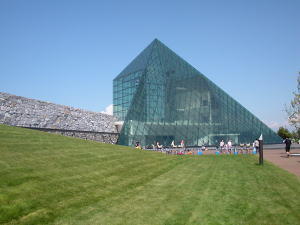
This year, the grand opening of Moerenuma Park, the last
work of the world-renowned sculptor, Isamu Noguchi, took
place in Sapporo. Taking this opportunity, Sapporo city
trying to create a new image of the city centering on
'ART' integrated with the magnificent natural beauty of
Hokkaido.

Moerenuma Park is located in the northeastern part of
Sapporo, where a unique project built a park on land
used as a waste disposal site. The project began in 1979
and the total of 2.7 million tons of waste was collected
and used as landfill until the site closed in 1990.


Isamu Noguchi first visited Sapporo in March 1988, and
showed a strong interest in the project. The city of
Sapporo commissioned Noguchi to design the park;
however, Noguchi died soon after completing only the
master plan of the park.

The Isamu Noguchi Foundation and the city of Sapporo
cherished the desire and will of Noguchi and continued
with the project. This whole 189-hectare parkland is
regarded as a sculptural work of Isamu Noguchi.

JjL

East China sea gas : Shoichi Nakagawa urges China to dialogue

Explosive perspective in the East China sea?


Japanese trade minister Shoichi Nakagawa urged China
Friday to resolve a row with Japan over gas projects in
the East China Sea through dialogue. Nakagawa's call
followed Beijing protesting Tokyo's decision to grant
test-drilling rights in a disputed area of the sea to a
Japanese oil company. "China recognized that it is in a
dispute (with Japan) over the sea area," Nakagawa said
during a news conference. "I want the country to
sincerely discuss the matter." The two countries should
try to turn the disputed waters into "a sea of
friendship," Nakagawa said.


On Thursday, Japan granted Teikoku Oil Co. concessions
to conduct experimental drilling in the disputed waters,
which immediately drew fire from China. Chinese Foreign
Ministry spokesman Liu Jianchao said later Thursday that
the Japanese government decision will cause "severe
damage" to China's claim and "further complicate"
matters. A Chinese consortium is conducting gas projects
near the sites Teikoku Oil is to explore. Liu said it is
"an objective fact" that the two countries have a
dispute over the area. "We strongly urge the Japanese
side not to undertake activities not good for stability
in the East China Sea or overall Sino-Japanese
relations," he added.

The sites of the Teikoku Oil test-drilling are just east
of what Japan claims as a median line separating the
200-nautical-mile exclusive economic zones of Japan and
China in the East China Sea, an area about 400
kilometers east of Shanghai. China says the line is
invalid and claims its economic waters stretch to the
end of the continental shelf.


Japan and China have held two rounds of talks aimed at
resolving the row, during which China proposed joint
development of natural resources. But they have yet to
reach a breakthrough. On Friday, Economy, Trade and
Industry Ministry officials said the ministry and
Teikoku Oil have given nicknames to three gas fields to
be explored by the oil company. The three areas were
given Japanese nicknames of Shirakaba (white birch),
Kusunoki (camphor tree) and Kikyo (Chinese
bellflower), they said. Of the three, underground
structures in the Shirakaba and Kusunoki fields are
connected to those of two Chinese-developed natural gas
fields, according to a Japanese geophysical survey. The
Chinese gas fields -- Chunxiao and Duanqiao -- are
located a few kilometers from the Japan-designated
median line. The Kikyo is located north of the other two
fields.

China has formally protested Japan's decision to grant
drilling rights in a part of the East China Sea also
claimed by Beijing.


Cui Tiankai, a Foreign Ministry official, summoned a
diplomat from the Japanese Embassy in Beijing to issue a
strong protest against the Japanese government's July 14
award of drilling rights in the disputed area to Teikoku
Oil Co. Ltd. Cui told the embassy's economic section
minister that Japan's decision was a severe provocation
and a violation of China's sovereignty and interests.
End of quotes

Friday, July 15, 2005

If under attack "we will have to respond with nuclear weapons", Chinese general!


How to defuse the lift of the European embargo on the
sales of weapons to Pop China? Ask a Chinese hawk to
comment about threats, rely on the FT to publicize, and
the DoD boys will sing " Oh Happy day".

Quote : "... China is prepared to use nuclear weapons
against the US if it is attacked by Washington during a
confrontation over Taiwan, a Chinese general said on
Thursday. " If the Americans draw their missiles and
position-guided ammunition on to the target zone on
China's territory, I think we will have to respond with
nuclear weapons, " said General Zhu Chenghu.

Gen Zhu was speaking at a function for foreign
journalists organised, in part, by the Chinese
government. He added that China's definition of its
territory included warships and aircraft. " If the
Americans are determined to interfere [then] we will be
determined to respond, " said Gen Zhu, who is also a
professor at China's National Defence University.

" We will prepare ourselves for the destruction of all
of the cities east of Xian. Of course the Americans
will have to be prepared that hundreds of cities will be
destroyed by the Chinese". Gen Zhu is a
self-acknowledged hawk who has warned that China could
strike the US with long-range missiles.

But his threat to use nuclear weapons in a conflict over
Taiwan is the most specific by a senior Chinese official
in nearly a decade. However, some US-based China
experts cautioned that Gen Zhu probably did not
represent the mainstream People's Liberation Army
view.... " Click the title to access the report.

And as one good news is not enough for the US Japan
military alliance :

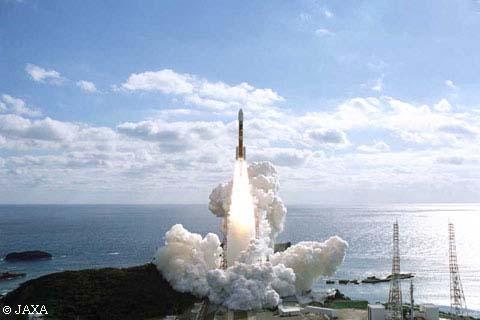
" Japan, U.S. interceptor missiles could be offered to
others: Ono


Interceptor missiles to be jointly developed by Japan
and the United States could be offered to third
countries, Defense Agency Director General Yoshinori Ono
said Thursday.

"If there is a request from the United States, it could
be possible for those missiles to be provided to third
countries under certain circumstances," Ono told a Diet
panel session, referring to a Japan-U.S. research
project on sea-based interceptor missiles to counter the
alleged threat of ballistic missiles from North Korea.

Japan hopes to make sure in advance that the United
States would obtain Japan's agreement for any transfer
to third countries of weapons to be developed jointly
with Japan, Ono told the House of Councillors Foreign
Affairs and Defense Committee.


If the United States consulted Japan about such a
transfer, Japan would study the offer in light of the
government's policy to basically ban weapons exports, he
said in response to questions from Democratic Party of
Japan lawmaker Shinkun Haku.

Japan and the United States agreed in February to enter
the joint development phase. They had been conducting
research on the missiles since 1999.

The two countries envision entering the joint
development phase in Japan's fiscal 2006, which begin
next April, according to Japanese government sources.

Chief Cabinet Secretary Hiroyuki Hosoda said in a
statement in December that the joint development and
production of missiles systems with the United States
are exceptions to Japan's weapons export ban principles
on condition that they are strictly managed.

Hosoda issued the statement when Japan adopted a new
defense policy guideline announcing a relaxation of the
arms exports ban to enable the sales of missile defense
components to the United States. (Kyodo) "